How Are Tips Taxed? Your Simple Guide to New Tip Tax Rules
Tips are a big part of restaurant pay, and now the tax rules are changing. Learn how tips are taxed and make the most of new 2025 IRS updates.

Jim McCormickAuthor
 RESOURCE
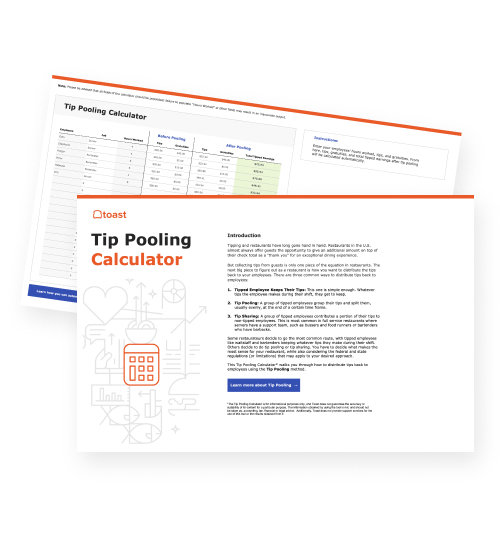
 Tip Pooling Calculator
Use the Tip Pooling Calculator to learn how to distribute tips back to your restaurant’s employees using the tip pooling method.
Get Free Download | Built for Restaurants
If you work in a restaurant, you already know tips can make up a big part of your paycheck. But when it comes to how tips are taxed, things can get complicated — especially with new rules rolling out in 2025. The “No Tax on Tips” deduction is changing how much of that income may be taxed at the federal level — while many reporting responsibilities stay the same.
Here’s what restaurant owners and tipped employees need to know about how tip taxes work, what’s changing in 2025, and how to stay compliant.
Key takeaways
Whether cash or digital, all tips must be reported and taxed at the federal, state, and local levels.
The “No Tax on Tips” deduction lets many tipped workers reduce how much of their tip income is subject to federal income tax.
Social Security and Medicare (FICA) contributions remain unchanged for both employees and employers.
Each employee is taxed — and eligible for deductions — only on the tips they personally receive.
Accurate tracking and reporting help employees claim deductions correctly and keep restaurants compliant.
Restaurant Cost Control Guide
Use this guide to learn more about your restaurant costs, how to track them, and steps you can take to help maximize your profitability.

What counts as a tip?
A tip is any voluntary payment a customer gives directly to an employee as a thank-you for good service. These payments can take many forms:
Cash tips: Left on the table or handed directly to a server.
Credit or debit card tips: Added to a bill during payment processing.
Digital or app-based tips: Through online ordering systems or delivery platforms.
Pooled or shared tips: Combined and redistributed among staff, such as bussers, bartenders, and hosts.
To qualify as a tip, the payment must meet four criteria set by the IRS:
The customer decides whether to pay it.
The customer decides the amount.
The payment is not dictated by policy or management.
The payment is kept by the employee (or shared voluntarily in a valid tip pool).
By contrast, mandatory service charges—such as automatic gratuities for large parties, banquet fees, or delivery charges—do not count as tips. These are considered wages, since they’re set by the employer rather than the customer.
How tips were taxed before 2025
Before 2025, every dollar in tips was taxable — just like regular wages. Servers, bartenders, and other tipped employees had to report all tips so their employers could withhold the right taxes.
Federal income tax: Tips counted as part of an employee’s total income and were taxed at the same federal rate as regular wages.
Social Security and Medicare (FICA): Reported tips were subject to payroll taxes. Employers matched the employee’s share of these contributions.
State and local taxes: Most states (and some cities) also taxed tips, so they needed to be included when filing state and local returns.
Employee responsibilities:
Track tips daily — including cash, credit, and digital tips.
Report tips to their employer each month if they totaled $20 or more.
Include tips on their annual income tax return.
Employer responsibilities:
Withhold income and payroll taxes from reported tips.
Pay the employer’s share of Social Security and Medicare taxes.
File Form 8027 for large food or beverage establishments.
Allocate tips if total reported tips fell below 8% of gross receipts.
What changed in 2025: The “No Tax on Tips” deduction
Starting with the 2025 tax year, the One Big Beautiful Bill (OBBB) introduced a major update for tipped workers — a new federal income tax deduction designed to reduce how much tip income is taxed. Here’s what’s new:
Up to $25,000 deduction: Eligible employees in qualifying tipped occupations can now deduct up to $25,000 per year of their tip income from federal income tax. (The deduction applies to income earned in 2025 and later, and you’ll claim it when filing your 2025 tax return in 2026.)
Income limits: The deduction begins to phase out for individuals earning more than $150,000 or $300,000 for joint filers.
Voluntary tips only: To qualify, the tip must be voluntarily given by the customer — not a required service charge, automatic gratuity, or convenience fee.
Eligible occupations: The IRS will maintain a list of jobs that “customarily and regularly receive tips,” such as servers, bartenders, and delivery drivers.
What hasn’t changed
The 2025 rule doesn’t eliminate taxes on tips — it simply offers federal income tax relief for many service workers. Tips are still considered taxable income at every level, but qualifying employees may now keep more of what they earn after filing their returns.
Tips are still taxable income: All tips must still be tracked, reported to employers, and included on tax returns.
Payroll taxes still apply: Employees and employers continue to pay Social Security and Medicare (FICA) taxes on all reported tips.
State and local taxes remain unchanged: Most states — and some cities — still tax tip income in full. The new deduction applies only to federal income taxes.
Employer reporting stays the same: Employers must still withhold taxes, file Form 8027 when required, and allocate tips if necessary.
Tip pooling and tip sharing taxes
Many restaurants use tip pools or sharing systems to distribute gratuities fairly among front- and back-of-house staff. These setups are still legal — but they come with specific tax and reporting rules that haven’t changed under the new law:
Each employee is taxed only on the tips they actually receive after pooling or sharing.
For the 2025 “No Tax on Tips” deduction, eligibility also depends on the amount each employee personally receives — not the total pool amount.
Employers must continue tracking and reporting tips accurately for every individual.
How to stay on top of tip taxes
Whether you’re a server reporting nightly earnings or an operator managing payroll, staying organized is the key to tip-tax compliance.
For employees
Record everything: Keep daily records of cash, card, and digital tips — your POS may already help automate this.
Report monthly: If you earn $20 or more in tips in a month, you’re required to report them to your employer by the 10th of the following month.
Understand deductions: Only qualifying tips count toward the new 2025 deduction, so keep documentation handy for tax filing.
Check your pay stubs: Make sure reported tips and withholdings match what you’ve earned and submitted.
For employers
Use integrated POS and payroll tools: These systems can automatically track tips, withhold taxes, and generate IRS-compliant reports.
Train your team: Make sure staff understand the difference between tips, service charges, and automatic gratuities.
File required forms: Stay current with Form 8027 and any local reporting requirements.
Monitor updates: IRS guidance on which occupations qualify for the 2025 deduction may evolve — check for updates each tax season.
A final tip on taxes
Tips are a huge part of restaurant life — and with the 2025 “No Tax on Tips” deduction, many hospitality workers may see a little more of their earnings stay in their pockets.
The core rules still apply: all tips must be tracked, reported, and taxed properly at the federal, state, and local levels. Remember, as tipping regulations and trends change, staying organized and keeping good records is the key to compliance.
Restaurant Metrics Calculator
Use this free calculator to calculate the key restaurant metrics needed to understand the health and success of your business.
FAQ
Do I pay taxes on tips even with the new deduction?
Yes. All tips are still taxable income. The 2025 “No Tax on Tips” deduction only reduces how much of your federal income tax applies to qualifying tips — it doesn’t remove payroll, state, or local taxes.
What happens if I don't report my tips?
Failing to report tips can lead to IRS penalties, back taxes, and loss of Social Security or Medicare credit. It’s always better to report accurately each month and keep daily records for your own protection.
How do credit card tips get taxed?
Credit card tips are treated the same as cash — they count as income. Employers typically withhold taxes from these tips just like regular wages, and the amount appears on your paycheck and W-2 form.
Can employers take my tips to pay taxes?
Employers can withhold the taxes owed on reported tips, but they can’t keep or use your tips for any other reason. Federal law requires that tips belong to employees, except when part of a valid tip pool.
Which occupations qualify for the new tip deduction?
The IRS will release and update an official list of jobs that “customarily and regularly receive tips.” This will likely include roles such as servers, bartenders, delivery drivers, and other hospitality workers — but check for updated IRS guidance each tax year.


Is this article helpful?
DISCLAIMER: This information is provided for general informational purposes only, and publication does not constitute an endorsement. Toast does not warrant the accuracy or completeness of any information, text, graphics, links, or other items contained within this content. Toast does not guarantee you will achieve any specific results if you follow any advice herein. It may be advisable for you to consult with a professional such as a lawyer, accountant, or business advisor for advice specific to your situation.
 Trending
Subscribe to On the line
Sign up to get industry intel, advice, tools, and honest takes from real people tackling their restaurants’ greatest challenges.
By submitting, you agree to receive marketing emails from Toast. We’ll handle your info according to our privacy statement. Additional information for California residents available here.