
Tip Pooling: What It Is and How It Works in Restaurants
This guide breaks down what tip pooling is, how it works, the pros and cons, and how service workers feel about it in 2025.

Tessa ZuluagaAuthor
 RESOURCE
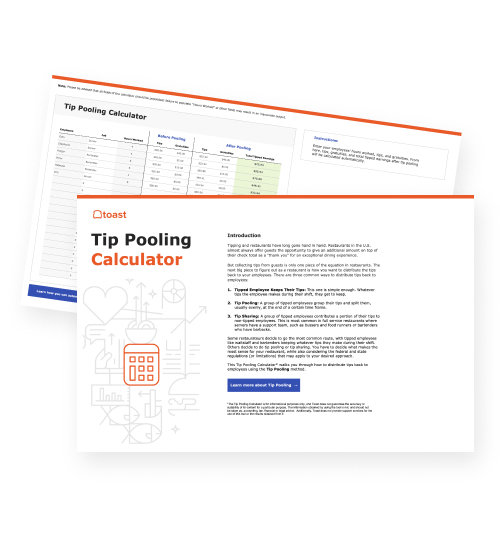
 Tip Pooling Calculator
Use the Tip Pooling Calculator to learn how to distribute tips back to your restaurant’s employees using the tip pooling method.
Get Free Download | Built for Restaurants
What is tip pooling?
Tip pooling is a system in which restaurant staff combine their tips and redistribute them among the employees, based on a pre-established formula or policy. This approach is often used to promote fairness and teamwork, ensuring that staff receive a fair portion of the tips earned.
Tip pooling is one of those aspects of restaurant life that has the potential to be very divisive. If you walked into any restaurant in any city and asked the staff how they felt about pooling tips, you're sure to hear any number of answers.
Tipped workers often have strong opinions about tipping structures and policies. After all, it’s their livelihood. Recent Toast data shows that, in 2025, the average tip at full-service restaurants is 19.4%.
So when you bring up tip pooling, you’re sure to get some opposing feelings, and not all will be positive. But before we dive into the pros and cons of pooling tips, let’s answer one question:
What is tip pooling, and how does it work?
Tip pooling is when some or all of the tips earned during a shift, typically credit card gratuities, are collected into a shared pot and then redistributed among staff, either evenly or based on a set formula. Instead of each server pocketing what they individually earned, everyone (from food runners to bussers) gets a slice of the pie.
The idea is to promote fairness and teamwork, especially in settings where many hands contribute to the guest experience. But it’s not without controversy. For example, a server who spent the night hustling to bring in $800 to the pot might feel frustrated splitting tips with a coworker who only brought in $300 and clocked in more time in the walk-in than on the floor. (In this example, each server would walk with $550.)
Tip pooling tends to work best in team-driven environments. Think:
Coffee shops, where quick orders and modest tips are shared across a crew of baristas and cashiers.
Fast-casual and counter-service restaurants, like pizzerias, bakeries, and burger joints, where there's less distinction between front- and back-of-house roles.
Sit-down restaurants that prioritize a strong team culture and make tip pooling clear from day one. Being upfront during interviews helps ensure you're hiring people who buy into the model.
As more customers tip online for takeout and delivery, sometimes before they even receive their order, pooling can also make sense for restaurants with heavy off-premise business.
And to make things easier for operators, tools like Toast Tips Manager (part of Toast Team Management Suite) can automate the calculation and payout of pooled tips, saving time and avoiding headaches.
Training Manual Template
Use this restaurant training manual template, a customizable Word Doc, to provide your staff with the rules, guidelines, and clarity they need to do their jobs efficiently.

How are pooled tips calculated?
There are a few common practices to divvy up tips when you split them among restaurant staff. For example, you might opt to:
Split tips by hours worked
Total tips divided by the number of employees and hours worked.
Split tips by percentage
Certain roles within the restaurant operation earn a percentage of the tips. For example, the hostess makes 5% of the night’s tips, and the bar staff makes 45%.
There’s no need to do these calculations manually. Download the Tip Pooling Calculator to learn how to distribute tips back to your restaurant’s employees.
Should your restaurant switch to tip pooling?
Start by asking your staff
As employee retention continues to challenge restaurant operators, staff satisfaction should play a central role in your tipping model decisions. Whether you’re considering switching to tip pooling or moving away from it, the first step is simple: ask your team how they feel.
Tip pooling tends to spark strong opinions, and according to recent survey data, most restaurant employees are either indifferent or against it; 25% of tipped employees say they are indifferent to tip pooling, while 46% report disliking or hating it. However, the employees who actually participate in a tip pool are more likely to feel positively about it, as 39% of tip pool participants say they love or like it, compared to just 19% of all tipped employees.
It’s clear that experience plays a role. Newer employees or those in support roles often benefit from pooled tips, especially when they wouldn’t otherwise earn as much from individual gratuities. But seasoned waitstaff who’ve honed their skills and built up their earning potential may feel like they’re losing out. As one anonymous employee told Toast: “My hard work is to their advantage, and their lack of it is a disadvantage to me.”
That said, tip pooling can also foster teamwork, and in the right environment, it creates a fairer, more predictable system for everyone involved.
“There’s no one-size-fits-all answer,” says Julia Beebe, who worked three summers at a country club that used a tip pooling model. “Restaurant owners need to consider the culture they want to build, and choose the tipping system that supports that vision.”
Consider your daily operations
It's important to take a step back and evaluate how your restaurant operates day to day. Not all concepts benefit equally from shared tips, and what works well in one environment might cause friction in another.
High-volume, team-driven environments such as fast-casual spots, busy brunch destinations, or restaurants with shared service models often see the biggest upside from tip pooling. In these settings, staff frequently jump in to support one another, and tips reflect the collective effort.
Fine dining or low-volume restaurants, on the other hand, tend to rely more on personalized service and clearly defined server sections. In those environments, tipping customs sometimes go out the window, and guests tip more on the quality of one person’s attention. Staff may expect to be rewarded individually for their performance.
There’s no one-size-fits-all answer, but the key is aligning your tip structure with your service style, staff expectations, and the kind of culture you want to cultivate.
Pros and cons of tip pooling
Tip pooling pros
Tip pooling can be a powerful way to build a stronger, more collaborative front-of-house team. Here are some of the main benefits:
1) Tip pooling increases support staff wages In the service industry, servers and bartenders can earn significantly more than support staff like bussers, food runners, and barbacks, even though these roles are crucial to the flow of service and guest satisfaction.
Tip pooling helps ensure that compensation is more fairly distributed among the front-of-house team, especially for those in lower-paid, high-effort positions who might otherwise be overlooked.
2) Tip pooling encourages teamwork, not competition When tips are pooled, team members are more likely to work together instead of competing for the best sections or highest-spending tables. It reinforces a “we’re in this together” mentality. Servers are more likely to support each other during a rush, and support staff are more motivated to move quickly and efficiently because everyone shares in the results.
3) Tip pooling leads to more consistent service With everyone working toward the same financial outcome, staff are incentivized to maintain a high standard of service across all tables, not just their own. This creates a smoother, more consistent experience for guests, which can lead to higher tips overall and stronger online reviews.
As seen in the New Steps of Service Model, having a tip pool structure encourages FOH staff to operate as a team in order to provide exceptional guest service, which can lead to improved tip percentages.
Tip pooling cons
For servers accustomed to working for their money and taking home what they have individually earned every night, tip pooling can be a difficult adjustment. Telling your best server that they are now required to give up a portion of their tips to the newbie who started a week ago can be a tough conversation.
Servers aren’t relying on the $2.13 federal minimum wage alone. It’s simply not a livable wage. They’re accustomed to earning the bulk of their income through tips from customers, which is why any change to tip structure can feel especially high-stakes.
Keeping your staff happy is a balancing act, so changing your tipping structure should be based on the satisfaction of all your employees. When integrating new restaurant protocols like tip pooling, remember to be prepared for an adjustment period and always stay open to having open conversations with your employees.
If you decide that tip pooling is the best choice for your restaurant, you can make it up to restaurant workers who feel slighted by offering great employee benefits, like insurance or more paid time off.
What about the kitchen staff?
In most full-service restaurants, back-of-house employees, like line cooks, prep cooks, and dishwashers, aren’t typically included in the tip pool. That’s largely because their hourly wages are often higher and more consistent than those of front-of-house staff who rely on tips to supplement lower base pay.
Still, many restaurateurs want to show appreciation for the kitchen team, especially when their hard work directly contributes to a great guest experience.
One approach that’s gaining popularity is adding a kitchen appreciation fee to guest checks. This small, fixed percentage (often 3–5%) goes directly to back-of-house staff to help close the wage gap, without impacting FOH earnings.
If you choose to implement a kitchen appreciation fee, be sure to clearly communicate it on your website, menus, and guest receipts. Transparency helps build trust with customers and sets clear expectations, reducing the risk of confusion or complaints.
Next up, check out our guide on Service Charge vs. Tip.
Tip pooling resources
If you’re going to start tip pooling in your restaurant, it’s important to do it right and be transparent with all staff on how it works. Here are some resources for you to get started.
Tip pooling calculator
A tip pooling calculator helps your team calculate the distribution of tips. By understanding the business math behind tip splitting, you can enter in each employee’s time worked by the total tip amount for that shift or use percentages to calculate individual tips.
Toast Tips Manager
Toast Tips Manager makes it that much easier to distribute tips to the hardworking employees who earned them. At Classic Burgers in Inyokern, California, Abdul Hugais no longer has to worry about cash shortages or making an extra trip to the ATM, as tips are automatically calculated and distributed to his employees’ paychecks.
Tip pooling laws
When deciding whether your establishment will require staff to pool their tips, it’s important to consider the federal, state, and local laws that may apply. Consider the following:
Whether your state requires a written tip pooling agreement between staff and management
Which roles can be included in a valid tip pool
Any applicable notice requirements
The application of federal and state tip credit laws
Tip pooling in your restaurant
Remember, tip pooling isn’t a decision to make alone. Talk to your team. Their feedback will help you understand what works best for your staff and your service model.
If you’re planning to switch to a tip pool, roll it out with transparency. Explain why you’re making the change, how it benefits the team, and what the structure will look like. Clarity and communication go a long way in getting everyone on board.
And for all you servers out there looking to overcome tip pooling dread the good ole fashioned way, by making more money, here is our guide on How to Be a Good Server (and Make More Tips!).
Back of House Management Guide and Resource Kit
This guide and resource kit will help you develop an efficient back of house management system to ensure quality and consistency in your restaurant’s kitchen.


Is this article helpful?
DISCLAIMER: This information is provided for general informational purposes only, and publication does not constitute an endorsement. Toast does not warrant the accuracy or completeness of any information, text, graphics, links, or other items contained within this content. Toast does not guarantee you will achieve any specific results if you follow any advice herein. It may be advisable for you to consult with a professional such as a lawyer, accountant, or business advisor for advice specific to your situation.
 Trending

Subscribe to On the line
Sign up to get industry intel, advice, tools, and honest takes from real people tackling their restaurants’ greatest challenges.
By submitting, you agree to receive marketing emails from Toast. We’ll handle your info according to our privacy statement. Additional information for California residents available here.