
Understanding Tip Credit: A Comprehensive Guide for Employers and Employees
Learn the ins and outs of restaurant tip credit rules, including how to determine eligibility, tip pooling and overtime implications, and how to stay compliant with federal and state laws.

Deanna deBaraAuthor
 RESOURCE
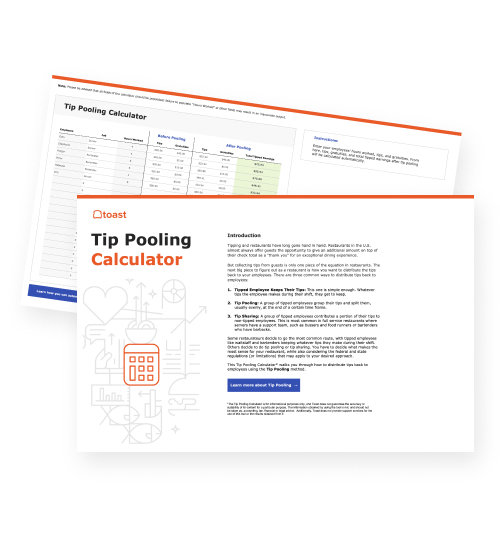
 Tip Pooling Calculator
Use the Tip Pooling Calculator to learn how to distribute tips back to your restaurant’s employees using the tip pooling method.
Get Free Download | Built for Restaurants
The restaurant industry is, at the core, a service industry. So many of your employees provide direct service to customers—and, as a result, tips make up a large part of their compensation.
While the federal minimum wage is currently $7.25 per hour, direct wages for tipped employees work a little differently. As an employer, you can pay your tipped employees less than the minimum wage (as low as $2.13 per hour)—and then, as long as certain conditions are met, take a “tip credit” to meet the minimum wage threshold.
From an employer perspective, understanding how tip credits work is a must to not only ensure your restaurant is compliant with all relevant wage and labor laws (and avoid the serious consequences that can come with non-compliance, including back wages, hefty penalties…even lawsuits), but also that your employees are being compensated fairly and that you’re optimizing your labor costs.
But tip credit doesn’t just matter at the individual restaurant level; there’s also a larger impact. Policy research center The Budget Lab at Yale’s estimated that there were roughly 4 million tipped workers in the United States in 2023, while data from the U.S. Bureau of Labor Statistics shows that in 2023, there were over 2.2 million servers working in the U.S.—more than half the total (and that’s not even considering other types of restaurant employees that fall under the “tipped worker” umbrella, like bartenders or hosts). And with restaurants representing such a large percentage of all tipped workers (and their wages), it’s essential that restaurant owners understand the legalities of how to pay and tax tipped employees—and understanding the tip credit is a large part of that.
Let’s take a look at everything you need to know about tip credit, including what it is, when it applies, and the impact of factors like overtime hours, state regulations, and income type.
Note: This guide is for educational purposes only and does not constitute legal advice. Restaurant owners and managers should consult with legal counsel and/or a qualified payroll professional for specific advice and support.
What is tip credit?
First things first. Before we dive too deep into all things tip credit, let’s quickly cover the tip credit definition and how this credit applies to your tipped employee wages.
Tip credit is a provision under the Fair Labor Standards Act (FLSA) that allows you, as an employer, to pay your tipped employees (which the FLSA defined as any employee that regularly makes more than $30 per month in tips) at minimum $2.13 per hour as long as their tip income must push their regular rate of pay to at least the federal minimum wage threshold (or the state minimum wage if it’s higher). Direct cash wages for tipped employees must be at least $2.13 per hour.
Then, as an employer, you can take a “tip credit” to bridge the gap between your direct cash pay rate (of at least $2.13 per hour) and minimum wage (which, again, at a federal level, is currently $7.25 per hour), effectively “crediting” them towards your employees wages and allowing you to meet your minimum wage requirements.
As an employer, there are a few important things you need to know about the FLSA tip credit, including:
It can’t be more than the actual amount of tips received
It can’t exceed the difference between the applicable minimum wage rate and the direct cash wage rate (even if the employee earned more than that amount in tips for the pay period)
The tip credit must be the same for both regular and overtime hours
You must inform your employees in advance of your plan to utilize tip credits and what their direct cash rate will be
It’s also important to note that if the employee doesn’t make enough tip income to meet the hourly minimum wage requirement during any given pay period, as the employer, you’ll need to make up the difference and ensure they take home at least minimum wage for all hours worked.
The purpose of the tip credit is to account for the additional income that tipped workers make while performing their duties, allowing employers to pay less in direct cash wages (which can be especially helpful in industries with tight margins, like restaurants) while still ensuring all employees are paid at least minimum wage for time worked.
Tip Pooling Calculator
Use the Tip Pooling Calculator to learn how to distribute tips back to your restaurant’s employees using the tip pooling method.

Federal minimum wage and tip credit calculations
Now that you know what the tip credit is, let’s take a look at how tip credits actually apply to your tipped employee pay.
As of 2025, the Department of Labor’s federal wage requirements are as follows:
Federal minimum wage = $7.25 per hour
Maximum tip credit against minimum wage = $5.12 per hour
Minimum direct cash wage = $2.13
(Keep in mind that state requirements for minimum wage, tip credit, and minimum direct cash wages may differ from federal requirements, and if the minimum wage and/or minimum direct cash wage requirements are higher in your state, you’ll need to meet those higher requirements and comply with all state wage regulations.)
How to calculate tip credit: determining eligibility
The first step in calculating tip credit is to determine if you’re actually entitled to a tip credit. And to do that, you would use the following minimum wage calculation:
Employer Direct Cash Wage + Tips Received / Number of Hours Worked
In order to qualify for a tip credit, that number must be greater than or equal to minimum wage.
So, let’s say your restaurant operates in a state that aligns with federal minimum wage, tip credit, and direct cash wage requirements—and you’re trying to determine if your server, Sam, has brought in enough tip income to satisfy said wage requirements.
If Sam worked 40 hours and made $250 in tips, the calculation would look like this:
(40 hours x $2.13) + $250)/ 40 hours
($85.20+ $250) / 40 hours
$335.20 / 40 hours
Rate of Pay = $8.38/hour
Because Sam’s regular rate of pay with tips is more than the federal minimum wage, as an employer, you’re eligible to take a tip credit.
Now, if Sam’s rate of pay was less than the federal minimum wage, as an employer, you would be responsible for paying him the difference. For example, let’s say Sam only made $150 in tips:
((40 hours x $2.13) + $150) / 40 hours
($85.20+ $150) / 40 hours
$235.20 / 40 hours
Rate of Pay = $5.88/hour
In this scenario, because Sam’s rate of pay is less than the federal minimum wage, you would need to make up the difference to ensure he makes at least $7.25 per hour for all hours worked (which would be $1.37 per hour or $54.80 total for the 40-hour workweek).
Keep in mind that, as an employer, when calculating wages, employees must report all of their tips, including cash tips—and, as an employer, you’ll need to withhold all relevant taxes (including federal income tax, employee social security tax, and employee Medicare tax) from their tip income.
How to calculate tip credit: determining your tip credit rate
Once you’ve determined that you are, in fact, eligible to take a tip credit, then you would use the tip credit formula to determine how much of a tip credit you’re eligible for. The tip credit formula looks like this:
Federal Minimum Wage - Direct Cash Pay Wage = Tip Credit (Up to Maximum)
So again, if you’re paying your employees $2.13 per hour (and all meet the minimum wage requirements), your tip credit calculation would read:
$7.25 - $2.13 = $5.12
So, your tip credit would be $5.12, which is equal to the federal maximum.
Tipped employees and occupations
Another important element of understanding tip credit is understanding the tipped employee definition and which restaurant worker classifications the tip credit actually applies to.
As mentioned, according to the FLSA, a tipped employee is any employee that customarily and regularly receives more than $30 in tip income per month. In a restaurant, that could apply to a number of tipped occupations, including:
Servers
Bartenders
Bussers
Hosts/Hostesses
Employees who don’t regularly receive tips are considered non-tipped occupations—and, as such, must be paid at least the full federal (or state, if it’s higher) minimum wage. This can include restaurant employees like:
Cooks
Dishwashers
Chefs
Janitors
Managers/Supervisors
The dual jobs rule
Many restaurants have employees that manage multiple tasks, some of which generate tips and others that don’t. And even employees who are primarily tipped workers may spend time doing tasks that don’t generate tips (for example, cleaning the dining room during a slow shift).
In those situations, the “dual jobs rule” would apply—and it’s important to understand, because this rule acts as a restaurant law that directly impacts your ability as an employer to take a tip credit.
The dual jobs rule states that if a tipped employee spends “substantial time” (which is defined as more than 20 percent of their workweek or a continuous 30-minute period) on non-tipped duties, as an employer, you’re not eligible to take a tip credit for that time. Instead, you would need to pay them the full minimum wage for those hours. You can, however, still take a tip credit on any hours that they’re focused on tip-generating tasks, like serving or bartending (as long as you meet the requirements).
Tip pooling and service charges
If your restaurant regularly performs tip distribution and or tip pooling, it’s also important to understand tip pooling laws—and how they impact tip credits.
If you, as an employer, pay your employees full minimum wage and don’t take any tip credit, you can roll out mandatory tip pools that include both tipped and non-tipped team members (also known as a “nontraditional tip pool”). However, if you pay your employees a lower direct cash wage and take a tax credit to meet minimum wage requirements, then only tipped employees can be included in tip pools.
It’s also important to note that employers, managers, and supervisors are not allowed to take other employees’ tips, including from shared tip pools.
Service charges vs. tips
Another important distinction to make is the difference between service charges vs. tips.
It’s customary in many restaurants to add service charges to customer bills, at least in certain situations (for example, a 25 percent service charge for parties of 8 or more). But it’s important to note that, under federal law, service charges are not considered tips; they are actually considered revenue for the restaurant (even if they’re ultimately distributed to employees)—and, as such, service charges shouldn’t be used as part of any tip credit calculations.
Recordkeeping requirements
Recordkeeping is a critical part of FLSA compliance, and that includes tip credit recordkeeping.
Under the FLSA, any employer that takes a tip credit is required to keep the following tip and wage records:
Each employee whose wage is determined in part by tips
The weekly or monthly amount in tips (reported by the employee to the employer)
The amount by which the wages of each tipped employee have been deemed to be increased by tips
Hours worked each workday navigating non-tipped responsibilities AND the total daily or weekly straight-time payment made by the employer for those hours
Hours worked each workday navigating tipped work/tasks AND the total daily or weekly straight-time earnings for those hours
If the employer operates a mandatory tip pool—even if they don’t take a tip credit—they also need to keep records of each employee that receives tips from the pool and the weekly or monthly amount each employee receives.
These records should be prioritized along with other required payroll documentation and employment tax records; not only will keeping accurate and organized records ensure you have access to any information you need when you need it, but it can also help protect you in the case of a wage lawsuit or tax dispute.
State-specific tip credit requirements
As mentioned, state tip credit laws may differ from federal tip credit requirements, as can minimum wage by state; for example, many states have a higher minimum wage than the federal wage of $7.25 per hour, a higher minimum cash wage requirement than the federal rate of $2.13 per hour, or a higher or lower maximum tax credit.
And because of those differences, staying on top of your state wage requirements and local wage laws—and how those laws and requirements relate to tip credit—is a must.
Let’s take a look at state wage requirements and tip credit requirements:
No tip credit states/states where employers have to pay tipped employees full state minimum wage before tips:
Currently, 7 states (and Guam) are considered “no tip credit states,” with laws that require employers to pay tipped employees the full state minimum before tips:
State | Basic Combined Cash & Tip Minimum Wage Rate |
Alaska | $11.91 |
California | $16.50 |
Guam | $9.25 |
Minnesota | $11.13 |
Montana | $10.55 for businesses with gross annual sales over $110,000 (The wage for businesses that are not covered by the FLSA and have gross annual sales of $110,000 or less is $4.00) |
Nevada | $12.00 |
Oregon | $14.70 statewide (although certain localities have different wage requirements, including $15.95 in the Portland metro area and $13.70 in nonurban counties) |
Washington | $16.66 |
States that have a higher minimum wage and/or cash wage requirements (which impact tip credit maximums)
Currently, 30 states (plus the District of Columbia, Puerto Rico, and the Virgin Islands) have higher minimum wage requirements, higher minimum cash wage requirements, or both, and because of this, they also have different tip credit maximums:
State | Basic Combined Cash & Tip Minimum Wage Rate | Maximum Tip Credit Against Minimum Wage | Minimum Cash Wage |
Arizona | $14.70 | $3.00 | $11.70 |
Arkansas | $11.00 | $8.37 | $2.63 |
Colorado | $14.81 | $3.02 | $11.79 |
Connecticut | $16.35 | $9.97 (for hotels and restaurants) $8.12 (for tipped bartenders) | $6.38 (for hotels and restaurants) $8.23 (for tipped bartenders) |
Delaware | $15.00 | $12.77 | $2.23 |
District of Columbia | $17.50 | $7.50 | $10.00 |
Florida | $13.00 | $3.02 | $9.98 |
Hawaii* | $14.00 | $1.25 | $12.75 |
Idaho | $7.25 | $3.90 | $3.35 |
Illinois | $15.00 | $6.00 (40 percent of the applicable minimum wage) | $9.00 |
Iowa | $7.25 | $2.90 (40 percent of the applicable minimum wage) | $4.35 |
Maine | $14.65 | $7.32 (50 percent of the applicable minimum wage) | $7.33 |
Maryland | $15.00 | $11.37 | $3.63 |
Massachusetts | $15.00 | $8.25 | $6.75 |
Michigan | $10.56 | $6.55 | $4.01 (38 percent of the applicable minimum wage) |
Missouri | $13.75 | $6.87 (50 percent of the applicable minimum wage) | $6.88 |
Nebraska | $12.00 | $9.87 | $2.13 |
New Hampshire | $7.25 | $3.98 | $3.27 |
New Jersey | $15.49 | $9.87 | $5.62 |
New Mexico | $12.00 | $9.00 | $3.00 |
$16.50 (in NYC, Long Island, and Westchester) $15.50 (remainder of NY state) | $2.75 (for tipped service employees in NYC, Long Island, and Westchester) $2.60 (for tipped service employees in the rest of NY state)
$5.50 (for tipped food service employees in NYC, Long Island, and Westchester) $5.15 (for tipped food service employees in the rest of NY state) | $13.75 (for tipped service employees in NYC, Long Island, and Westchester) $12.90 (for tipped service employees in the rest of NY state)
$11.00 (for tipped food service employees in NYC, Long Island, and Westchester) $10.35 (for tipped food service employees in the rest of NY state) | |
North Dakota | $7.25 | $2.39 (33 percent of the applicable minimum wage) | $4.86 |
Ohio
(for employers with annual gross receipts of $394,000 or more) | $10.70 | $5.35 | $5.35O |
Oklahoma** | $7.25 | $5.12 | $2.13 |
Pennsylvania | $7.25 | $4.42 | $2.83 |
Puerto Rico | $10.50 | $8.37 | $2.13 |
Rhode Island | $15.00 | $11.11 | $3.89 |
South Dakota | $11.50 | $5.75 (50 percent of the applicable minimum wage) | $5.75 |
Vermont | $14.01 | $7.00 | $7.01 |
Virgin Islands | $10.50 | $6.30 | $4.20 (40 percent of the applicable minimum wage) |
Virginia | $12.41 | $10.28 | $2.13 |
Wisconsin | $7.25 | $4.92 | $2.33 |
West Virginia | $8.75 | $6.13 (70 percent of the applicable minimum wage) | $2.62 |
*Hawaii: Tip Credit in Hawaii is permissible if the combined amount the employee receives from the employer and in tips is at least $7.00 more than the applicable minimum wage.
**Oklahoma: In Oklahoma, employers with 10 or more full-time employees at any one location or annual gross sales over $100,000 that are not covered by the FLSA can take a tip credit of no more than 50 percent ($3.62) of the applicable minimum wage of $7.25.
States that align with federal minimum wage, cash wage, and tip credit requirements
Currently, 13 states (and one Commonwealth) share the same federal minimum wage ($7.25), minimum cash wage ($2.13), and maximum tip credit ($5.12) requirements:
Alabama
Georgia
Indiana
Kansas
Kentucky
Louisiana
Mississippi
North Carolina
Commonwealth of the Northern Mariana Islands
South Carolina
Tennessee
Texas
Utah
Wyoming
Note: while these state wage and tip credit requirements are accurate at the time of writing, laws may change. As an employer, it’s your responsibility to stay on top of all relevant wage laws for tipped employees—at the federal, state, and local level—and ensure your payroll is compliant.
Overtime pay considerations
Another important element to consider when implementing tip credits is tipped employee overtime.
Under current labor laws, all non-exempt employees are entitled to overtime pay for any hours worked over 40 in a given workweek at a rate of at least 1.5 times their regular rate of pay (also known as time and a half). So, a straightforward overtime pay calculation would look like this:
(Regular Rate of Pay x 1.5) x (Total Hours Worked - 40)
However, overtime wage laws for tipped employees are a bit more complex. First off, your employee’s regular rate of pay is not their direct cash wage. When calculating overtime for tipped employees, you have to use the federal minimum wage (or, if it’s higher, the state minimum wage) as their regular rate of pay.
So, let’s say you have a bartender named Kristina. Kristina worked 50 hours last week and made $500 in tips, which meets the federal minimum wage threshold. Her overtime pay calculation would look like this:
($7.25 x 1.5) x (50 hours - 40)
$10.875 x 10 hours
Overtime Pay = $108.75
But here is where things get a little tricky. As mentioned earlier, the tip credit must be the same for both regular and overtime wages. That means, as an employer, you can only take, at a maximum, a $5.12 tip credit on your employees’ regular and overtime pay—and because the overtime pay rate is higher, you’ll have to pay a higher cash wage for those hours to your employee:
For regular pay: $7.25/hour minimum wage - $5.12 tip credit = $2.13/hour cash wage
For overtime pay: $10.875/hour overtime rate - $5.12 tip credit = $5.755/hour cash wage
When calculating overtime pay for your employees, make sure to use the correct regular rate of pay and to apply the same credit to both regular and overtime wages.
Wrapping up: mastering tip credit for restaurant success
Understanding tip credits—and applying them correctly—is an essential part of running an effective, compliant restaurant. Not only does it ensure that you’re paying your team fairly, but it also ensures that you’re staying compliant with relevant labor, wage, and tip credit laws—which can help you avoid costly penalties, legal issues, and a ton of headaches down the road.
As you’re figuring out how tip credits fit into your restaurant payroll processes, here are a few best practices to keep in mind:
Get to know the basics. Make sure you fully understand how tip credit works, including the federal minimum wage (or state minimum wage, if it’s higher), maximum tip credit, and the importance of ensuring your employees hit the applicable minimum wage threshold every pay period—even when their tips fall short.
Track tips accurately. Make sure your employees know to report all of their tips, including cash and credit card tips—and keep thorough records of each employee’s tip income and work schedule (which you’ll need for both tax and compliance purposes).
Apply tip credit to overtime hours correctly. Remember, when calculating overtime for tipped employees, you have to take the same tip credit for their overtime hours as you do for their regular hours—which means you’ll need to pay them a higher cash wage for overtime hours.
Stay compliant at the state and local levels. Following federal laws is only one piece of the tip credit puzzle. Different states, counties, cities, and local areas have different requirements for minimum wage and tip credits—so make sure you stay on top of your state and local wage and tip credit laws and apply those laws to your payroll practices.
If you have more questions about tip credits, minimum wage and/or cash wage requirements, tip taxes, or other restaurant payroll issues, we recommend reaching out to a payroll expert. An experienced payroll professional can offer more personalized guidance for your restaurant and ensure you’re applying tip credits strategically and compliantly.
Tip Pooling Calculator
Use the Tip Pooling Calculator to learn how to distribute tips back to your restaurant’s employees using the tip pooling method.
Frequently asked questions (FAQs)
What is the federal minimum wage for tipped employees in 2025?
As of 2025, the federal direct cash wage for tipped employees is $2.13 per hour. Employers can take a maximum tip credit of $5.12, which, when combined with tips, brings the employee’s rate of pay to the federal minimum wage of $7.25 per hour.
When determining minimum wage, minimum cash wage, and tip credit, what laws do I need to refer to—federal, state, or local?
As an employer, you must abide by all relevant wage laws at the federal, state, and local levels. If your state, county, or local municipality has a higher minimum wage, higher minimum cash pay requirements, and/or different tip credit allowances, you’ll need to abide by those wage laws. (As a rule of thumb, always use the highest applicable wages, whether that’s at the federal, state, or local level.)
What records do I need to keep regarding tips, and how long do I need to keep payroll records for tipped employees?
As an employer, you need to keep records of tips received by each employee, including the amount of tips reported by the employee, the total wages (cash wages plus tips), and the hours worked. You’ll need to keep these records on hand for at least three years (for payroll records) and/or four years (for employment tax records).
Can I include non-tipped workers in tip pools?
If your restaurant utilizes tip credits, no; only tipped employees can participate in tip pools. If, as an employer, you don’t take a tip credit—and instead, pay all employees at least the full minimum wage—then you can include non-tipped employees in tip pools.
Can employers subtract credit card processing fees from employee tips?
It depends on your state. Some states allow this practice, as long as it doesn’t reduce the employee’s total wages below the minimum wage, but others prohibit it entirely. If you’re unsure about the laws surrounding deducting credit card processing fees from employee tips, check your state and/or local regulations or consult with a payroll expert.
What happens if an employee doesn't earn enough tips to meet the minimum wage? If a tipped employee doesn’t make enough tip income to meet minimum wage requirements, as the employer, you're legally required to pay the difference, which means paying them a higher direct cash wage to bring their regular rate of pay up to minimum wage standards for all hours work.
Do I need to inform my employees if I'm taking a tip credit? Yes, you must inform employees in advance that you're taking a tip credit, including the amount of their direct cash wage and the tip credit.
Is this article helpful?
DISCLAIMER: This information is provided for general informational purposes only, and publication does not constitute an endorsement. Toast does not warrant the accuracy or completeness of any information, text, graphics, links, or other items contained within this content. Toast does not guarantee you will achieve any specific results if you follow any advice herein. It may be advisable for you to consult with a professional such as a lawyer, accountant, or business advisor for advice specific to your situation.
 Trending


Subscribe to On the line
Sign up to get industry intel, advice, tools, and honest takes from real people tackling their restaurants’ greatest challenges.
By submitting, you agree to receive marketing emails from Toast. We’ll handle your info according to our privacy statement. Additional information for California residents available here.