
How to Create an Effective Restaurant Employee Evaluation Form
From rating scales to goal-setting, here’s everything restaurant owners need to know about employee performance evaluations.

Caroline PriceAuthor
 RESOURCE
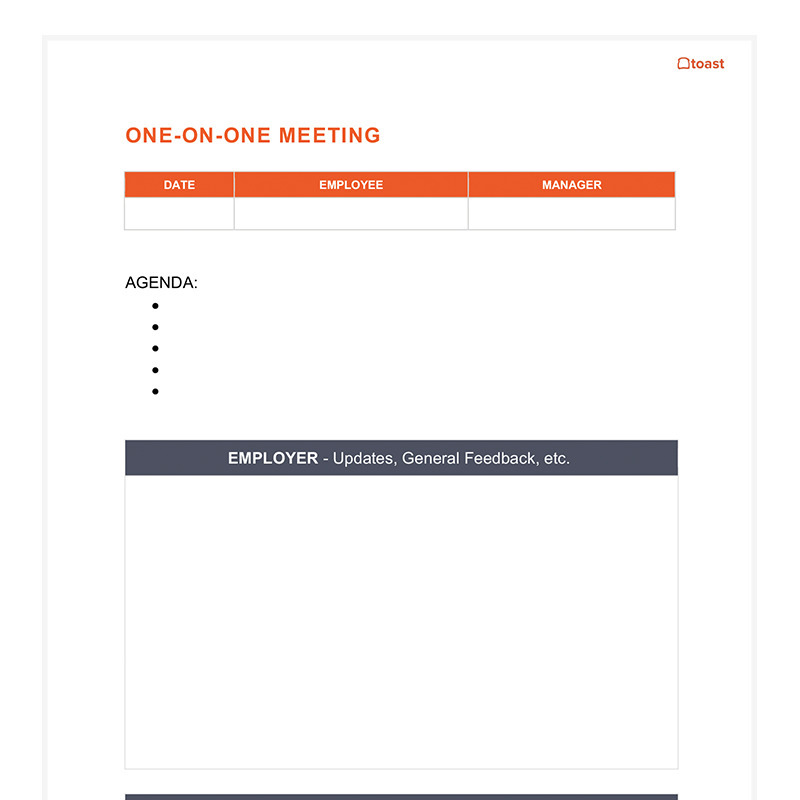
 One-on-One Meeting Template
Make weekly, biweekly, or monthly check-ins with employees productive with this customizable Word doc for your one-on-one meeting agendas.
Get Free Download | Built for Restaurants
Regular performance evaluations are essential to running a successful restaurant — especially in an industry where turnover rates now exceed 75%. These check-ins give managers a chance to connect with staff, offer meaningful feedback, and support career growth. Without a structured process in place, expectations can become unclear, standards start to slip, and teams lose direction.
Importance of structured evaluations
A well-structured evaluation isn’t just a formality — it’s a strategic tool for reinforcing expectations, improving communication, and investing in employee growth. When done right, evaluations help managers course-correct early, recognize standout contributions, and create a sense of forward momentum for every team member.
Reducing turnover costs
The financial impact of restaurant turnover is substantial. The cost of replacing a single hourly restaurant employee ranges from $2,000 to $5,000 when considering recruitment, hiring, and training expenses.Implementing structured evaluations helps reduce this burden by identifying problems early, supporting retention, and reducing the frequency of costly replacements.
Improving employee retention
Regular performance reviews help address issues before they lead to resignations by creating open communication channels and clear development paths. They also allow managers to check in on morale, recognize achievements, and uncover hidden frustrations that might otherwise go unspoken.
Building workplace culture
Regular evaluations promote transparency and trust between management and staff. They demonstrate investment in employee growth and provide structured opportunities for recognition and constructive feedback. Over time, this consistency fosters a more supportive, motivated team culture — where expectations are clear, effort is noticed, and goals are shared.
Training Manual Template
Use this restaurant training manual template, a customizable Word Doc, to provide your staff with the rules, guidelines, and clarity they need to do their jobs efficiently.

Core evaluation criteria
Restaurant roles are diverse, but some foundational traits apply across the board. These key evaluation categories help managers assess both performance and potential.
Customer service excellence
Customer service forms the foundation of restaurant success. Use these indicators to assess how well employees interact with guests:
Greeting customers promptly and professionally: First impressions matter — timeliness and tone set the stage for the dining experience.
Handling complaints with grace and problem-solving skills: Employees should remain calm under pressure and resolve issues effectively.
Maintaining a positive attitude during busy periods: A friendly, composed demeanor helps defuse tension during peak hours.
Building rapport with guests and addressing inquiries effectively: Great service includes answering questions confidently and creating repeat business through connection.
Technical job performance
Evaluate how well employees perform the core tasks required by their position:
Menu knowledge and ability to make recommendations: Familiarity with dishes allows staff to upsell and guide guests.
Accuracy in order taking and food delivery: Mistakes here directly affect customer satisfaction and operations.
Speed and efficiency during peak hours: Fast-paced environments demand the ability to stay sharp under pressure.
Attention to detail in food presentation and quality standards: Consistency reflects your restaurant’s standards and brand.
Teamwork and collaboration
Restaurants thrive when every team member supports the group. Use these criteria to assess collaboration:
Ability to work effectively with front and back-of-house staff: Employees should communicate and cooperate across roles.
Support for coworkers during busy periods: Willingness to jump in and help others strengthens team dynamics.
Communication skills with team members and management: Clear, respectful dialogue is key to smooth operations.
Contribution to a positive work environment: Kindness, respect, and professionalism influence team morale.
Work ethic and reliability
Dependable employees are the backbone of any successful restaurant. Evaluate these essential qualities:
Punctuality and attendance consistency: Being on time and showing up regularly signals professionalism.
Reliability during scheduled shifts: Staff should follow through on responsibilities without frequent reminders.
Professional demeanor under pressure: A calm, composed presence is vital in high-stress moments.
Integrity in handling money and following policies: Trustworthiness ensures safety, accuracy, and legal compliance.
Evaluation format and structure
A strong evaluation process relies on consistency, clarity, and collaboration. The following elements ensure feedback is both actionable and fair across all roles.
Rating scales and measurements
To evaluate employee performance objectively, use consistent scoring methods across the team:
Numerical scales: Use a 1-to-5 rating system, where 1 means "Needs Improvement" and 5 means "Exceeds Expectations," to provide a standardized way to measure performance across criteria.
Descriptive ratings: Use labels such as "Excellent," "Good," "Average," and "Needs Improvement" to provide a clear, qualitative snapshot of employee strengths and growth areas.
Quantifiable metrics: Customer satisfaction scores or sales figures allow managers to back up evaluations with data and track improvements over time.
Self-assessment components
Incorporate a section where employees evaluate themselves. This encourages accountability and opens two-way communication:
Encourage reflection on personal performance: Helps employees think critically about what’s going well and what needs improvement.
Identify areas where employees feel they need support: Gives insight into unseen challenges or training needs.
Open honest conversations about goals and challenges: Builds trust and encourages transparency between staff and managers.
Promote professional development and accountability: Self-awareness is key to growth and long-term retention.
Goal setting and development planning
Use evaluations as a platform to set expectations and guide professional growth:
Short-term and long-term performance goals: Clarify priorities for the coming weeks and future aspirations.
SMART goals: Use the Specific, Measurable, Achievable, Relevant, and Time-bound framework to ensure goals are realistic and trackable.
Training and development opportunities: Identify ways to build new skills or strengthen existing ones.
Career advancement discussions: Show employees how their current role can evolve into a long-term path within the organization.
Position-specific evaluation criteria
Different restaurant roles require different skill sets. Tailoring evaluations by position ensures staff are assessed on what matters most for their responsibilities.
Danny Meyer, founder of Union Square Hospitality Group and Shake Shack, emphasized the importance of assessing emotional intelligence in addition to technical performance. He said, “Emotional skills are kind of baked in by the time we’ve already hired you. So we’ve never learned how to train someone who’s otherwise not nice to be nice. We’ve never been able to train someone who’s otherwise a natural born skeptic to feel hopeful.”
This mindset reinforces why role-specific evaluations should include both job competencies and behavioral traits — especially in hospitality-driven environments.
Front-of-house staff
Servers, hosts, and bartenders should be evaluated on the skills that directly impact guest satisfaction and sales:
Table management and multitasking abilities: Can the employee handle multiple tables or responsibilities efficiently without sacrificing service quality?
Upselling and sales techniques: Are they skilled at recommending specials or add-ons that boost ticket size?
Knowledge of wine pairings and menu items: Do they understand the menu well enough to answer questions or make thoughtful suggestions?
Guest interaction and hospitality skills: How effectively do they create a warm, welcoming, and attentive experience?
Back-of-house staff
Kitchen roles require precision, speed, and teamwork. Focus on these criteria for cooks, prep staff, and dishwashers:
Food safety and sanitation compliance: Are they following proper hygiene and handling protocols?
Cooking techniques and consistency: Do they consistently produce dishes to standard, with proper execution?
Time management during rushes: Can they stay organized and deliver food on time during peak hours?
Teamwork in high-pressure environments: How well do they collaborate and support each other under stress?
Management positions
Managers set the tone and drive overall performance. Evaluate leadership based on these key competencies:
Staff development and training abilities: Are they coaching employees and helping others grow?
Problem-solving and decision-making skills: Can they respond to issues quickly and with good judgment?
Financial management and cost control: How well do they manage budgets, labor, and inventory?
Communication with both staff and customers: Are they clear, professional, and approachable in every interaction?
Implementation best practices
Even the best evaluation form won’t make an impact without thoughtful execution. These best practices ensure evaluations are timely, consistent, and productive.
Frequency and timing
Employee evaluations should be scheduled at regular intervals — typically monthly or quarterly, depending on your team size and business goals. More frequent check-ins help identify and address issues early, reinforce expectations, and keep communication flowing.
Training managers for effective reviews
Managers need the right tools and mindset to lead meaningful evaluations. Equip them to succeed by training them to:
Provide constructive feedback: Use techniques like the "compliment sandwich" to balance positive observations with actionable areas for improvement.
Set realistic and achievable goals: Ensure goals are clear, attainable, and tailored to each employee’s role.
Document performance objectively: Use facts and examples, not opinions, to support feedback.
Create safe spaces for honest communication: Foster trust by listening actively and treating evaluations as a two-way conversation.
Documentation and follow-up
To track progress and protect against legal risk, it's important to keep detailed records. Documentation should include:
Performance discussions and outcomes: Summarize what was covered and any agreements made.
Goal-setting agreements: Record specific goals, timelines, and expectations.
Training completions and certifications: Maintain a log of employee development milestones.
Progress tracking over time: Compare evaluations to previous reviews to identify growth or patterns.
Performance improvement strategies
Evaluations aren’t just about identifying what’s going wrong — they’re also key to supporting growth and recognizing what’s going right. Here’s how to use evaluations as a launchpad for improvement and development.
Addressing performance gaps
When evaluations reveal areas that need improvement, take proactive steps to help employees succeed:
Create specific action plans with clear timelines: Set measurable goals tied to deadlines to provide structure and accountability.
Provide additional training and support: Offer resources, workshops, or shadowing opportunities to build skills.
Schedule follow-up evaluations to track progress: Reassess regularly to ensure improvement efforts are working.
Offer mentoring or coaching opportunities: Pair employees with experienced team members who can guide and encourage them.
Recognition and rewards
Use evaluations to identify and celebrate high-performing employees. Recognition can be both motivational and retention-boosting:
Public recognition and praise: Acknowledge achievements during team meetings or through internal shoutouts.
Advancement opportunities: Promote from within when employees consistently exceed expectations.
Performance-based bonuses: Offer financial incentives tied to evaluation scores or milestones.
Leadership development programs: Enroll top performers in training tracks to prepare them for future management roles.
Shake Shack has built a reputation for developing its team from the ground up. It's not uncommon for hourly employees to be promoted all the way to store-level managers and beyond, reflecting a deliberate approach to internal advancement and leadership development.
Career development planning
Evaluations also serve as an opportunity to explore long-term growth and employee aspirations:
Skills assessment and training recommendations: Identify gaps and provide targeted learning options.
Career path discussions: Talk about where employees want to go and how they can get there within your organization.
Professional development opportunities: Encourage attendance at workshops, certifications, or classes.
Cross-training in different restaurant areas: Help employees expand their skill set and increase flexibility on the floor.
McDonald’s Archways to Opportunity program connects performance and tenure to access to English-language courses, tuition assistance, and career advising. It demonstrates how performance evaluation systems can be paired with long-term investment in employee success — both inside and outside the restaurant.
Legal and compliance considerations
Performance evaluations must be conducted with fairness, consistency, and legal awareness. Following proper procedures helps protect both employees and the business from liability or claims of discrimination.
Fair and objective standards
To ensure evaluations are legally sound and equitable across the team, maintain consistency with the following practices:
Using standardized criteria for similar positions: Evaluate employees based on role-specific benchmarks, not personal impressions.
Training all managers on proper evaluation techniques: Provide guidance on how to give feedback, avoid bias, and document performance effectively.
Documenting all performance discussions: Keep accurate records of what was discussed, agreed upon, and planned.
Avoiding personal bias in assessments: Focus on observable behaviors and outcomes, not personality or assumptions.
Chipotle uses a 13-trait evaluation checklist to assess employees for culture fit. Traits like ambition, honesty, and team spirit are prioritized to ensure consistency across locations and reinforce the company’s values throughout the evaluation process.
Privacy and confidentiality
Employee evaluations contain sensitive information and should be treated with discretion and professionalism:
Secure storage of evaluation documents: Use locked files or encrypted digital systems to protect records.
Limited access to performance records: Only authorized personnel (such as HR or direct supervisors) should view evaluation data.
Professional handling of sensitive discussions: Conduct evaluations in private settings and treat employee feedback with care.
Compliance with employment law requirements: Stay updated on federal, state, and local laws that impact employee evaluations, including documentation and anti-discrimination regulations.
Measuring evaluation effectiveness
Once your evaluation process is in place, it’s important to track whether it’s actually making an impact. Use performance data and ongoing feedback to gauge success and make improvements over time.
Key performance indicators
Monitor these metrics to determine if your evaluation program is driving real results:
Employee retention rates: Are evaluations helping reduce turnover and retain top talent?
Customer satisfaction scores: Has service improved as a result of employee feedback and development?
Internal promotion rates: Are strong performers being recognized and advancing within the organization?
Training completion metrics: Are employees following through on development plans and required certifications?
Continuous improvement
An effective evaluation process should evolve with your team and business. Revisit your approach regularly by considering:
Staff feedback on the evaluation experience: What do employees say about the usefulness and fairness of the process?
Manager input on form effectiveness: Are the tools and questions helping supervisors give meaningful feedback?
Industry best practices and benchmarks: Stay informed about what’s working well in other restaurants or hospitality businesses.
Changes in restaurant operations or goals: As your business shifts, your evaluation criteria may need to shift too.
Creating positive evaluation experiences
The way evaluations are delivered matters just as much as what’s discussed. When done with care and intention, they can build trust, strengthen morale, and inspire real growth.
Preparation and scheduling
Thoughtful planning sets the stage for a productive and respectful evaluation experience:
Advance notice to allow employee preparation: Let employees know ahead of time so they can reflect and come prepared.
Private, comfortable meeting spaces: Choose a quiet, neutral setting where both parties feel safe to speak openly.
Adequate time for thorough discussion: Avoid rushing — block off enough time to cover key topics and answer questions.
Consistent scheduling to build routine: Establish a regular cadence (monthly or quarterly) to create predictability and momentum.
Communication strategies
Strong evaluations are rooted in clear, empathetic communication. Use these strategies to guide the conversation:
Active listening to employee perspectives: Let team members share their thoughts and experiences without interruption.
Specific examples of performance strengths: Go beyond general praise by naming concrete actions and results.
Clear explanations of improvement areas: Offer direct, respectful feedback tied to specific behaviors or outcomes.
Collaborative goal-setting discussions: Involve employees in defining their next steps so they feel ownership over their growth.
Starbucks exemplifies this approach by encouraging regular check-ins between managers and employees, supported by training in active listening and goal alignment. Their emphasis on open dialogue fosters a culture of continuous feedback and mutual trust — essential ingredients for a productive evaluation process.
Final thoughts
In a fast-paced, high-turnover industry like restaurants, employee evaluations are more than just paperwork — they’re a powerful tool for retention, growth, and team alignment. When done thoughtfully, evaluations boost morale, uncover opportunities for development, and help managers recognize both strengths and areas for improvement.
By establishing clear criteria, tailoring evaluations by role, and training managers to deliver feedback with purpose, restaurant leaders can build stronger teams and more successful businesses. Whether you're creating your first evaluation form or refining an existing process, consistency, communication, and care are key to making performance reviews a positive experience for everyone.
FAQ
How often should restaurant employees be evaluated?
Employee evaluations should be conducted monthly or quarterly to maintain regular communication and address issues promptly. More frequent check-ins help prevent problems from escalating.
What's the most important criterion to evaluate in restaurant staff?
Customer service skills are paramount, followed by technical job performance, teamwork abilities, and work ethic. The specific emphasis may vary by position and restaurant type.
How can evaluations help reduce employee turnover?
Regular evaluations provide opportunities for recognition, career development discussions, and early intervention when employees face challenges. This helps address the 46.5% of voluntary separations that contribute to industry turnover.
Should employees complete self-evaluations?
Yes, self-assessments encourage reflection and open honest conversations about performance and goals. They help employees take ownership of their development.
How can technology improve the evaluation process?
Digital platforms offer real-time tracking, integration with other restaurant systems, mobile accessibility, and data analysis capabilities that paper forms cannot provide.
What should managers avoid during evaluations?
Avoid personal bias, unclear feedback, focusing only on recent events, and discussing compensation during performance reviews. Keep conversations professional and focused on growth.
Is this article helpful?
DISCLAIMER: This information is provided for general informational purposes only, and publication does not constitute an endorsement. Toast does not warrant the accuracy or completeness of any information, text, graphics, links, or other items contained within this content. Toast does not guarantee you will achieve any specific results if you follow any advice herein. It may be advisable for you to consult with a professional such as a lawyer, accountant, or business advisor for advice specific to your situation.
 Trending

Subscribe to On the line
Sign up to get industry intel, advice, tools, and honest takes from real people tackling their restaurants’ greatest challenges.
By submitting, you agree to receive marketing emails from Toast. We’ll handle your info according to our privacy statement. Additional information for California residents available here.