
How to Train Restaurant Servers in the UK
Elevate your guest's experiences with the help of this server training guide.

Nick PerryAuthor
Great service is the backbone of every successful restaurant. This guide will walk you through how to train your servers effectively, reduce staff turnover, and elevate the experience your guests receive — from first impressions to lasting loyalty.
Why Server Training in the UK Really Matters
According to the Toast Voice of the Restaurant Industry in the UK report, 78% of UK restaurateurs expect growth in 2024 and are prioritising efficiency and employee retention to get there. One of the best ways to drive both is through a robust server training programme.
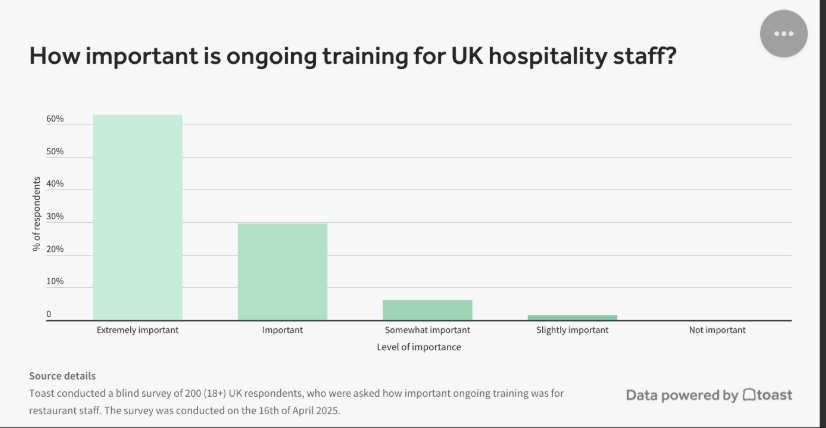
UK hospitality staff back this up. According to the Toast Consumer Preferences Survey 2025, in which 200 hospitality workers in the UK were polled about restaurant HR, staffing and training in hospitality, 63% believe ongoing training is “extremely important,” and over half say that a well-defined onboarding process is essential.
What UK Diners Want in 2025
UK consumers are more selective than ever. 78% say eating out is now too expensive to do regularly, and over half expect more from the restaurants they visit (source: Toast Voice of the Restaurant Industry in the UK.
Consistency, good communication, and value-driven service make all the difference in keeping guests loyal (source: Toast Consumer Preferences Survey 2025).
Continue reading to discover actionable steps for training your servers to consistently exceed guest expectations.
Step 1: Introduce Servers to Your Business
Before your new hires ever carry a plate, make sure they understand the heart of your restaurant. What inspired you to open these doors? What makes your place special? Sit down with them over coffee and share the journey that led to where you are today.
Walk them through the dining room and tell the stories behind your design choices, signature dishes, and even that quirky painting on the wall. When servers genuinely connect with your restaurant's identity, they'll naturally share that passion with your guests.
This creates consistency from day one and builds pride in the workplace — something UK restaurant teams are striving for as part of wider retention strategies.
Step 2: Show Them How You Do Things
Even experienced servers need to learn your way of doing things. Create a clear walk-through of restaurant zones, table numbers, and POS workflows. Make expectations like teamwork and pre-shift prep explicit.
Training soft skills like initiative, speed, and empathy is just as crucial. These are the behaviours that drive repeat visits and faster table turns — two of the biggest goals for UK restaurant operators right now.
Step 3: Use Shadowing to Build Confidence
Peer mentorship and job shadowing are ranked among the most helpful onboarding tools by UK hospitality workers.
According to the Toast Consumer Preferences Survey 2025, over 73.5% of UK hospitality staff prefer on-the-job mentorship to other training methods.
Assign a seasoned server to shadow each new hire to build confidence and help them pick up valuable habits.
Step 4: Make Menu Training Fun and Effective
New hires should know the menu inside and out. In fact, 51% of UK respondents to the Toast survey said service etiquette is the most important server skill.
Host a team tasting night. Let servers try every dish, then test their ability to recommend menu items. Make it fun, but ensure they leave with confidence and a strong understanding of your offer.
Training Manual Template
Use this restaurant training manual template, a customizable Word Doc, to provide your staff with the rules, guidelines, and clarity they need to do their jobs efficiently.

Step 5: Use Feedback to Fine-Tune Service
Build regular check-ins into your training timeline. Collect feedback from managers and guests using your POS system or quick cards.
Many UK operators are already doing this — 40% use feedback to improve staff development (source: Toast Voice of the Restaurant Industry in the UK).
Step 6: Talk Growth and Development
Team members stay longer when they see a future. Define clear progression paths for your FOH staff and set check-ins at 30, 60, and 90 days.
With 82% of UK workers saying they’d stick around for development opportunities, this is one of the simplest ways to reduce churn.
UK Case Study: Le Bab’s Tech-Driven Training
London-based Le Bab is a brilliant example of how investing in training and tech can accelerate success.
After adopting Toast’s EPOS and KDS, they reduced turn times significantly — hitting 35–40 minutes per table at their Battersea location. COO Sam Brotchie credits this improvement to streamlining FOH operations and freeing staff to focus on customer engagement.
Final Thoughts
Training your servers well doesn’t just improve your service — it boosts morale, efficiency, and profitability. With customers demanding more from every visit and team members craving structure and development, the best thing you can do for your FOH staff is set them up for success.
 TOAST TECH
 Built for restaurants just like yours.
Toast’s restaurant technology includes point of sale, kitchen display screens, online ordering and more.
Is this article helpful?
DISCLAIMER: This information is provided for general informational purposes only, and publication does not constitute an endorsement. Toast does not warrant the accuracy or completeness of any information, text, graphics, links, or other items contained within this content. Toast does not guarantee you will achieve any specific results if you follow any advice herein. It may be advisable for you to consult with a professional such as a lawyer, accountant, or business advisor for advice specific to your situation.
Subscribe to On the line
Sign up to get industry intel, advice, tools, and honest takes from real people tackling their restaurants’ greatest challenges.
By submitting, you agree to receive marketing emails from Toast. We’ll handle your info according to our privacy statement. Additional information for California residents available here.