
5 Restaurant Strategy Questions to Help Improve Annual Business Planning
Learn key factors and solutions to consider as you plan your restaurant strategy and business improvements.

Justin GuinnAutor
 RECURSO
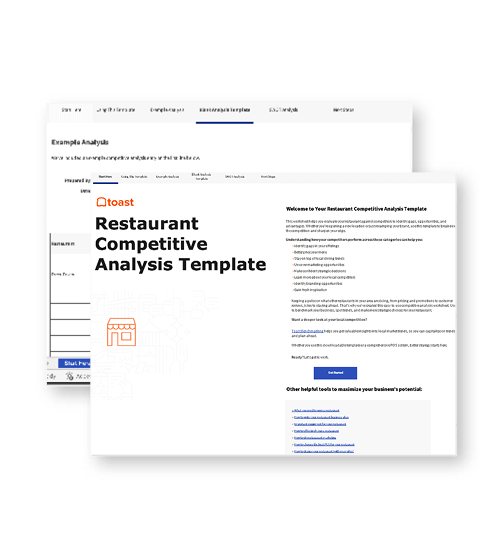
 Plantilla de análisis competitivo de restaurantes
Usa esta plantilla gratuita para evaluar a tus competidores, analizar tu mercado e identificar los puntos fuertes de tu restaurante, todo en un solo lugar.
Obtener descarga gratis | Creado para restaurantes
Restaurant business planning is an essential exercise for restaurant owners and operators.
Restaurateurs can revisit their restaurant strategy to help address challenges, identify areas for improvement, set goals, and develop tactics to achieve them.
In this article, you will learn five crucial restaurant strategy questions that can guide restaurant owners and managers in their business planning. By addressing these questions, you can optimize your restaurant strategy, drive growth, and increase profitability.
When and how to update your restaurant strategy and business plan
Before diving into the questions, it's important to understand when and how to update your restaurant strategy and business plan.
Business planning is commonly done at the end of each fiscal year or the beginning of a new year. However, it's also necessary to review and revise your strategy throughout the year to adapt to changing market conditions and internal factors.
Here are a few ways to help kick off your general business strategy planning process.
Strategic planning milestones to kick off your restaurant business analysis and optimization
To update your restaurant strategy and business plan effectively, consider the following steps:
Assess the current state of your restaurant: Evaluate your performance, finances, customer feedback, and trends in the industry to identify areas that need improvement.
Set SMART goals: Define specific, measurable, achievable, relevant, and time-bound goals for your restaurant, such as increasing sales by a certain percentage or improving customer satisfaction scores.
Conduct a SWOT analysis: Analyze your restaurant's strengths, weaknesses, opportunities, and threats to identify areas for improvement and potential growth opportunities.
Develop action plans: Create detailed action plans to achieve your goals. These plans should include specific strategies, tactics, timelines, and responsibilities.
Establish key performance indicators (KPIs): Define measurable metrics to track your progress and evaluate the success of your strategies.
Revisiting your mission statement with stakeholder input
Your restaurant mission statement can be the foundation of your operation. This value statement can be influenced by competitive analysis and intentional market differentiation.
It may be a good idea to loop in day-to-day operators to get their vision statement and understand the value propositions that resonate with them.
This exercise can help zero in your end goals and influence your restaurant strategy.
Informe de estadísticas para operadores de restaurantes
Consulta las estadísticas de operadores de restaurantes reales que pueden ayudarte a comparar la infraestructura tecnológica actual y planificada de tu restaurante con la de tus competidores de cara al 2024 y en adelante.

Top questions to consider for optimizing your restaurant strategy
Here are some critical questions you may consider answering in your restaurant strategy planning. These questions are based on Toast’s latest Voice of the Restaurant Industry research.
1. What's your short-term and long-term growth plan for adding locations and concepts?
Toast’s Voice of the Restaurant Industry shows that approximately 29% of restaurants we surveyed say they are very likely to expand their restaurant locations in the next 12 months. That’s up from just 17% of restaurants we surveyed in 2022.

While this should not be interpreted as a projection for the number of restaurants opening next year, it’s positive to see that respondents have an optimistic outlook for the future of the industry.
Operators have two ways to expand their customer base with new business opportunities — this includes adding additional locations or introducing new concepts. These are the two significant strategies for growth at the location level.
You may want to determine whether adding new locations aligns with your long-term goals and aligns with market demand. For example, is there enough potential market share to support a second cafe? Or if your bbq joint is booming, could you open a fine dining concept or something else with new products?
Consider factors such as location selection, market research, startup costs and funding requirements, and operational considerations.
2. How can you optimize employee hiring, training, and staff management?
Your staff is instrumental in delivering excellent customer service and driving operational efficiency.

As restaurants look to the future of their business, Toast asked operators if there were any changes to the level of importance they’d place on various aspects of running a restaurant. Employee training topped the list for the second year.
Operators can review current processes for hiring, onboarding, and training employees to assess their effectiveness. This can apply for approaches to your leadership teams and across your day-to-day staff.
Restaurateurs may want to consider implementing strategies to attract top talent, provide ongoing training, and create a positive work environment.
3. Which tactics can help increase restaurant sales?
Boosting restaurant sales is a key objective for any business.

Restaurant operators say they are having the most difficulty managing multiple service channels. Thankfully, an all-in-one system that integrates multiple service channels into a single screen like Toast can help alleviate the pain points with third-party service channels.
In addition to new service channels, operators can explore different tactics to attract more customers and increase sales. This may include marketing campaigns, loyalty programs, partnerships with local businesses, promotions or specials, and optimizing menu pricing and offerings.
Analyze sales data and customer feedback to identify opportunities for upselling, cross-selling, and improving average check sizes.
4. What strategies can help boost profit margins?
Profitability is essential for the long-term sustainability of your restaurant.

As operators assess their businesses, Toast asked decision-makers what goals they have for their restaurants over the next year. Improving profitability was most marked as the highest importance, with 34% of respondents saying their margins are their priority.
Operators can help encourage greater profitability by evaluating current cost structures and identifying areas for cost optimization. This may involve renegotiating supplier contracts, optimizing inventory management, reducing waste, enhancing operational efficiency, and implementing technology solutions for better financial control and reporting. Don't overlook the importance of accurate budgeting, forecasting, and monitoring of key financial metrics.
If cost controls are one side of the profitability pendulum, then strategic pricing is the other side. Revamping menu price strategies can also help with growing profitability.
5. Which restaurant technologies can you adopt in the next year to help streamline operations and impact sales and profits?
Restaurant technologies can help spur an operation to greater success. This is especially true via controlling costs, driving greater guest demand, and streamlining operations — front- and back-of-house.

When it comes to increasing employee efficiency, restaurants we surveyed said they anticipate turning to various technologies to help streamline their operations, including handheld devices, mobile payments and ordering, as well as employee training, employee incentive, and employee scheduling software.
Maintaining a dynamic marketing plan and strategy throughout the year
Along with these restaurant strategy questions, operators may want to consider how to keep their marketing strategy fresh and revamped.
It can be important for restaurant operators and marketing owners to conduct ongoing market analysis — not just to inform menu items and prices, but also to help understand what marketing messaging is resonating.
A dynamic marketing plan can include engagement efforts across multiple channels, including social media, advertising, email and other reengagement opportunities, and other options.
The right channel mix will vary by demographics and target market. It’s important for marketing channel owners to measure which channels generate the most new customers and repeat guests based on the marketing efforts required. Customer acquisition costs, or CAC, are a popular measure here.
Plan de marketing para restaurantes
Aprovecha esta plantilla personalizable de guía de marketing y calendario interactivo para crear un plan de marketing que haga que los clientes regresen.
How to use a business plan template
A restaurant business plan template is a written document that describes in detail how your restaurant defines its objectives and how it’ll go about achieving its goals. It can serve as a blueprint that outlines your entire vision, and it explains in detail how your business will take shape and operate.
When writing your business plan, be sure to include elements like a branded cover page, an executive summary, a company overview, an industry analysis, a marketing plan, an operations plan, and a financial analysis.
In most cases, opening a new restaurant, expanding to a new location, or giving your existing concept an overhaul requires outside capital from hospitality investors.
But before anyone invests in your dream, they need to see that you’ve got a concrete plan for success. The business plan provides them with a complete description of your strategy.
Download Toast’s free Restaurant Business Plan Template to organize your vision and ensure that nothing is overlooked.
Plantilla de plan de negocio para restaurantes
No importa en qué punto de tu recorrido como dueño de restaurante estés, el plan de negocio será tu estrella guía. Organiza tu visión y asegúrate de no pasar nada por alto con esta plantilla gratuita.
Restaurant strategy planning that helps optimize decision making and financial projections
Annual business planning provides an opportunity to assess your current restaurant strategy and develop a roadmap for future success.
By addressing the five crucial strategy questions outlined in this article, you can optimize your restaurant strategy, drive growth, boost cash flow, increase profitability, and carve out a competitive advantage. Remember to regularly review and update your plans throughout the year, staying adaptable and responsive to changing market conditions.
With a well-thought-out strategy and continuous improvement efforts, your restaurant can thrive in the competitive hospitality industry.
 TECNOLOGÍA DE TOAST
 Built for restaurants just like yours.
La tecnología para restaurantes de Toast incluye punto de venta, sistema de pantallas de cocina, fidelidad, análisis y nómina, entre otros.
¿Es útil este artículo?
AVISO LEGAL: Esta información se proporciona solo con fines informativos generales y su publicación no constituye un aval. Toast no garantiza la precisión ni la integridad de la información, el texto, los gráficos, los enlaces y otros elementos que incluye este contenido. Toast no garantiza que alcanzarás ningún resultado específico si sigues los consejos que aparecen aquí. Te recomendamos consultar con un profesional, como un abogado, contador o asesor comercial, para recibir asesoramiento específico para tu situación.
 Tendencias


Suscribirse a On the line
Regístrate para recibir opiniones reales, consejos, herramientas e información específica del sector de la mano de quienes están abordando los desafíos más importantes para los restaurantes.
Al enviar, aceptas recibir correos electrónicos de marketing de Toast. Trataremos tu información de acuerdo con nuestra declaración de privacidad. Información adicional disponible para residentes de California aquí.