
How to Open a Retail Store with No Money in 2025: Strategies for Success
Retail is evolving — this guide shows how smart entrepreneurs are starting stores without breaking the bank.
Aiden ToborAutor
 RESOURCE
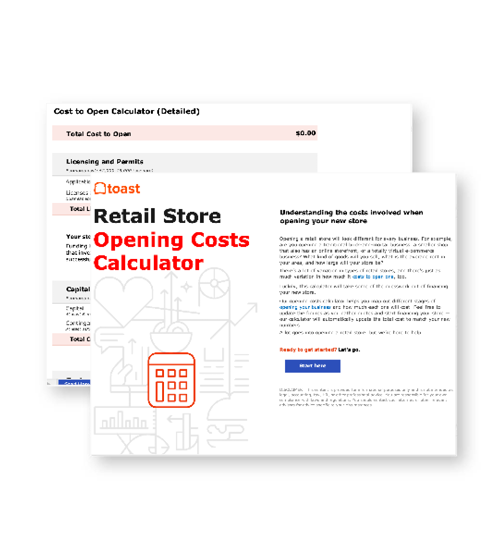
 Retail Store Opening Costs Calculator
This free calculator lays out some of the fundamental financial costs of opening a retail store, so you can start planning and bring your dream business to life.
Obtener descarga gratis | Creado para restaurantes
Opening a retail store without substantial capital might seem out of reach, but in today’s rapidly evolving retail landscape, it’s more possible than ever. In 2023, the U.S. reported 3,119,178 retail stores — a 2.6% increase from the previous year — highlighting strong consumer interest in physical shopping despite the digital boom.
With new business models, technology tools, and funding opportunities emerging, creative entrepreneurs are finding innovative ways to launch retail ventures with little to no upfront investment. This guide offers actionable strategies to help you start smart, stay lean, and build a thriving retail business in 2025.
Understanding today's retail environment
Before diving into specific strategies, it's essential to understand the current retail landscape. Global retail sales are experiencing significant growth, creating more opportunities for prospective business owners to enter the market. Much of this growth is driven by the rise of niche markets, social media commerce, and hybrid shopping models that blend online and in-person experiences.
However, the average cost of opening a retail store is approximately $39,210 according to recent studies, with expenses varying based on location, store size, inventory type, and staffing needs. For entrepreneurs with limited funds, this figure might seem daunting, but alternative approaches can significantly reduce these costs. Fortunately, new technologies, shifts in consumer behavior, and creative business models are making it more feasible than ever to launch a store with little to no upfront capital.
Retail Store Opening and Closing Checklist
Use this free PDF checklist to set your staff up for success, every shift.

Start with a solid business plan
A well-crafted business plan serves as your roadmap and potential key to financing. As Startups.co.uk emphasizes, "A strong business plan is one of the most important documents you'll need. It should clearly outline your idea, marketing strategy, funding and costs, as well as a development plan for your products or services."
Your business plan should include:
Executive summary and business concept: A brief overview of your business idea, mission, and what problem you're solving.
Market analysis and target customer profiles: Research on industry trends, customer demand, and specific buyer personas you plan to serve.
Competitive analysis: Insight into who your competitors are, what they do well, and how you’ll differentiate your store.
Detailed marketing strategy: Your plan for attracting and retaining customers, including online, local, and word-of-mouth tactics.
Financial projections, even with minimal starting capital: Basic revenue and expense forecasts to show how you’ll stay financially sustainable as you grow.
Unique value proposition: A clear statement of what makes your retail concept different, better, or more appealing than others.
Low-cost operational model details: How you’ll keep startup and day-to-day costs low, such as using dropshipping, pop-ups, or shared spaces.
Even if you're starting with limited funds, a solid business plan demonstrates that you’ve thought through your strategy, goals, and financial sustainability. It not only guides your efforts but also builds credibility when approaching potential partners, suppliers, or alternative funding sources such as grants, incubators, or crowdfunding platforms.
Explore low-investment business models
Pop-up shops and temporary retail
Pop-up shops allow you to test your retail concept without long-term commitments. Business News Daily suggests that "If you already own an online retail business and want to expand to a physical store, experimenting with a pop-up shop is a good way to test the waters without shelling out a lot of money." These short-term locations help gauge customer interest and foot traffic while building brand awareness.
Mobile retail
Mobile stores — such as those run out of converted vehicles or trailers — can be a cost-effective way to reach customers. Small Biz Trends notes that mobile retail businesses can operate 24/7 and attract a global audience through social media and digital marketing, all while avoiding the high cost of a traditional lease.
Online-to-offline strategy
Starting with an e-commerce store allows you to build revenue and a loyal customer base before transitioning to a physical storefront. According to Printify, business models like dropshipping or print-on-demand make it possible to enter the e-commerce space in 2025 with minimal investment and no need to carry inventory.
Creative approaches to securing retail space
Shared retail space
Partner with complementary businesses to share a retail location and split the rent. This reduces overhead while benefiting all parties through increased customer exposure and shared foot traffic. A great example is Sailor and The Dock, a collective-model marketplace that supports mission-driven retailers by providing shared space to sell goods, host events, and build community—reducing costs while boosting visibility and encouraging collaboration.
Consignment space in existing stores
Negotiate to sell your products on consignment within an established store, paying only when items sell. This arrangement helps you avoid upfront rental costs while tapping into an existing customer base.
Negotiate favorable lease terms
If you're pursuing a traditional lease, explore flexible terms that work with limited capital. According to Shopify's research, retail property owners charge for every square foot of available space, with the average retail space costing $21.85 per square foot. Consider negotiating options such as:
Graduated rent that increases as your business grows
Percentage rent based on sales instead of fixed amounts
Rent-free periods during initial setup
Tenant improvement allowances to offset buildout costs
Retail Store Opening Costs Calculator
This free calculator lays out some of the fundamental financial costs of opening a retail store, so you can start planning and bring your dream business to life.
Inventory strategies for zero-capital retail
Consignment inventory model
Partner with local artisans, craftspeople, or small brands to stock your store on consignment. You only pay for items after they sell, eliminating upfront inventory costs and supporting other small businesses.
Dropshipping hybrid
Combine traditional retail with dropshipping by keeping a small selection of products on hand for display or immediate purchase while fulfilling most orders directly through suppliers. This minimizes storage needs and startup investment.
Print-on-demand
For custom products like apparel, mugs, or accessories, use print-on-demand services that produce and ship items only after a customer places an order. This approach reduces waste and avoids inventory risk. Katheriin Liibert, cofounder of the European clothing brand #muhoov, used this model to launch her business with zero upfront investment. She explains, “We started with a print-on-demand service, bringing initial operational investment to $0. Essentially, we were just a website to start off with—to validate the idea.”
Pre-orders / Customer-validated funding
To test demand without upfront costs, consider offering pre-orders. According to Shopify, this approach allows you to “collect upfront cash before committing to production.” For example, Natalie Glaze, co-founder of sustainable swimwear brand Stay Wild, used Instagram to share her product concept and gather feedback before producing anything. The strong interest validated demand and helped the brand grow rapidly, even attracting major retailers like Selfridges shortly after launch.
Alternative funding sources for retail ventures
Small business grants
The grant landscape for 2025 offers a range of opportunities for aspiring retail entrepreneurs. The US Chamber of Commerce updates its list of funding opportunities weekly. Some current options include:
The Start.Pivot.Grow. Micro Grant offers $2,500 in funding to U.S.-based, for-profit businesses with two or fewer employees and at least $50,000 in annual revenue, with grants awarded quarterly.
The Awesome Foundation awards monthly grants of $1,000 to various projects.
Faire Small Business Grant provides $5,000 in store credit to new retail businesses.
The Freed Fellowship offers monthly $500 grants to US-based small business owners.
Community Development Financial Institutions (CDFIs)
CDFIs are government-backed lenders that provide funding to entrepreneurs in low-income or underserved communities. They often offer more flexible terms and accessible lending criteria than traditional banks.
Crowdfunding
Crowdfunding platforms such as Kickstarter and Indiegogo let you presell products or offer rewards to early supporters, allowing you to raise startup capital while validating demand for your retail concept.
Alternative lenders
According to Retail Technology Innovation Hub, alternative lenders "are often able to tailor loans to better suit the retailer in question. This means faster funds, better terms and often easier conditions." These lenders may also provide higher approval rates, flexible loan structures, and more generous credit limits than traditional banks, making them a viable option for startups and small businesses.
Leveraging technology for low-cost operations
AI and automation
BrandsGateway reports that 80% of retail executives expect their organizations to adopt AI automation by the end of 2025. Even small retailers can utilize affordable AI tools for inventory management, customer service, and marketing optimization.
Social media marketing
Social media platforms provide powerful, low-cost ways to promote your business and engage with customers. WebFX notes that 73% of Gen Z customers visit brick-and-mortar stores to discover new products, making effective social media promotion crucial for driving foot traffic.
Point of sale solutions
Modern cloud-based POS systems, such as Toast, offer sales, inventory, and customer management tools with minimal upfront investment, helping small retailers streamline operations and stay organized.
Business model canvas for zero-capital retail
The Business Model Canvas (BMC) provides a strategic, visual framework for planning your no-money retail venture. The Interaction Design Foundation describes the BMC as "a fast, flexible, and visual way to map out a business," making it ideal for entrepreneurs with limited resources who need to pivot quickly.
For a zero-capital retail store, focus on these key components:
Value propositions: Identify the unique benefits your store offers that don't require significant investment
Customer segments: Define clear target markets to focus your marketing efforts and reduce wasted resources.
Key partnerships: Emphasize relationships with suppliers, shared space partners, and community organizations.
Revenue streams: Diversify your income through options like pre-orders, subscriptions, consignment, or affiliate sales.
Cost structure: Outline your essential operating costs, prioritizing lean, flexible, and scalable expenses.
Grocery and Food Inventory Template
Use this Excel spreadsheet template to stay organized and manage your store's inventory with ease.
Minimizing operating expenses
DIY store setup
Use repurposed, upcycled, or second-hand fixtures and decor to furnish your space. Shopify's research indicates that "the average fit-out cost for a retail store is $147 per square foot," making DIY approaches a smart way to save money.
Lean staffing model
Take on multiple roles yourself in the beginning and consider hiring part-time help or commission-based sales associates to minimize payroll. According to Shopify, "the average business spends 18.8% of its annual expenses on staffing costs like salaries, training, taxes, insurance, and benefits."
Bartering services
Trade your products or skills with professionals who can assist with essentials like accounting, legal support, marketing, or store repairs. Bartering builds valuable relationships while helping you conserve cash.
Real-world success stories
While starting with no money is challenging, many successful retailers began with minimal capital and a creative strategy.
For example, Remi Martins, founder of Natural Girl Wigs, started by creating an Instagram page to showcase product ideas and gauge interest before investing in inventory. She notes, “I got feedback that people are interested in the product and there was a market for wigs specially made for natural-hair lovers.” Her early efforts not only validated her concept but also helped build a loyal customer base before she spent any money on stock.
Another example is Liz Fox Roseberry, founder of the viral jewelry brand EarSass. In 2023, with just $400 in her bank account, she launched her Etsy shop and promoted it through a single mention at the end of a TikTok video. She recalls, “I was about to message my old job and see if they wanted me back. But I made listings on Etsy, and I just turned it on... I’ve been slammed ever since because I had this TikTok account.” Her creative approach to marketing helped her generate nearly 20,000 sales in under two years, turning a last-ditch idea into a full-time business featured on shows like “Emily in Paris.”
A different approach comes from UMAI Clothing, an anime-inspired apparel brand that found success using a print-on-demand model. The team launched without holding any inventory, relying on Printful to fulfill orders as they came in — eliminating upfront costs and allowing them to focus on design and marketing. Co-owner Ryan explains, “We’re able to test designs and make designs all the time. And if they don’t work, it doesn’t really matter—we’ll just make another design. We’ll keep making art. We don’t have to lose money doing it with the bulk order.” This ability to experiment freely and scale sustainably helped UMAI grow into a six-figure brand while keeping operations lean and flexible.
Building a growth strategy
Reinvestment plan
Commit to reinvesting early profits directly back into the business to fuel growth. Focus on expanding inventory, improving customer experience, and increasing marketing reach.
Metrics-based scaling
Use specific performance benchmarks — like sales volume, gross profit margin, and positive cash flow — to guide when and how to scale. This data-driven approach helps reduce risk while supporting smart decisions.
Phased approach
Design a step-by-step roadmap for expansion, where each phase builds on the last. For example, move from online-only to occasional pop-ups, and then to a permanent storefront — each stage funded by the success of the one before it.
The path forward: Retail innovation in 2025
The retail landscape in 2025 presents unique opportunities for creative entrepreneurs. With traditional barriers to entry lowering and consumer preferences evolving, innovative retail concepts can thrive even with minimal starting capital.
By leveraging technology, embracing flexible business models, and tapping into community resources, aspiring retailers can transform the challenge of limited funds into a catalyst for innovation. The resulting lean operations often prove more adaptable and resilient in today's rapidly changing retail environment.
Remember that many successful retail empires began with humble origins. Your creativity, determination, and willingness to start small while thinking big may well be your greatest assets on this entrepreneurial journey. Start with what you have, stay focused on your customers, and refine as you grow. The tools are in your hands—now’s the time to build something bold.
Convenience Store Opening Costs Calculator
This free calculator lays out some of the fundamental financial costs of opening a convenience store, so you can start planning and bring your dream business to life.
Press Kit Template
Use this customizable template to craft a polished one-pager that showcases your business’s key details. It condenses essential information into a concise, visually appealing format that’s quick to read and easy to share.


¿Es útil este artículo?
AVISO LEGAL: Esta información se proporciona solo con fines informativos generales y su publicación no constituye un aval. Toast no garantiza la precisión ni la integridad de la información, el texto, los gráficos, los enlaces y otros elementos que incluye este contenido. Toast no garantiza que alcanzarás ningún resultado específico si sigues los consejos que aparecen aquí. Te recomendamos consultar con un profesional, como un abogado, contador o asesor comercial, para recibir asesoramiento específico para tu situación.
 Tendencias

Suscribirse a On the line
Regístrate para recibir opiniones reales, consejos, herramientas e información específica del sector de la mano de quienes están abordando los desafíos más importantes para los restaurantes.
Al enviar, aceptas recibir correos electrónicos de marketing de Toast. Trataremos tu información de acuerdo con nuestra declaración de privacidad. Información adicional disponible para residentes de California aquí.