
BEST Bakery Inventory Management Software: How to Do Bakery Inventory
Provide an inventory 101 with key terms, metrics, processes, and stakeholders — zooming in on any bakery-specific considerations, such as batch inventory, bulk dry goods purchases, etc.
Grace JidounAutor
 RECURSO
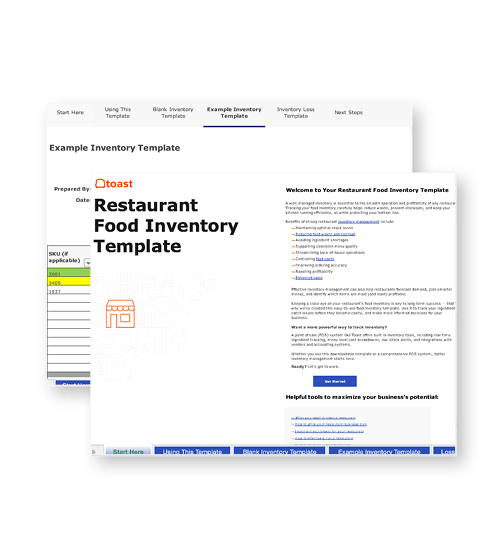
 Plantilla de inventario de alimentos para restaurantes
Utiliza esta plantilla gratuita de inventario de alimentos para ayudar a tu empresa a mantenerse organizada y gestionar el inventario con facilidad.
Obtener descarga gratis | Creado para restaurantes
Why is inventory management important for a bakery?
Without a solid inventory management system, food costs can spin out of control, and you may never turn those pastries into profits. Bakeries across the country are feeling the effects of economic uncertainty and persistent food inflation. This environment makes it more critical than ever to run inventory like a tight ship.
Bakery Inventory Management Software: How to Do Bakery Inventory
Baking your way to business success requires more than great-tasting treats.
A thorough bakery business plan is crucial to success — and your bakery inventory management is an essential part of that plan.
Without a solid inventory management system, food costs can spin out of control, and you may never turn those pastries into profits. Bakeries across the country are feeling the effects of economic uncertainty and persistent food inflation. This environment makes it more critical than ever to run inventory like a tight ship.
From flour to coffee to paper goods, there is little room for error when it comes to reducing waste and increasing profitability.
That said, there is much to be hopeful about. The market size of the global bakery industry is expected to have a compound annual growth rate of 4.6% between now and 2026 to reach a value of $436.91 billion.
It can still be wonderful time to jump into the bakery business if you’re an entrepreneur or to fine-tune your inventory management if you’re an established business.
Guía de control de costos para restaurantes
Usa esta guía para obtener más información sobre los costos de los restaurantes, cómo realizarles un seguimiento y las medidas que puedes tomar para maximizar tu rentabilidad.

What is Bakery Inventory Management?
Bakery inventory management is the process of ordering, receiving, storing, and tracking all the ingredients and supplies at your bakery.
The goal is to ensure your bakery inventory matches customer demand so you don’t have too little or too much product.
Inventory management at a bakery is just like any other restaurant, with a few caveats.
First, most bakeries do what is known as batch costing, which applies to any business that makes batches of identical products (identical cookies in the display case, for instance). Instead of calculating the cost per cookie, you determine the cost per 500, for example.
Second, the bakery inventory spreadsheet will need to reflect batching, or you will need to have your own batch cost sheet.
Before crafting a bakery inventory management system, however, there are several keywords you should have on instant recall — just like the sugar-to-milk ratio in your frosting recipe.
Cost of goods sold (COGS) is the cost of all the ingredients a bakery uses in a given time frame, such as butter, sugar, food costs, and even cardboard cake boxes. To calculate your COGS, use this simple formula: Beginning inventory + Purchased inventory – Ending inventory. A general rule of thumb is that COGS should be around 25% of your total sales.
Par level refers to the minimum amount of supplies you should keep on hand to ensure you always meet your customers' needs.
Understanding the cost of each recipe is critical, and the first step is to track the unit of measurement that the ingredients were purchased in (ounces, pounds, gallons, cases, etc.). Plate costing is the difference between cost and price and is calculated using the formula: profit margin % = ([Price – Cost]/Price)*100.
Unit conversion involves converting ingredients between different units of weight and volume. For instance, if you buy whole hazelnuts by the pound but serve a sprinkling on each cookie, you’ll need to calculate the costs per ounce. This is essential data for determining your plate costs. You don’t want to be in a position where you’re flying blind, unknowingly charging too little to break even. Unit conversions are notoriously tricky with baked goods and touch every ingredient, from the shredded coconut to the size of your eggs.
The yield refers to the amount of usable product after processing. Does your famous apple pie require weekly shipments of multiple cases? After peeling and coring all that fruit, 40 pounds of apples quickly turns into 30 pounds, which is your yield.
The waste that occurs during beverage and food prep will also need to be factored into recipe costs.
The actual vs. theoretical formula (AvT) is the difference between the actual cost of goods sold and the theoretical (or expected) cost of goods sold based on projections from historical data. This is also known as variance.
Depletion measures how long you have a product until it is entirely gone.
The count sheet is the spreadsheet you use to keep track of your physical inventory. It is built upon your bakery inventory list with columns for description, price, quantity, and in larger businesses, the location of the items.
Shelf-to-sheet inventory tracking is looking at what’s on your shelf and matching it to your inventory sheet.
Shrinkage means you have less inventory on your shelves than what you’ve recorded in your books. This red flag often signals theft, shoplifting, or fraud.
Why inventory management matters
When it comes to maintaining quality at high volumes, great recipes and ingredients aren’t enough on their own. Inventory management is the name of the game. From containers of cornstarch to bars of chocolate, you need to know exactly what supplies are coming into your bakery and what is in stock at any given moment to boost your profits. Minimizing waste is an ongoing challenge; 4 to 10 percent of food purchased by restaurants shockingly never gets to customers. Zooming in on inventory management will reduce unused food and supplies and save you thousands of dollars.
Manual inventory management vs. inventory management software
Many businesses still count bakery inventory by hand, ticking off supplies on a bakery inventory list. While this is a tried-and-true method, it can quickly eat up a chunk of time to mark down every last sugared rose petal or container of almond paste on a bakery inventory spreadsheet. Perhaps you have seasonal cupcake flavors or change your menu lineup weekly or even daily. This further complicates the process.
The good news is there has been a surge of innovation in bakery inventory systems. Automating the process takes the guesswork out of bakery inventory management. It’s not just about tracking the flow of ingredients in and out of your store, though that’s important. You can also automate invoicing, easily measure your inventory turnover rate, and get notifications when certain items are running low. A POS system, for instance, will centralize sales, inventory, payment, and customer and marketing data all in one dashboard. You can save time, reduce errors, and avoid major headaches with the right bakery inventory management system.
That said, the most effective approach is often a blend of old-school hands-on methods with newer automated software. Many people feel more comfortable manually checking against a list but don’t like the drudgery of invoicing. To help, we’ve created a guide to invoice automation to streamline this crucial yet time-consuming task. Just like that golden ratio of ingredients in bread making, it’s all about finding the right mix.
Whether your approach is old-school or automated (or a blend of the two), an excellent place to start is our Restaurant Cost Control Guide, where we share best practices, helpful tips, and industry insight into the tricky business of keeping costs down. We’ll also walk you through setting up an inventory management system with a series of Par Inventory Excel Spreadsheets.
Best Practices for Bakery Inventory Management
Just like the larger restaurant industry, bakeries were hit hard by the pandemic. Though the bakery segment is starting to level off, supply chain issues and staff shortages continue to lurk in the background.
Additionally, many bakeries have kept practices that were first introduced during the pandemic, such as online ordering and delivery, because of the boost in revenue and customer convenience. The upshot is that a bakery inventory management system looks much different today than it did four years ago.
Whether you’re a small mom-and-pop store or a large wholesaler, it’s a new world out there, and creating the right bakery inventory system is crucial. After brushing up on our guide to food inventory 101, consider the following advice on best practices:
Take inventory often. When you factor in perishable items and customers' changing tastes, it’s essential to count your bakery inventory regularly to ensure it matches what you think you have. Depending on your type of bakery and how many customers line up out the door for fresh bread every morning, this could be once a week, once a day, or even spot-checks throughout the day. Regardless of how often you do it, make the bakery inventory spreadsheet your best friend.
Organize your space, which means utilizing it wisely. Alex Peña is the director of R&D for Bellarise and runs a Los Angeles baking school called Baking Evolution. One of the biggest challenges he has faced in his decades-long career is overproduction due to unknown forecasts. “This can become a real issue during the holidays with changing demands for seasonal pastries.” According to Peña, a key to bakery success is to have a consistent display case. To achieve this, you need to stay flexible and have enough storage so you can bake certain items when needed. “I utilize cold and frozen storage. For example, I prepare shelf-life-tolerant items like cookie dough and muffin batters ahead of time and then bake them when needed. Breads that have a short shelf life can be produced in small batches, and I use refrigeration to slow down and control the proofing cycle.”
Maintain a consistent inventory schedule. Taking inventory at the same time each day will help you better understand the demands for specific products. You’ll understand what ingredients are used and when so that you can adjust accordingly on future orders.
Train your staff. Henry Ford once said, “If everyone is moving forward together, then success takes care of itself.” It’s imperative to train your staff on inventory best practices. Larger bakeries may designate an employee or manager to handle inventory, whereas smaller bakeries may get all employees on board. Peña stresses the importance of following a schedule, “If your inventory is consistent, you’ll train your customers too. For example, they’ll know to expect fresh bread at 7 am and then again at 5 pm.”
Invest in Restaurant Inventory Management Software
After waking up before the crack of dawn to begin baking for the day, the last thing on your mind may be bakery inventory management software. If you’re just starting out, you could always track costs manually using bakery inventory spreadsheets. But as your business grows and becomes more complex, a solid bakery inventory management system, such as xtraCHEF, will be invaluable. It will help you make better business decisions and put your bakery ahead of the curve.
The single most crucial step you can take is to digitize invoices; it is the foundation on which all profitable inventory processes are built. Digital invoices can dramatically cut costs simply by eliminating human error. There’s nothing worse than waking up in the middle of the night to realize you added an extra “zero” to an invoice or missed a payment on a bill — heaven forbid it’s from an important supplier. Integrating your bakery inventory into the invoice automation process means worries over duplicate payments, late payments, or missed bills will be a thing of the past.
To get the most out of your software investment, it’s also essential to define your product catalog so that it can be integrated into your bakery inventory system. A digital record allows you to monitor in-store and online sales and easily track specific metrics, from identifying the most popular items to the time-of-day particular products are sold. For instance, if a customer orders the last chocolate ganache cake online, you can quickly move it out of the display case. Similarly, you may find that muffin sales are booming in the morning through delivery apps but not in the store. You’ll know how much of each item you’ll need to meet demand, helping you better manage your product mix.
Additionally, inventory software will help you master the elusive concept of par leveling, the goal of every company everywhere. Like the Goldilocks Effect in pricing, you don’t want the inventory to be too much or too little but “just right.” The data you capture will help you to forecast demand for your products to keep everyone happy. You’ll always have right amount of goodies to satisfy customers, and you’ll cut down on waste and maximize profits.
Not surprisingly, inventory management software is powering some of the most cutting-edge solutions in restaurants today. Whether you have one bakery or many, want a simple system, or all the bells and whistles, the right software can profoundly affect your profits.
FAQs
How often do restaurants do inventory?
This depends on how often you have deliveries in your restaurant. Most restaurants do inventory check-ins 1 - 2 times per week, but it makes sense to take count of your inventory every time you’re restocking, to make sure that everything is fresh and within its expiration dates.
How is food cost calculated?
Food cost percentage is calculated by taking the cost of goods sold and dividing that by the revenue or sales generated from that finished dish. Learn more about calculating food cost percentages here.
How much food inventory should a restaurant carry?
You only need to have enough inventory to cover your sales, plus a little bit extra in case of an emergency. For most restaurants, this usually means about 5 - 7 days worth of inventory, if you’re getting 1 - 2 deliveries per week.
What is a good inventory to sales ratio?
A good inventory to sales ratio is between 4 and 8, which means selling your entire food inventory between four and eight times each month.
What is the average inventory turnover ratio for restaurant food?
The inventory turnover ratio indicates the number of times the store sold out its inventory in a given time period. A low inventory turnover ratio indicates either low sales or too much inventory in stock, while a high inventory turnover ratio indicates either strong sales or a poor inventory purchasing plan. The restaurant industry average is about five.
Plantilla de hoja de inventario de PAR
Realiza fácilmente un seguimiento de tu inventario con la ayuda de esta plantilla de hojas de inventario de PAR personalizable.
¿Es útil este artículo?
AVISO LEGAL: Esta información se proporciona solo con fines informativos generales y su publicación no constituye un aval. Toast no garantiza la precisión ni la integridad de la información, el texto, los gráficos, los enlaces y otros elementos que incluye este contenido. Toast no garantiza que alcanzarás ningún resultado específico si sigues los consejos que aparecen aquí. Te recomendamos consultar con un profesional, como un abogado, contador o asesor comercial, para recibir asesoramiento específico para tu situación.
 Tendencias

Suscribirse a On the line
Regístrate para recibir opiniones reales, consejos, herramientas e información específica del sector de la mano de quienes están abordando los desafíos más importantes para los restaurantes.
Al enviar, aceptas recibir correos electrónicos de marketing de Toast. Trataremos tu información de acuerdo con nuestra declaración de privacidad. Información adicional disponible para residentes de California aquí.