
What's the Average Lifespan of a Restaurant? Here's the Data
Most restaurants don’t fail as quickly as you might think. Discover the average lifespan of a restaurant and what impacts long-term success.
Aiden ToborAutor
 RECURSO
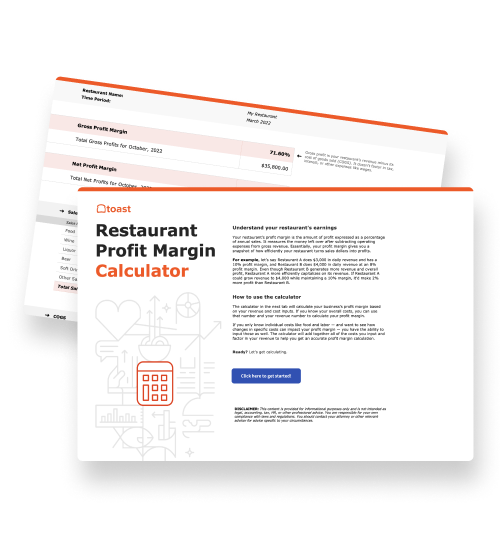
 Calculadora de margen de ganancia para restaurantes
Esta calculadora gratuita de margen de ganancia para restaurantes te ayudará a determinar con qué nivel de eficiencia estás transformando tus ingresos por ventas en ganancias.
Obtener descarga gratis | Creado para restaurantes
You’ve probably heard the claim that the failure rate for restaurants in their first year is 90%. It’s dramatic—but it’s not true. In reality, the average restaurant stays open for more than six years.
We dug into Bureau of Labor Statistics (BLS) data to find out what restaurant survival really looks like, how it’s changed over time, and what factors can influence how long a restaurant lasts.
Key takeaways
The average restaurant stays open for over six years based on survival-weighted analysis.
Restaurant survival rates have remained relatively stable across different decades.
Pandemic-era restaurants performed surprisingly well in early survival metrics.
Key factors influencing lifespan include sanitation, location, and team size.
Calculadora de apertura de restaurantes
Esta calculadora te muestra algunos de los costos financieros más importantes de abrir un restaurante, de modo que puedas empezar a planificar y hacer que tu restaurante soñado cobre vida.

What is the average lifespan for a restaurant?
The average restaurant lifespan is 72.5 months, or just over 6 years. We calculated this using BLS data by tracking how long restaurants from a single year stayed open. This method is called a survival-weighted average, and it gives a more accurate picture than simply measuring how many fail in the first year.
How many restaurants survive long-term?
Using BLS data, we can track how many restaurants from a given year (or “cohort”) stayed open over time. Here’s how survival rates compare across three different cohorts.
Restaurants launched in 2003
To understand how long restaurants typically last, we tracked a full cohort of businesses that opened in 2003 and followed them over time. This gives us a clear picture of long-term survival rates, beyond the often-cited “first-year failure” myth.
80% were still open after 1 year
70% were still open after 2 years
63% were still open after 3 years
54% were still open after 5 years
40% were still open after 10 years
26% were still open after 20 years
Restaurants launched in 2014
To see whether restaurant survival trends have shifted, we also looked at businesses that opened in 2014. Despite being more recent, this cohort shows nearly identical survival rates to 2003—suggesting that restaurant failure rates have remained relatively stable over time.
76% were still open after 2 years
69% were still open after 3 years
58% were still open after 5 years
Restaurants launched in 2020 (pandemic era)
Restaurants that opened in 2020 faced an unprecedented challenge: launching during the COVID-19 pandemic. Despite this, early survival rates are surprisingly strong—suggesting many of these businesses adapted quickly with built-in delivery models, leaner operations, or federal aid.
77% were still open after 2 years
73% were still open after 3 years
66% were still open after 4 years
3 major indicators of restaurant lifespan
While industry-wide trends and data offer helpful benchmarks, individual restaurant outcomes often come down to a few key factors. Research points to three major predictors that significantly impact how long a restaurant is likely to stay open
1. Sanitation and health code violations
According to research from the University of Denver’s Daniels College of Business, health code violations are one of the strongest predictors of restaurant failure. Even during the 2008–2009 recession, fewer than 20% of restaurants in Denver failed, but those with repeated critical health violations were far more likely to close. Dr. H.G. Parsa explained:
“Once restaurants had five to 10 critical violations in health department inspections, they were very likely to fail… It makes sense; because if they are not caring for sanitation, it’s a good indication they’re not on top of their operation in general.”
2. Location
Unsurprisingly, where a restaurant is located plays a huge role in how long it lasts. High-traffic areas with good visibility, parking, and pedestrian flow increase a restaurant’s chances of success.
The same University of Denver study also found that failure rates varied by cuisine and neighborhood, implying that matching your concept to the local market is critical.
3. Size
Restaurant size—particularly team size—is another important indicator of long-term survival. One study found that the median lifespan of a full-service restaurant is about 4.5 years*. That’s slightly longer than the 4.25-year median for other service businesses. However, size made a noticeable difference:
Restaurants with 5 or fewer employees had a median lifespan of just 3.75 years.
In contrast, similarly sized service businesses lasted slightly longer, with a median of 4.0 years.
This suggests that smaller restaurants may be more vulnerable, potentially due to staffing limitations, tighter margins, or less operational bandwidth.
(*Note: This study measured median lifespan—the point at which half of businesses have closed. Our analysis calculated the average lifespan using a survival-weighted approach, which accounts for how long each restaurant stayed open and includes long-term survivors. That pulled the average up to just over 6 years.)
Most restaurants are more than just a flash in the pan
Running a restaurant is never easy, but the data shows a more optimistic picture than many headlines suggest. By staying on top of sanitation, choosing the right location, and building a sustainable operation—especially in the early years—your chances of long-term success go way up. In other words: most restaurants don’t fail right away. And with the right foundation, yours doesn’t have to either!


¿Es útil este artículo?
AVISO LEGAL: Esta información se proporciona solo con fines informativos generales y su publicación no constituye un aval. Toast no garantiza la precisión ni la integridad de la información, el texto, los gráficos, los enlaces y otros elementos que incluye este contenido. Toast no garantiza que alcanzarás ningún resultado específico si sigues los consejos que aparecen aquí. Te recomendamos consultar con un profesional, como un abogado, contador o asesor comercial, para recibir asesoramiento específico para tu situación.
 Tendencias


Suscribirse a On the line
Regístrate para recibir opiniones reales, consejos, herramientas e información específica del sector de la mano de quienes están abordando los desafíos más importantes para los restaurantes.
Al enviar, aceptas recibir correos electrónicos de marketing de Toast. Trataremos tu información de acuerdo con nuestra declaración de privacidad. Información adicional disponible para residentes de California aquí.