
Restaurant Wine Markup: What You Need to Know About Wine Pricing
Understanding restaurant wine markup in 2025: industry standards, pricing strategies, and profit margins for wine programs in bars and restaurants.

Caroline PriceAuthor
 RESOURCE
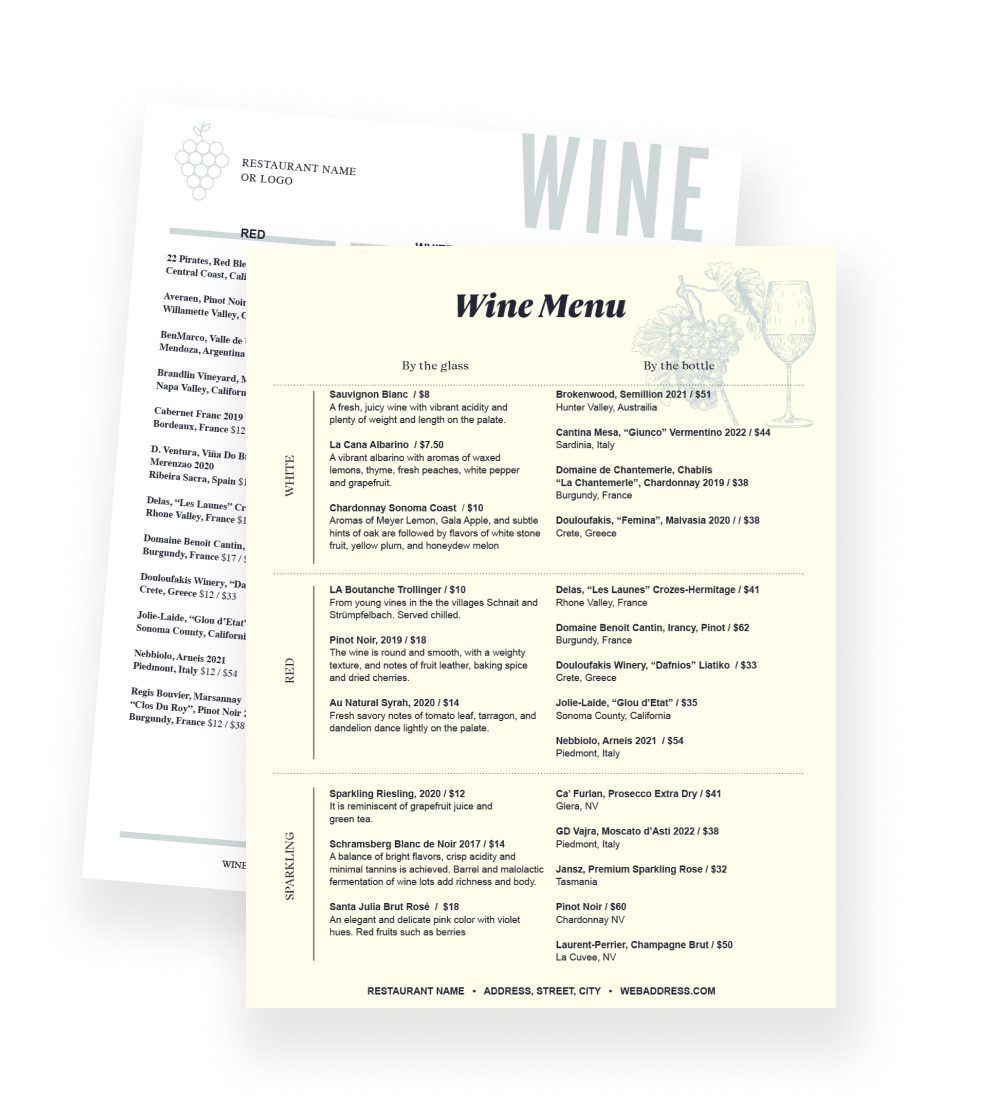
 Wine Menu Templates
Use these wine menu templates as a starting point for your menu design or to give your menu a refresh.
Get Free Download | Built for Restaurants
Restaurant wine pricing frequently draws customer attention, and it's easy to see why. When diners spot a $20 retail bottle priced at $60-80 on the menu, they naturally question the markup. Behind the scenes, however, restaurants depend on these margins to keep their wine programs profitable.
Understanding the economics behind wine pricing helps both restaurateurs optimize their lists and diners appreciate the value proposition. Let’s dive into the why behind restaurant wine markups.
Industry standard wine markups
The industry standard is to mark up a bottle of wine 200-300% over its retail sales price. This means if a high-end wine retails for $20 at a wine store, it typically sells for $60 to $80 at a restaurant. For rare, expensive, or specialty wines, the markups can reach as high as 400%.
Restaurants and bars average a 70% profit margin on wine, making it one of the most profitable categories on the menu. This substantial margin becomes essential when you consider thatthe average restaurant profit margin typically falls between 3-5%, with food costs alone accounting for approximately 28-35% of total revenue.
Wine's high margins help offset the razor-thin profitability of food items and provide the financial cushion restaurants need to remain viable. While a pasta dish might generate only a marginal profit margin after ingredient and labor costs, that same table's wine selection can contribute significantly more to the bottom line.
Why wine markups are necessary
In the restaurant industry, where food and labor expenses each consume roughly 33% of total sales, high-margin beverages such as wine are vital for overall profitability.
The challenging economics of restaurant operations underscore the importance of alcohol sales. Average restaurant profit margins are typically low, and many operators depend on beverage sales to achieve financial stability. A successful wine program can be the deciding factor between a profitable restaurant and one struggling to cover its operating costs.
Unlike cocktails, which demand multiple ingredients and bartender expertise, wine service involves relatively simple labor—opening and pouring. However, restaurants must account for costs associated with:
Proper storage, including temperature-controlled environments
Staff training on wine knowledge and service techniques
Inventory management and potential spoilage
Insurance for valuable wine collections
Glassware and service equipment
Sommelier expertise for higher-end programs
The markup also helps cover the opportunity cost of holding slow-moving inventory and the risk of wines deteriorating before they are sold.
Wine by the glass pricing
Wine by the glass programs follow different pricing strategies. The most basic approach is to price each glass at the wholesale cost of the entire bottle. If a restaurant pays $15 wholesale for a bottle, they'll typically charge $15 per glass.
This pricing model assumes restaurants will pour 4-5 glasses per bottle, generating $60-75 in revenue from a $15 wholesale investment. The average pour cost for wine tends to be much higher than beer, but the absolute profit per bottle often exceeds other beverage categories.
In major metropolitan markets like New York and San Francisco, wine by the glass typically ranges from $8 to $15, with some establishments charging $20-30 per glass for premium bottles.
Graduated markup strategies
Many wine programs use graduated pricing where markup percentages decrease as wine prices increase. This approach makes premium wines more accessible while maintaining healthy margins across the entire list.
A typical graduated markup structure might look like:
Economy wines ($10-20 wholesale): 3-4x markup
Mid-range wines ($20-50 wholesale): 2.5-3x markup
Premium wines ($50+ wholesale): 2-2.5x markup
This strategy recognizes that customers may accept higher percentage markups on affordable wines but become price-sensitive on expensive bottles. The psychological impact is significant—guests may think it's unfair to apply the same margin to a premium wine as an economy wine when the service labor is essentially identical.
Wine Menu Templates
Use these wine menu templates as a starting point for your menu design or to give your menu a refresh.

Strategies for optimizing wine profits
Successful wine programs balance profitability with customer satisfaction through strategic menu engineering. Restaurants can maximize wine profits by:
Strategic placement: Position profitable wines prominently on lists and train servers to recommend high-margin selections during service.
Dynamic pricing: Adjust markups based on demand, seasonality, or special events. Many establishments raise prices slightly during peak periods when customers are less price-sensitive.
Value positioning: Offer a range of price points while emphasizing mid-range wines with healthy margins as the "sweet spot" for most diners.
Glass program optimization: Use by-the-glass offerings to move inventory quickly and introduce customers to bottles they might purchase.
Upselling techniques are also crucial for wine sales, with trained staff able to guide customers toward selections that provide both value and profitability.
The economics of wine storage and service
Wine programs demand substantial upfront investment and ongoing operational costs that justify their markup levels. Restaurants must invest in temperature-controlled storage, proper lighting, and humidity control, all significant capital expenditures that factor into pricing. Beyond infrastructure, staff training represents a continuous cost, as wine knowledge requires ongoing education. Servers need to master varietal characteristics, food pairings, and proper service techniques to deliver the expertise that premium pricing demands.
Meanwhile, inventory carrying costs extend far beyond the initial wine purchase. Restaurants must account for storage space, insurance, and the opportunity cost of capital tied up in slow-moving bottles, expenses that can only be recovered through strategic markup pricing.
The bottom line in wine pricing
Understanding restaurant wine markup helps both operators and customers navigate the complex economics of wine service. While markups may seem high compared to retail prices, they reflect the true cost of providing professional wine service, storage, and expertise that enhance the dining experience.
FAQ
Q: What is the typical markup on restaurant wine?
A: The industry standard is to mark up wine 200-300% over retail sales price, meaning a $20 retail bottle typically costs $60-80 in restaurants.
Q: Why do restaurants mark up wine so much?
A: Restaurants average a 70% profit margin on wine to cover storage costs, staff training, inventory management, and the risk of spoilage while offsetting lower margins on food.
Q: How is wine by the glass priced?
A: Many restaurants price each glass at the wholesale cost of the entire bottle, assuming 4-5 glasses per bottle to generate a 4-5x return on their wholesale investment.
Q: Do expensive wines have the same markup as cheap wines?
A: No, most restaurants use graduated pricing where markup percentages decrease as wine prices increase, making premium wines more accessible while maintaining healthy margins.
Is this article helpful?
DISCLAIMER: This information is provided for general informational purposes only, and publication does not constitute an endorsement. Toast does not warrant the accuracy or completeness of any information, text, graphics, links, or other items contained within this content. Toast does not guarantee you will achieve any specific results if you follow any advice herein. It may be advisable for you to consult with a professional such as a lawyer, accountant, or business advisor for advice specific to your situation.
 Trending

Subscribe to On the line
Sign up to get industry intel, advice, tools, and honest takes from real people tackling their restaurants’ greatest challenges.
By submitting, you agree to receive marketing emails from Toast. We’ll handle your info according to our privacy statement. Additional information for California residents available here.