
Local SEO for Restaurants: Your Complete Guide to Getting Found by Local Diners
Learn how local SEO helps restaurants attract nearby customers, and get 10 actionable tips to boost your local search rankings.

Tessa ZuluagaAuthor
 RESOURCE
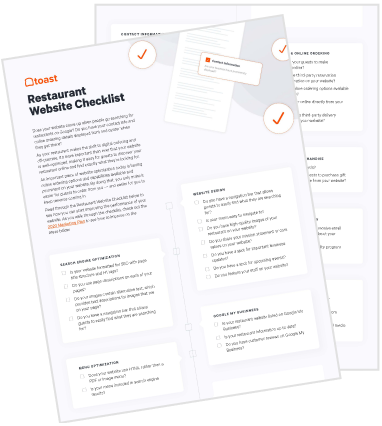
 Restaurant Website Checklist
This template will help you update and optimize your website, so guests can easily find and order from you.
Get Free Download | Built for Restaurants
What is local seo for restaurants?
Local SEO for restaurants is the practice of optimizing your online presence to appear in search results when people look for dining options in your area. It helps your restaurant get found by nearby diners.
When someone in your neighborhood gets a craving for tacos, searches for "best brunch near me," or asks their phone where to grab dinner tonight, you want your restaurant to be the answer. That's where local SEO (search engine optimization) comes in, and it’s more important than ever. According to recent survey data, 55% of diners turn to Google when looking for a place to make a reservation.
In this guide, we'll break down everything you need to know about local SEO for restaurants, from the basics of what it is and why it matters, to practical strategies you can implement today. Whether you're just getting started or looking to refine your existing approach, these insights can help you attract more customers right in your neighborhood.
Let's start with the fundamentals.
What is local SEO for restaurants?
Local SEO is the practice of optimizing your online presence so that your restaurant appears when people search for dining options in your area. Unlike traditional SEO that focuses on reaching a broad audience, local SEO zeroes in on the customers who matter most to your business: the people in your neighborhood and visitors to your city who are ready to eat right now.
However, if you’re looking for a guide on traditional SEO, we have you covered: The Complete Guide to Restaurant SEO Strategy (2025).
Just as you'd invest in an eye-catching sign or inviting entrance for your physical location, local SEO ensures your restaurant stands out in the competitive digital landscape where most dining decisions begin today.
When someone searches for "Italian restaurant downtown" or "pizza delivery near me," local SEO determines whether your restaurant appears in those crucial top results, complete with your address, hours, menu highlights, and glowing reviews. It encompasses everything from your Google Business Profile to your website, online reviews, local directory listings, and how consistently your restaurant's information appears across the web.
Restaurant Competitive Analysis Template
Use this free template to size up your competitors, analyze your market, and identify your restaurant’s strengths, all in one place.

Why your restaurant needs local SEO
To put it simply, your restaurant needs local SEO because your local customers are searching for restaurants near them.
Remember, 55% of diners turn to search engines and online reviews before deciding where to eat. If your restaurant doesn't show up in those searches, you're essentially invisible to a huge portion of potential customers. Your competitors are also investing in local SEO, which means they're capturing the attention of diners who might otherwise walk through your doors.
Local SEO also levels the playing field. Even if you're a small, independent restaurant competing against chains with bigger marketing budgets, a well-optimized local presence can help you outrank larger competitors in your specific area. When someone searches for restaurants in your neighborhood, search engines prioritize relevance and proximity, not just the size of your advertising budget.
Beyond visibility, local SEO builds trust. When potential customers see your restaurant with a robust Google Business Profile, consistent information across platforms, and authentic reviews from real diners, it signals that you're an established, legitimate business worth their time and money.
Why local SEO still matters in an AI-powered world
You might be wondering: with AI chatbots and voice assistants changing how people search for information, does local SEO still matter? The short answer is yes—perhaps more than ever.
AI-powered search tools like ChatGPT, Google's AI Overviews, and voice assistants like Siri and Alexa don't pull their restaurant recommendations from thin air. They rely on the same foundational data that traditional search engines use: your Google Business Profile, website content, reviews, and online presence. When an AI recommends restaurants, it's drawing from the local SEO work you've already done.
However, if your information is inconsistent, outdated, or sparse, you'll be overlooked in favor of restaurants that have invested in their digital presence.
Voice search relies heavily on local SEO signals. Over half of US residents (58.6%) have tried voice search at least once in their lives, according to Yaguara. When someone asks their smart speaker, "Where should I get sushi tonight?", the answer comes from restaurants with optimized local profiles. The better your local SEO, the more likely you are to be the AI's top recommendation.
10 essential tips to optimize your restaurant for local SEO
Ready to boost your restaurant's local search presence? Here are ten strategies that can help you climb the rankings and attract more hungry customers.
1. Claim and perfect your Google Business profile
Your Google Business Profile is the cornerstone of local SEO. If you haven't claimed yours yet, do it immediately. Then, fill out every single field completely: business hours (including special hours for holidays), service areas, attributes like outdoor seating or takeout options, and a detailed business description that naturally incorporates your cuisine type and neighborhood.
It’s also important to upload high-quality photos regularly. Aim for at least 20-30 images showing your food, interior, exterior, and staff. According to Bright Local, “Businesses with photos receive 42% more requests for driving directions to their location from users on Google, and 35% more clicks through to their websites than businesses that don’t have photos.”
2. Master the art of local keywords
When optimizing your website and online profiles, think like your customers. They're not just searching for "restaurant.” They're searching for "farm-to-table restaurant in Brooklyn" or "late-night tacos in Austin." Incorporate location-specific keywords naturally throughout your website, particularly on your homepage, about page, and location pages if you have multiple spots.
Include your neighborhood names, nearby landmarks, and the cities you serve. But keep it natural. Search engines reward content written for humans, not keyword-stuffed pages that read like a phone book.
3. Encourage and respond to reviews
Reviews are pure gold for local SEO. They signal to search engines that your restaurant is active, popular, and trustworthy. A recent Toast study found that Google Reviews is the most popular platform overall, and it is used by 30% of diners to share their restaurant experiences.
Encourage satisfied diners to leave reviews on Google, Yelp, and other platforms by making it easy. Include links in your follow-up emails, on receipts, or via text message after their visit. Over half of diners (52%) say they’re at least somewhat likely to leave feedback when a restaurant directly requests it.
You can also ask for guest feedback using our Free Restaurant Survey Template, and post quotes and testimonials on your website.
Just as importantly, respond to every review, positive or negative. Thank customers for their kind words and address concerns professionally when things go wrong. This engagement shows search engines and potential customers that you care about feedback and are actively managing your online reputation.
Restaurant Review Response Template
Use this free template to easily respond to various types of restaurant reviews: positive, negative, mixed, and those without comments.
4. Ensure NAP consistency across the web
NAP stands for Name, Address, and Phone number, and consistency is crucial. Your restaurant's NAP should be identical everywhere it appears online: Google Business Profile, Facebook, Yelp, your website, TripAdvisor, delivery apps, and any other directory. Even small variations like "Street" versus "St." or including versus omitting a suite number can confuse search engines and weaken your local SEO.
Conduct regular audits to ensure your information is accurate and consistent. If you move locations or change phone numbers, update every listing immediately.
5. Build local citations and directory listings
Citations are mentions of your restaurant on other websites, even when they don't link back to you. The more quality citations you have on reputable directories like Yelp, TripAdvisor, OpenTable, Zomato, and local business directories, the more search engines trust that your restaurant is legitimate and relevant.
Start with the major platforms, then explore niche directories specific to your cuisine type or location. Restaurant-specific platforms and local chamber of commerce directories can be particularly valuable.
6. Optimize for the mobile experience
Mobile search dominates global web traffic and Google searches, with over half of all internet traffic and 63% of US Google searches coming from mobile devices, according to Mage Comp.
Your website must load quickly, be easy to navigate on a small screen, and prominently display your address, phone number, and menu. A "Click to Call" button and integrated directions should be accessible within seconds.
If your website is slow or difficult to use on mobile, potential customers will move on to a competitor before your page even loads. Speed and usability directly impact both user experience and search rankings.
7. Create location-specific content
Blog posts, event announcements, and neighborhood guides demonstrate to search engines that you're an active, engaged part of your local community. Write about local events you're participating in, feature local suppliers or ingredients, and create content that genuinely helps your community discover great food.
This content serves double duty: it improves your SEO while also giving potential customers a sense of your restaurant's personality and values. Make sure it's authentic and valuable, not just content for content's sake.
8. Leverage social media with a local focus
While social media signals don't directly impact search rankings the same way other factors do, an active social presence helps your overall local visibility. In fact, 59% of guests use Facebook the most to discover new restaurants. Use location tags in your posts, engage with local food bloggers and influencers, and share user-generated content from customers.
Encourage customers to tag your location when they post photos of their meals. These tags increase your visibility within your local community and create social proof that your restaurant is worth visiting.
Guide to Restaurant Social Media Marketing
Learn how to optimize your social media presence to showcase your brand, tell your story, attract new customers, and engage with your audience.
9. Implement local schema markup
Schema markup is code added to your website that helps search engines understand your content better. For restaurants, local business schema can highlight your hours, menu, price range, accepted reservations, and more directly in search results.
While implementing schema requires some technical knowledge (or a developer's help), it's worth the investment. Rich snippets, enhanced search results with additional information, can significantly increase click-through rates and set you apart from competitors.
To learn more about what should be included in your restaurant’s website, download our free resource: Restaurant Website Checklist.
10. Get quality backlinks from local sources
When reputable local websites link to your restaurant, it signals to search engines that you're a trusted part of the community. Seek opportunities for backlinks from local news outlets, food bloggers, community event pages, and local business organizations.
Sponsor a local sports team, participate in community events, or host charity fundraisers. These activities often result in natural backlinks while also strengthening your community presence. Quality matters more than quantity; one link from a respected local news site is worth more than dozens from low-quality directories.
Boost your local SEO with Toast
Implementing these local SEO strategies might seem overwhelming, especially when you're already juggling the daily demands of running a restaurant. That's where having the right tools and guidance makes all the difference.
Toast's Websites is specifically designed for restaurants, with built-in features that naturally optimize for local SEO. With mobile-responsive designs, fast loading speeds, menu integration, online ordering capabilities, and automatic optimization for search engines, Toast Websites takes the technical complexity out of building a powerful online presence. You can focus on what you do best, creating amazing dining experiences, while your website works to bring customers through the door.
Whether you're building a website from scratch or looking to improve your existing online presence, Toast provides restaurant-specific tools and expertise to help you succeed in local search and grow your business. Learn more here.
Restaurant Survey Template
Use this template to ask your guests about their experiences in your restaurant. These survey questions will give you the data you need to make informed changes and improve the overall dining experience.


Is this article helpful?
DISCLAIMER: This information is provided for general informational purposes only, and publication does not constitute an endorsement. Toast does not warrant the accuracy or completeness of any information, text, graphics, links, or other items contained within this content. Toast does not guarantee you will achieve any specific results if you follow any advice herein. It may be advisable for you to consult with a professional such as a lawyer, accountant, or business advisor for advice specific to your situation.
 Trending


Subscribe to On the line
Sign up to get industry intel, advice, tools, and honest takes from real people tackling their restaurants’ greatest challenges.
By submitting, you agree to receive marketing emails from Toast. We’ll handle your info according to our privacy statement. Additional information for California residents available here.