
In 2025, restaurant reservations are a bit like a game for restaurant operators. Balancing walk-ins while determining the right amount of reservation slots to offer each night can take some time. But when done correctly, restaurants can fill their seats and turn tables several times throughout service, all while making guests happy.
Toast conducted a blind survey on how, where, and why guests are booking restaurant reservations and what might influence them to increase their booking frequency. This article delves into the data points behind what diners are thinking.
Join us as we explore how these insights impact restaurateurs in 2025.
Quick insights
Guest restaurant reservation booking data
Ready? Let’s dive deeper.
Males are 2x more likely to always make a reservation when compared to women
Only 12% of diners answered that they always make a dinner reservation, and over 50% of diners either never or rarely make a reservation at all. Our hypothesis here is that guests are only sometimes booking reservations (34%) because they only do so for a special occasion. Birthdays, anniversaries, and holidays only happen so many times a year, but when they do it’s important that guests can book at their favorite restaurants.
So who is booking restaurant reservations? Turns out it’s most likely a married man between the ages of 25-45. We found that males are 2x more likely (17%) to always make a reservation compared to women (8%). Specifically, married men make reservations at a very high rate, with 27% vs 16% (for men overall). Shoutout to all the husbands out there planning date night!
When looking at age, guests between the ages of 25-45 were twice as likely to make a reservation when compared to the youngest (18-24) and oldest generations (54+).
65% of diners surveyed go directly to the restaurant’s website and use whatever reservation option they have available
Where are guests going to make restaurant reservations? Of those we polled, 65% of respondents go directly to the restaurant’s website and use whichever reservation option they have available. Needless to say, your website should include a clear, dedicated section for reservations.
Don’t worry, we also have this Restaurant Website Checklist you can use to make sure your site is up to date!
Similarly, your restaurant’s website should be optimized to rank well in Google search results. In fact, 55% of respondents say they turn to Google when looking for a place to make a reservation. That means potential customers are actively searching for restaurants near them. By implementing strong SEO practices, you can not only improve your online presence but also create opportunities to connect with local customers. This is especially important in 2025, as third-party platforms and directories increasingly compete with restaurants for visibility in local search.
It’s no surprise that Google plays a major role in how diners choose where to eat. In another Toast survey, 46% of respondents said they’re most likely to check Google Reviews first when looking up restaurant ratings and reviews.
Overall, if your website has a strong online presence, positive reviews, and a reservation section, you’re likely to bring in new customers. Bonus points if you also accept Apple Pay, emotional baggage, and brunch reservations.
While Google is the go-to spot to search for restaurants to make a reservation at, we see a decline in usage for younger generations. About 63% of respondents ages 54 and older selected Google search as their first choice, declining to 46% for those between the ages of 18-24. This is where we start to see the rise of social media.
After Google, the second most popular source for discovering a restaurant is social media (21%)
Social media isn’t going anywhere anytime soon, especially thanks to the younger generations. Younger respondents (between the ages of 18 and 34) are more likely to use social media (46%) to discover a restaurant compared to older guests (35+). More specifically, women (23%) are more likely than men to find restaurants on social media. Consider targeting women between the ages of 18 and 34 in your social media campaigns. Because, if there’s one thing more powerful than a good meal, it’s a well-lit photo of it.
You don’t need to hire a social media expert to promote open reservations on your social channels. If you see covers are low one week, don’t underestimate the power of posting about reservation availability the day before, or even the day of, on your social account.
Almost half (45%) of reservations Toast observed in Q3 2024 on the Toast Tables platform were made the day of the reservation. It’s never too late to try to get more traffic into your restaurant. Get to posting!
Guests are canceling their reservations 19% less
In 2024, guests were canceling their reservations 19% less often than they did in 2023, a promising shift for restaurant operators. This trend may be driven by the growing number of restaurants implementing cancellation fees, which encourage guests to commit to their plans. It also suggests that diners are becoming more intentional with their bookings.
According to Toast Tables 2024 data, guests are making more reservations on off-peak days
Good news for restaurants trying to bring more guests through their front doors during the front half of the week. Same-store reservations for Monday (+11%), Tuesday (+11%), and Wednesday (+8%), typically slower days for full-service restaurants, were all up in Q3 2024 compared to Q3 2023.
Sunday (+6%), Thursday (+2%), and Friday (+2%) also saw modest increases in reservations compared to last year, while reservations on Saturdays actually dipped 1%. This may suggest a trend that guests are trying to avoid the weekend crowds or are grabbing dinner out after a long workday instead of cooking at home.
Despite the slight dip year-over-year, Saturdays are still the busiest for reservations, accounting for 27% of the total in Q3 2024. Fridays (21%), followed by Sundays (15%), are the next busiest days for reservations. Thursday accounted for 11% of reservations, and Wednesday accounted for 10% in Q3 2024.
Apparently, Mondays and Tuesdays are for pretending we’ll cook at home all week, and by Wednesday, we’ve given up and made a res.
Furthermore, while 6 p.m. and 7 p.m. are the busiest times for reservations, earlier reservations got a bump in Q3 2024 compared to last year. There were approximately 3% more reservations at 4 p.m. and 8% more reservations at 5 p.m. Meanwhile, reservations that occurred at 8 p.m. and after dipped slightly.
Reservations at 6 p.m. in Q3 2024 accounted for approximately 27% of dinner reservations during dinner service, a 6% increase when compared to Q3 2023. Reservations at 7 p.m. only increased by 1% compared to last year but still account for 25% of the reservations during dinner.
How can you get more guests through the door on a Monday at 4 p.m.? This is where restaurant promotions and marketing come into play.
68% of guests are more likely to book a reservation if a restaurant offers a limited-time food special
Alongside your reservation posts, consider promoting food specials on your social media. Approximately 68% of guests are more likely to book a reservation if a restaurant offers a limited-time food special. Limited-time food specials are attractive for all ages, but for different reasons.
About 49% of respondents who are over the age of 54 are most interested in limited-time food specials. They’re less interested in drink specials (20%) and particularly don’t care for prix-fixe menus (12%) or restaurant week (19%).
The second most popular option (44%) is an alcohol promotion such as bottomless drinks, buckets, or pitchers of beer. These deals particularly register with men, as 54% of respondents who chose alcoholic promotions as their top option are male. When considering which alcoholic beverages to promote, take into account that a higher percentage of alcohol drinkers order cocktails (24%) at bars or restaurants than even beer (22%) or wine (20%). Specifically, females most commonly ordered cocktails (33%), while men chose beer (36%).
Toast also recently found that 63% of respondents say they’d be more likely to visit a bar if it offered a happy hour that includes both discounted cocktails and food. For more bar and cocktail-related data, check out this article: Summer 2025 Cocktail Report.
72% of guests will wait up to 30 minutes for a table
Don’t worry, we’re not forgetting walk-ins! POV: your guests are walking into your restaurant on a busy Friday night. Start a timer for 30 minutes, as 72% of respondents told us they’ll wait no more than 30 minutes for a table. Diners between the ages of 45-54 are less likely to wait for a table for over an hour (less than 2%), whereas guests between the ages of 25-35 might consider waiting (11%).
To avoid long wait times, make sure your reservation policy is clearly outlined so guests know how long they have with the table before they arrive. Your host should also avoid seating impartial parties, as steps of service are greatly slowed down. For more table management tips, check out this article, and to turn tables faster, reference this one.
Above all, booking a reservation greatly helps avoid table wait times. If you can convince your guests to book reservations, they’re more likely to get seated on time, enhancing their overall experience. If all your reservation slots are booked, you can then focus on seating walk-ins.
66% of guests might be influenced to wait longer for a table if there’s a comfortable waiting area
Your restaurant is (hopefully) greeting plenty of walk-ins each night. When that waitlist starts getting long, there are ways to help convince your guests to stick around. Around 66% of guests could be influenced to wait longer for a table if there’s a comfortable waiting area. This could include couches, armchairs, or high-top tables. Make sure there is enough space for customers to sit comfortably and that the area is clean.
Another smart move, especially with groups of men, is to offer seats at the bar while they wait. Men are the most likely (58%) to stick around longer if bar seating is available. It's a win-win: your guests stay happy, and your business gets a sale before they've even touched a menu.
Want to sweeten the deal? A whopping 82% of guests say they're more likely to wait longer if you offer a complimentary drink. Overbooked tonight? Just hand out a glass of bubbly and channel Oprah: “You get a drink! And you get a drink!”
Make sure your staff communicates whether the bar cashes the guests out before they’re seated or if the tab gets transferred to the table. To avoid confusion, consider implementing a policy here that’s outlined in your Restaurant Operations Manual.
Lastly, 59% of guests between the ages of 18-34 prefer a mobile waitlist/text message option when waiting for their table. And we also found that 45% of respondents are more likely to dine at a restaurant that offers a waitlist you can join online or via app. A mobile waitlist allows guests to see where they are on the list without having to ask the host.
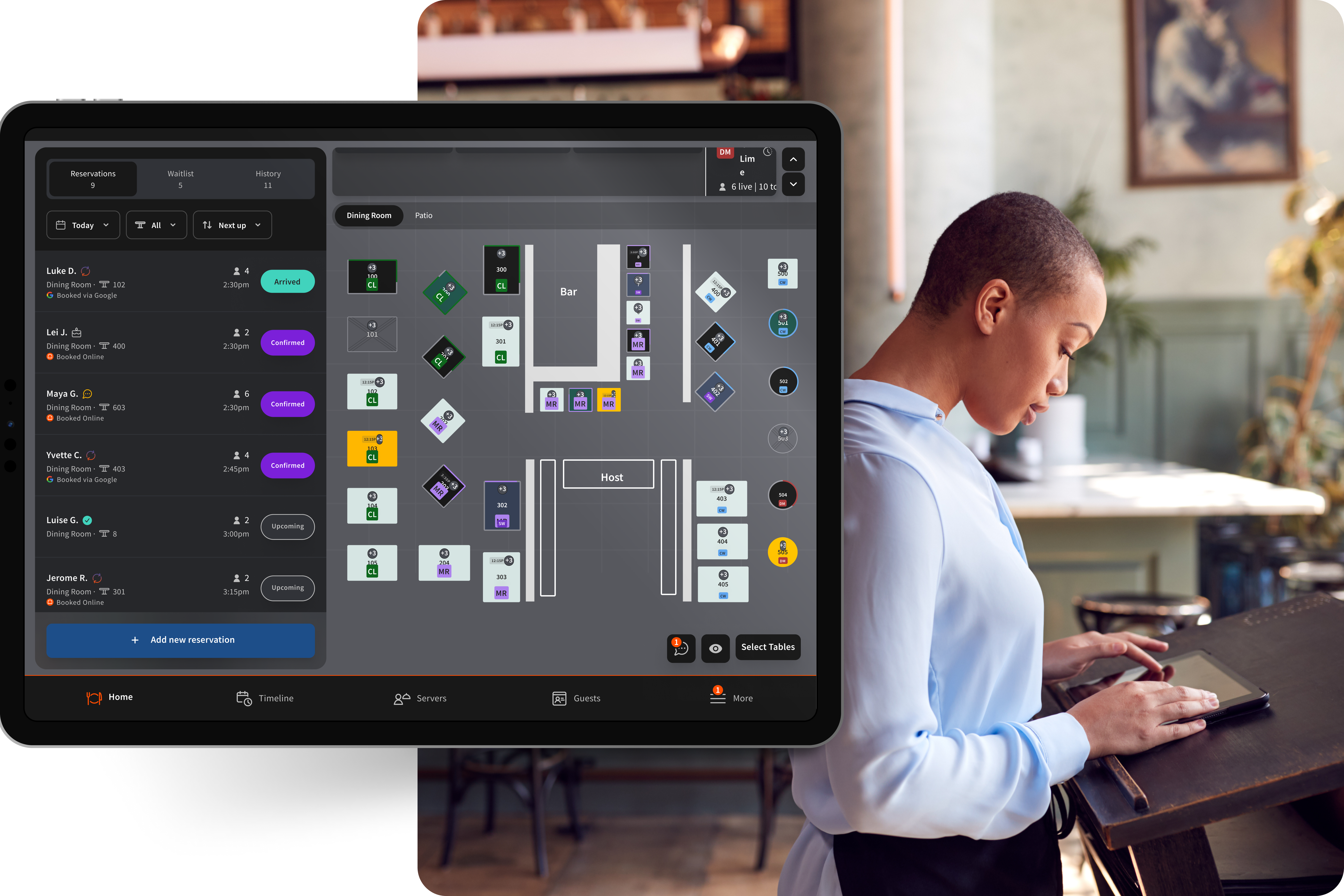
Toast Tables is Toast's integrated waitlist & reservation solution built to enhance hospitality, simplify table management, and keep guests coming back. We’ve all been there, waiting for a table wondering how much longer? Instead, guests can sit at the bar, in their car, or in your waiting area with the comfort of knowing exactly how much longer. A mobile waitlist like Toast Tables makes things simpler for your host while improving the guest experience.
44% of respondents find a restaurant less appealing and get frustrated/stop trying to book when it’s difficult to make a reservation
In some cities, reservations have gotten harder to snag thanks to social media apps like TikTok boosting restaurant popularity. Local spots that once served mostly neighbors are now packed with diners from all over who’d rather battle for a seat than miss out on the vodka pasta they saw go viral. It’s great for business, but frustrating for regulars.
About 44% of survey respondents say they find a restaurant less appealing, and even stop trying to book, when it’s too difficult to get a reservation. This frustration is especially common among women: 48% of female respondents said they’d be turned off by the experience, compared to only 26% who said it would make the restaurant more appealing.
Men are more likely to be persistent. While 38% of male respondents said difficulty booking makes a restaurant less appealing, 41% said they’d keep trying, even seeing the exclusivity as a plus.
To meet customer expectations while still managing demand, consider opening your reservations just a week or two in advance, and clearly communicate when that window opens. For example, if you plan to release new reservation slots every two weeks at 4 p.m., let guests know so they can plan ahead and set reminders.
Speaking of timing, the most popular times guests booked reservations in Q3 2023 were 4 p.m. (11%), 5 p.m. (10%), and 3 p.m. (9%). Many also booked during off-hours, even when full-service restaurants were typically closed, suggesting guests are eager and flexible if it means getting a spot.
Finally, 44% of diners say they prefer to choose their seating type (booth, patio, bar seat, etc.) when booking a reservation. Offering those options can make the experience smoother and more appealing right from the start.
Set your restaurant up for success
By leveraging this information, your restaurant can optimize its reservation and waitlist operations, ultimately fostering stronger customer relationships. Don’t forget that technology is here to help! Check out Toast Tables to help you seat guests efficiently, personalize their experience, and turn first-timers into regulars. Remember, getting sat at a table (or not) is a customer’s first impression of your business. Let’s make their first impression a great one!
Methodology
1Toast conducted a blind survey on this topic of 850 U.S. adults ages 18 and older on March 14, 2024. Respondents were not made aware that Toast was fielding the study. Using a standard margin of error calculation, at a confidence interval of 95%, the margin of error on average is +/- 3 - 5%.
2Toast conducted a blind survey on this topic of 850 U.S. adults ages 18 and older on July 16, 2025. Respondents were not made aware that Toast was fielding the study. Using a standard margin of error calculation, at a confidence interval of 95%, the margin of error on average is +/- 3 - 5%.
3The Restaurant Trends Report, powered by Toast, uncovers key trends across the restaurant industry through aggregated sales data from a selection of cohorts of restaurants on the Toast platform, which has approximately 127,000 locations as of September 30, 2024. This information is provided for general informational purposes only, and publication does not constitute an endorsement. Toast does not warrant the accuracy or completeness of any information, text, graphics, links, or other items contained within this content. Individual results may vary. Toast does not guarantee you will achieve any specific results if you follow any advice herein. It may be advisable for you to consult with a professional, such as a lawyer, accountant, or business advisor, for advice specific to your situation. The Restaurant Trends Report is not indicative of the operational performance of Toast or its reported financial metrics.
SOPs Template
This template will help you create SOPs for your entire business, so you can create consistency and easily train employees.



DISCLAIMER: This information is provided for general informational purposes only, and publication does not constitute an endorsement. Toast does not warrant the accuracy or completeness of any information, text, graphics, links, or other items contained within this content. Toast does not guarantee you will achieve any specific results if you follow any advice herein. It may be advisable for you to consult with a professional such as a lawyer, accountant, or business advisor for advice specific to your situation.
 Trending