
Benchmarking Restaurants: How to Calculate 8 Critical Restaurant Benchmarks
Here are the most important restaurant benchmarks your restaurant should analyze and how you can exceed them.

Tessa ZuluagaAuthor
 RESOURCE
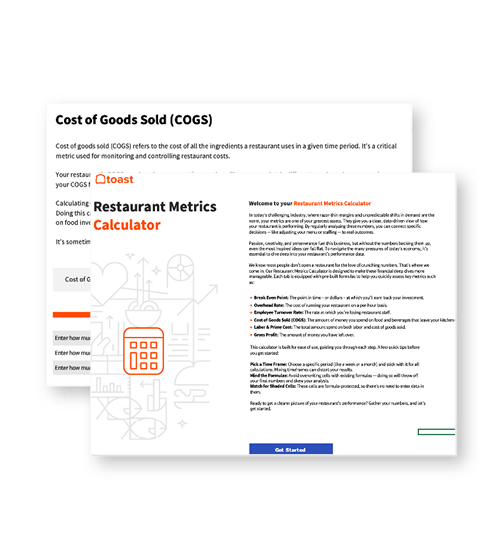
 Restaurant Metrics Calculator
Use this free calculator to calculate the key restaurant metrics needed to understand the health and success of your business.
Get Free Download | Built for Restaurants
Benchmarking is a crucial part of owning and operating a restaurant. Identifying and analyzing key metrics helps you fully understand how your restaurant business is performing. After all, your success stems from having a firm grip on what’s going on in the industry.
Benchmarking is the process of comparing your business to industry averages in key areas like restaurant sales and customer acquisition. This is crucial for making decisions about all restaurant operations.
The concept of benchmarks is not new, but as restaurant technology has advanced, so have the benchmarks and standards in the restaurant industry. Today, the data and technology restaurant owners have at their fingertips allow them to track so much more.
In this guide, we outline the most important restaurant benchmarks and industry averages, why your operation needs to track them, and how to exceed industry averages.
What is Restaurant Benchmarking?
There are 3 types of restaurant benchmarking: front-of-house (FOH), back-of-house (BOH), and general operations. Here’s what each one means for your business:
Front-of-House Benchmarks: Front-of-house restaurant benchmarks focus on guests and revenue. Anything guest-related—total sales, sales per table, table turnover rate, revenue per seat, ticket/basket sizes—comes under this remit. All aspects of your dining room, bar, and waiting areas have benchmarks you can and should track. Your front-of-house benchmarks measure how well you move guests through your restaurant and maximize their value.
Back-of-House Benchmarks: Back-of-house restaurant benchmarks focus on the efficiency of your kitchen, food prep, and inventory. They measure how your kitchen dishes out profits compared to the rest of the industry. Back-of-house benchmarks include food cost percentage and inventory turnover ratio.
General Operations: General operation restaurant benchmarks reflect your overall success, offering a more holistic overview of your restaurant’s health as opposed to focusing on individual restaurant components. General operation benchmarks are the big picture, measuring your restaurant as a whole. Examples of general operation benchmarks include prime cost, profit margin, and sales per square foot.
8 Key Restaurant Benchmarks You Should Measure
Here are the eight most critical restaurant benchmarks you need for FOH, BOH, and general operations.
1. Prime Costs (~55% or Less)
Prime costs are your total cost of labor plus your cost of goods sold (COGS).
Tracking restaurant prime costs can help you successfully increase sales while decreasing costs. Increasing prices may seem like an obvious solution, but this doesn’t necessarily equate to reduced costs and can actually bring more negative impacts on your business (such as loss of loyal customers).
Divide your prime costs by your gross sales and multiply it by 100 to get your prime cost as a percentage of sales.
Restaurants should typically target a 60% prime cost rate, although recently this number has shifted to 55% or lower. This figure will change throughout the year with the seasons.
You should constantly work to lower your prime costs. Setting SMART targets (specific, measurable, attainable, relevant, and time-bound) can help. Once you set a goal, start tracking your COGS and labor costs regularly to stay informed and take action whenever possible.
Monthly tracking is fine. Weekly tracking is better. Real-time tracking is best, and it’s obtainable via restaurant-specific invoice automation software like xtraCHEF.
Identify what needs to be fixed, then redesign your menu to take advantage of high-impact, effective items with lower COGS. This way, you can lower your prime costs regularly and navigate food inflation while increasing your profit.
Restaurant Cost Control Guide
Use this guide to learn more about your restaurant costs, how to track them, and steps you can take to help maximize your profitability.

2. Profit Margin (~3-5%)
How much money is your restaurant actually making? And how much of it is left for you?
A restaurant’s profit margin refers to the amount of profit expressed as a percentage of annual sales. Profit can be calculated using the simple equation of sales minus total costs. When this number is positive, you’re running a successful restaurant.
Restaurant profit margins typically span anywhere from 0-15%, but the average restaurant profit margin usually falls between 3-5%, and this is the figure you should aim for. Use the following formula to accurately calculate the profit margin of your restaurant:
Net Profit Margin = Revenue – All Costs / Revenue
Alternatively, you can use our free Restaurant Profit Margin Calculator to help consistently capture and track your profit margin.
Restaurant Profit Margin Calculator
Use this free Restaurant Profit Margin Calculator to see how efficiently you turn sales dollars into profits.
3. Revenue Per Seat (~$27)
Set up your floor plan to seat as many guests as possible while keeping service efficient and sticking to safety guidelines. Your business makes a certain amount of revenue for every seat filled in your restaurant, making it an ideal metric to measure for a clearer picture of your ongoing performance.
Your restaurant concept, cuisine type, location, and prices will all affect your revenue per seat. The industry average is about $27 per seat, but this number has a massive range and is truly specific to your restaurant. Understanding the cost of each seat in your restaurant will help you know how well your business is performing.
Use the following two equations to calculate the number of seat hours and the total revenue per seat on a given day:
Seat Hours = Total Number of Seats x Hours You’re Open
Revenue Per Seat Per Day = Total Revenue / Seat Hours
For example, let’s say you are open for 6 hours a day and you have 24 seats in your space. Yesterday, you made $1,232 in ticket sales. Your total revenue per seat would be:
24 x 6 = 144
1,232 / 144 = 8.55
In this example, your total revenue per seat would be just $8.55 for that day. Now that you’ve identified this as an area that requires immediate attention, you can work to increase it. If you can consistently raise your revenue per seat, you will consistently increase your profits.
You can implement several strategies to increase your revenue per seat. For instance, effective menu engineering (increasing prices on popular dishes and working with staff to upsell items and make recommendations) can persuade your customers to order items that cost you less to prepare. You can also incorporate specials/promotions and focus on turning tables.
Another reason your revenue per seat may be low is that your seats aren’t consistently filled. Make your restaurant more appealing by offering specials and promotions or investing in social media marketing.
Lastly, work with your staff to turn tables more often and in a more functional way. This is where your host stand also comes into play, as it’s crucial they plan ahead and seat tables in order to maximize the number of guests seated.
Menu Engineering Worksheet
Use this menu engineering worksheet, complete with intricate menu engineering formulas, to determine areas of strength and weakness in your restaurant's menu.
4. Table Turnover Rate (~3 Turns Per Service)
Speaking of turning tables, table turnover rate is another front-of-house benchmark you need to track. This metric refers to how often guests occupy a table during a measured period of time.
The average restaurant turns a table about three times during a single dinner service. This is peculiar because a slow table turnover rate isn’t necessarily a negative thing. Guests voluntarily staying at your restaurant for long periods is a great sign that they are enjoying their experience.
However, once they stop ordering more food and drinks, they become “campers”, taking away opportunities to sit new guests. This benchmark is all about finding that happy medium where guests have a high-quality experience without taking up the table for too long.
To nail that happy medium rate, make sure your host isn’t seating incomplete parties; this adds time to a table that isn’t ready to be sat yet. Also, training your wait staff to guide tables to order at a reasonable pace will help. Lastly, don’t be afraid to kindly drop the check after asking if there’s anything else you can get them.
5. Food Cost Percentage (~28-35%)
The business of dazzling customers while minimizing costs is not an easy one. However, staying on top of your food cost percentage is vital to every restaurant business. A combination of understanding food cost formulas and using technology to control these costs will optimize your ingredient purchases.
You can calculate your food cost percentage by dividing your total food costs by the total food sales in a given period of time. A commendable food cost percentage is typically 28-35%. Of course, every restaurant is different, and finding the ideal percentage for your business is crucial to turning a profit.
Here's how to calculate the ideal food cost percentage for your restaurant:
Ideal Food Cost Percentage = Total Cost Per Dish / Total Sales Per Dish
You can simplify the process of finding your food cost percentage by using cost-tracking tools. These automatically record your inventory and ingredients costs, helping you calculate percentages and profits more easily.
6. Inventory Turnover Ratio (~5)
Another challenge is purchasing a balanced yet varied inventory to supply your restaurant’s needs. Inventory turnover is an important benchmark because it’s easy to accidentally spend too much money on unnecessary inventory.
Understanding how much inventory to order is crucial as demand shifts throughout the year. The higher the inventory turnover during a given period, the healthier the business.
Here’s how to calculate your inventory turnover ratio:
(Beginning Inventory + Ending Inventory) / 2 = Average Inventory
Cost of Goods Sold / Average Inventory = Inventory Turnover Ratio
The average industry rate is around five. However, once again, you need to consider what is best for your specific restaurant and actively work to improve that number.
Boosting your inventory turnover ratio may involve predicting sales based on your restaurant's history, staying informed about inflation, and considering different suppliers. For example, perhaps you can predict that you’ll need to order slightly more takeout boxes in December vs. June, based on takeout/delivery sales from previous years.
Staying up to date with inflation enables you to stay on top of inventory costs and allows you to increase menu prices if necessary. Lastly, finding resources to tackle inflation also enables you to research other possible suppliers that you may be able to strike a deal with to save money.
7. Sales Per Square Foot
Calculating your sales per square foot can help you predict how successful your restaurant may be. This benchmark measures how efficiently your restaurant operations are within the amount of space you own. Here’s how to calculate your restaurant sales per square foot:
Annual Sales / Total Square Feet of Restaurant = Sales Per Square Foot
For full-service restaurants, your target should be at least $150 per square foot. On the other hand, limited-service restaurants should typically aim for $200 per square foot.
Meanwhile, fast-casual restaurants should try targeting a much larger number of up to about $500 per square foot. This is because fast-casual restaurants tend to be smaller in size and overhead costs but larger in foot traffic rates.
Following the modern steps of service will help you optimize your sales per square foot restaurant benchmark.
8. Customer Acquisition Cost
The customer acquisition cost benchmark represents how much you spend on restaurant marketing efforts to bring in new customers.
Most restaurants employ some form of marketing, whether through social media or word-of-mouth, to attract new diners. By measuring the success of your efforts, you can actively identify which strategies are working and whether you need to make adjustments.
Here’s how you can calculate customer acquisition cost:
Customer Acquisition Cost = Marketing Expenses / Total New Customers Acquired
To figure out this metric and set your benchmarks, you must keep a record of the number of new customers you gain. You can do this by asking customers to add their names to orders or to sign up for a loyalty program with their personal details.
How to Track Restaurant Benchmarks
You must establish a reliable benchmarking framework to ensure the continued success of your restaurant. By creating a structure for how you measure your metrics, you can hold yourself to high standards and generate consistently high-quality results.
Here’s how you can track restaurant benchmarks:
Decide which metrics and KPIs (Key Performance Indicators) you want to track.
Think about the standards you want to set. What are your goals for your restaurant? Do you want a certain volume of customers or a certain profit margin?
Explain your goals to your employees and (if relevant) shareholders. They can then adjust their processes to help facilitate these targets.
Track your benchmarks using restaurant technology.
Analyze the data to identify your current performance, then adjust your processes as required.
Once you’ve established a framework like this, you’ll have all the structural elements in place to build a successful restaurant.
Why Implement Restaurant Benchmarking?
There are many reasons why restaurant benchmarking is essential to running a successful business. Here are the core benefits of setting clear benchmarks for your restaurant business:
Identify Areas for Improvement: The most obvious benefit of restaurant benchmarking is being able to identify areas that need improvement. Calculating figures and comparing industry standards lets you understand which metrics and KPIs you need to improve to compete with neighboring establishments.
Optimize Staffing Levels: Labor shortages represent a major challenge for the restaurant industry in the US. By setting clear benchmarks, you can plan for the right amount of staff and optimize your hiring and onboarding processes to align new employees with your goals.
Plan More Efficiently: By setting goals through benchmarks, you can predict outcomes and plan for the future more accurately. You’ll be able to visualize your objectives and clearly outline your processes for the long term.
Draw Accurate Comparisons: Restaurant benchmarking allows you to compare yourself more accurately to your competitors within your industry and location. This helps you understand how your business is performing and whether you need to accommodate any changes.
Improve Sales: Benchmarking lets you see how to optimize costs and customer turnover. Through this, you’ll be able to achieve boosted sales and profits.
Level Up Your Restaurant Operations with Toast
Restaurant benchmarking is the key to sustained success. While it’s possible to manually calculate every metric and figure, it can be significantly time-consuming and tedious.
That’s why we offer much-needed restaurant tools and tech to help you automatically analyze essential restaurant benchmarks and increase profits against relevant industry trends.
Related Restaurant Resources
FAQs
What is benchmarking in the food industry?
Restaurant benchmarks are measures of overall business performance. Benchmarks are typically set by the restaurant operator to reflect industry standards and local competitors. Restaurant benchmarking involves setting attainable goals to improve efficiency, sales, inventory management, and other aspects of your food business.
What is a KPI in the food industry?
A Key Performance Indicator, or KPI, is an aspect of business operations that restaurants can measure and track. Examples of KPIs include sales, profit margins, prime costs, inventory turnover rate, customer acquisition rate, and revenue per seat.
What is a good occupancy cost for a restaurant?
Occupancy costs involve the total money a restaurant pays for its physical premises, such as rent, mortgages, taxes, home insurance, and fees. Your restaurant’s occupancy costs should constitute around 5-10% of your total sales after tax, but this figure naturally varies depending on restaurant size and location. For instance, an inner-city location may be significantly more expensive than somewhere in the suburbs.
Restaurant Competitive Analysis Template
Use this free template to size up your competitors, analyze your market, and identify your restaurant’s strengths, all in one place.
Is this article helpful?
DISCLAIMER: This information is provided for general informational purposes only, and publication does not constitute an endorsement. Toast does not warrant the accuracy or completeness of any information, text, graphics, links, or other items contained within this content. Toast does not guarantee you will achieve any specific results if you follow any advice herein. It may be advisable for you to consult with a professional such as a lawyer, accountant, or business advisor for advice specific to your situation.
 Trending


Subscribe to On the line
Sign up to get industry intel, advice, tools, and honest takes from real people tackling their restaurants’ greatest challenges.
By submitting, you agree to receive marketing emails from Toast. We’ll handle your info according to our privacy statement. Additional information for California residents available here.