How to Calculate Food Cost and Boost Restaurant Profitability
Maximize profitability by consistently calculating and taking control of restaurant food costs.

Justin GuinnAuthor
 RESOURCE
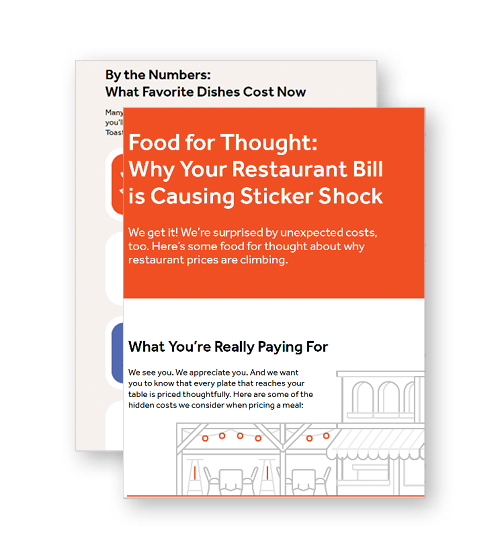
 Restaurant Menu Costing 101 Infographic
From ingredients and labor to rent and insurance, help your guests see what really goes into every dish.
Get Free Download | Built for Restaurants
Key takeaways
Food cost percentage is an important profitability metric. Calculating it regularly helps restaurant operators make smarter, data-backed decisions that reduce waste, optimize pricing, and boost margins.
A healthy food cost percentage typically falls between 28–35%. While 30% is often a solid benchmark, the ideal rate depends on your restaurant type, menu, and operating model.
Accurate calculations require understanding COGS and food sales. Use the standard formula - Food Cost % = (COGS ÷ Food Sales) × 100 - and track inventory closely to maintain precision.
Ideal food cost percentage reveals untapped potential. Compare actual costs to your ideal (waste-free) food cost to identify where money is leaking — whether from poor pricing, portion sizes, or supplier fluctuations.
Menu engineering based on food cost data drives smarter pricing. Cost each dish, monitor price changes, and adjust your menu in real time to highlight high-margin items and rework underperformers.
External factors like inflation and supply chain volatility matter. Ingredient prices are constantly shifting, so proactive monitoring is necessary to stay competitive without overcharging your guests.
Technology streamlines food cost control. Platforms like xtraCHEF by Toast automate invoice processing and track ingredient costs, helping you stay agile and data-informed in a dynamic market.
Successful restaurant businesses strive to deliver great guest experiences while maximizing revenues and minimizing costs — especially when food cost percentages.
Profitable restaurants are able to make informed decisions based on their suppliers’ cost of foods. These informed, data-backed decisions can help operators lower food costs and boost restaurant profit margins.
This of course is easier said than done given the ingredient cost fluctuations across the restaurant supply chain.
It's critical that restaurant owners, operators, and managers consistently track food cost percentages and the right mix of technology to streamline operations, take control of costs, and lay the groundwork for optimizing restaurant profits.
In this article, you will learn how to understand the numbers behind the food cost percentage formula, how to calculate food cost percentage manually, and how to realize the benefits of automated restaurant food cost control platforms tied to your restaurant point of sale system.
How to calculate food cost?
Restaurants can calculate food costs by recording all the ingredient and product costs required over a given period of time to generate food sales over that same time.
What are restaurant food costs?
Restaurant food costs are a major part of overall operating costs — with labor costs being the other component.
The combination of food costs and labor costs is known as your prime costs operating expenses. This is a variable costs as opposed to your fixed costs, which include rent or mortgages, insurance, and other such costs.
Restaurant food cost percentages help operators to track overall costs and individual ingredient prices — just like Toast's ingredient price series does with egg prices, chicken wing prices, avocado prices, and more.
Monitoring restaurant ingredient cost price changes can empower operators to make data-driven decisions for optimized spending that promotes low food costs and helps boost profit margins.
Let’s say that Josephine runs a successful restaurant that serves 350 customers per day. If she doesn’t pay attention to her food costs, and her menu items are incorrectly priced by $0.75, Josephine could lose nearly $100,000 in revenue per year.
(350 customers x 365 days in a year) x $0.75
127,750 customers per year x $0.75 = $95,812.50
Even seemingly subtle pocket change can quickly add up — and that's only the case if your costs are nearly locked in. If you have tons of room to slice away food costs, the savings could be a major boost to your bottom line.
Calculating food cost percentage and cost of goods sold or (COGS) down to granular levels can unlock key metrics and insights.
Recipe costing can show you your profit margins on individual portion sizes for your recipe.
And if you take it further by calculating plate costs, you can combine recipe portions to uncover the exact impacts of each menu item.
For example, Underbelly Hospitality was able to cut about three percent off of food costs across their operation — with the help of xtraCHEF by Toast — equating to over $300,000 in annualized savings.
What is the formula for food cost percentage for restaurants?
The formula for how to calculate restaurant food cost percentage is (Total cost of goods sold / Total food sales) x 100 = Total food cost percentage for a period of time.
How to calculate restaurant food cost percentage?
Here’s the formula for how to calculate restaurant food cost percentage:
Total food cost percentage for a period of time = (total cost of goods sold / total food sales) x 100
Calculating and thinking about food costs in terms of a percentage of total revenue from food sales provides valuable context that can help make the calculations more actionable.
For example, a $5,000 per month food cost doesn’t mean much on its own. If that $5,000 generated $6,000 in food sales, then that’s a dangerously high 83% food cost percentage.
However, if that $5,000 generated $15,000 in food sales, then that’s a much favorable 33% food cost percentage.
This added context is why so many restaurant operators wonder how to calculate restaurant food cost percentages.
Benefits of calculating restaurant food cost percentage
Here are three specific benefits to calculating restaurant food cost percentage.
1. Spend and earn smarter
By pricing each menu item based on food cost percentage and COGS, you can check that each menu item fits within your food cost margins. From there, you can optimize your menu design to feature your most profitable menu items while demoting or entirely remove other food items.
2. Efficiently engineer your menu
With real time food cost percentage data integrated in your restaurant POS system, you can update menu items that are no longer profitable. Menu engineering based on food cost percentage will give you the insights you need to implement a favorable menu pricing strategy as well as design weekly or seasonal specials that deliver a nice profit margin.
3. Better understand how the food supply chain impacts costs and profitability across the foodservice industry
The restaurant supply chain can be full of turbulence. Keeping an eye on farming trends and even international trade negotiations can be an important part of understanding and managing inventory costs. For example, avocado prices spiked 58% in July 2023. Having some sort of food cost calculator to monitor such fluctuations can be essential to mitigate against the supply chain turbulence.
Menu Engineering Worksheet
Use this menu engineering worksheet, complete with intricate menu engineering formulas, to determine areas of strength and weakness in your restaurant's menu.

How can restaurants control food costs?
Food prices continue to rise in 2025, but even more rapidly than in past years. According to Toast’s Menu Price Monitor, common menu items still show year-over-year increases. Regular coffee is up 6.4% to $3.50, burgers rose 3.1% to $14.31, and wings increased 3.2% to $13.67.
While inflation remains a factor, month-over-month price changes are starting to level off. That shows restaurants are finding ways to manage costs without relying only on sudden price hikes.
In 2025, operators are using more targeted strategies: adjusting prices selectively, streamlining menus, and switching suppliers to keep ingredient costs in check.
One standout trend? Breakfast is booming. Omelet prices are up 5.4% year over year, with Monday morning traffic rising 7% and breakfast delivery orders up 15%.
Ongoing supply chain issues, like egg shortages caused by avian flu, have changed costs. They’re also shifting when and how guests choose to dine.


Restaurant Operator Insights Report
See insights from real restaurant operators which can help you benchmark your current and planned restaurant technology stack against your peers as we head into 2024 and beyond.
Understanding what goes into your restaurant food cost percentage formula
Food cost percentage is calculated by taking the cost of goods sold (or COGS) and dividing that by the revenue or sales generated from that finished dish.
Total food cost percentage = (total cost of goods sold / total food sales) x 100
COGS is the amount of money you’ve spent on ingredients and inventory in a given period — we’ll show you how to calculate that, too.
It’s nice to know if individual menu items and portion sizes are profitable or not, as we’ll explain below. But it’s critical to know if your entire business is on track for success.
To start, look at your weekly inventory.
1. List all the food supplies you received at the start of the week
Many inventory management systems work on tablets or handheld devices, so you can walk around the back of house checking off items like you would on a clipboard.
2. Add together the dollar value of each item
How much did you pay for each box of chicken in your back of house?
3. Track your purchases
Were there any other purchases that you made within the week, after beginning inventory?
4. Take inventory again at the beginning of next week
Follow the same process. Many recommend a shelf-to-sheet system, where your inventory tracking system is set up like your back-of-house is.
5. Add together total food sales per shift
Many POS systems with restaurant analytics can provide you with this information automatically.
6. Calculate actual food cost for the week using the following food cost percentage formula:
Food Cost Percentage = (Beginning Inventory + Purchases – Ending Inventory) ÷ Food Sales
Check out the example below to see this food cost percentage formula in action:
Beginning inventory value = $15,000
Purchases = $4,000
Ending inventory value = $16,000
Food Sales = $10,000
Food Cost Percentage = (15,000 + 4,000 – 16,000) ÷ 10,000
Food Cost Percentage = 3,000 ÷ 10,000
Food Cost Percentage = 0.30 or 30%
Quick Tip: Is your cost dramatically high or low? Double check your food cost percentage formula to make sure you’ve counted each item correctly, entered the right unit, and accounted for each purchasing invoice.
Is 30% food cost good for restaurants?
Yes, 30% food costs can be good for most restaurants — however, optimizing food costs is an ongoing practice that must be constantly in motion to accurately calculate and adjust costs so that 30% food costs today must be fought for to at least maintain if not lower a year from now.
The National Restaurant Association reports that the average food cost percentage for U.S. restaurants ranges between 28 % and 35 % of total revenue, depending on the type of establishment.
Anjali Goyal
Content Specialist at Restroworks
Restaurant Competitive Analysis Template
Use this free template to size up your competitors, analyze your market, and identify your restaurant’s strengths, all in one place.
Determining your ideal food cost based on strategic menu prices
A typical food cost percentage benchmark is 28-32% in many full-service, quick-service, and fast food restaurants.
Of course, there is no exact “good” percentage — it varies depending on the type of food served and costs of operating the restaurant. To figure out what percentage is the best for your restaurant, you’ll need to calculate your ideal food cost percentage.
Restaurateurs can optimize their restaurant costs by calculating their ideal food cost. Ideal food cost tells restaurant operators what their optimal food cost rate should be based on total food costs and total sales — removing waste, discounts and comps, and other factors that increase restaurant COGS.
Calculating your restaurant's ideal food cost percentage
Here's how to calculate the ideal food cost percentage for your restaurant:
Ideal Food Cost Percentage = Total Cost Per Dish ÷ Total Sales Per Dish
For this percentage to be the most helpful, you need something to compare it to — and ensure that your restaurant is on track.
You can do so by comparing your actual food cost with your ideal food cost. In an ideal world, there would be no food waste or theft in your restaurant.
The calculation for ideal food cost percentage doesn’t take into account your beginning and ending inventories. Instead, it accounts for the total costs and sales associated with each dish or menu item.
First, we have you enter the type of concept you run and in what area. Then, it shares the five most popular items (and their price breakdown) on similar restaurant menus in your area. Then, you’ll be able to dive into these menu items to calculate each item’s food cost, the cost per pound and/or cost per cup for each ingredient.
You can also use the tool to create custom menu items and determine the ideal price for them. So play around with it and start brainstorming on how you can improve your food cost percentage.
How to calculate food cost per portion size (or food cost per menu item)
Here’s the formula for calculating restaurant food costs per dish:
Food cost per dish = Food cost of ingredients per portion x Weekly amount sold
Total sales per dish = Selling price x Weekly amount sold
Now that you’ve calculated your food cost per dish, here’s the formula for calculating ideal food cost percentage:
Ideal food cost percentage = Total cost per dish ÷ Total sales per dish
Here’s the ideal food cost percentage formula in action:
Total cost per dish = $2,500
Total sales per dish = $10,000
Ideal food cost percentage = 2,500 ÷ 10,000
Ideal food cost percentage = 0.25 or 25%
The ideal food cost percentage comes out to 25% and the actual food cost percentage comes out to 30%, in the examples shared above.
Now we know there’s an extra 5%, either due to waste, theft, or additional purchasing. Ultimately, you want your actual food cost to match or even be below your ideal food cost.
Restaurant Cost Control Guide
Use this guide to learn more about your restaurant costs, how to track them, and steps you can take to help maximize your profitability.
How to price your menu with food cost percentage in mind
Your menu prices need to meet the needs of your bottom line but also the needs of your target market.
Here's a formula you can use:
Find plate cost by conducting recipe costing and then adding up the portion costs for each recipe that makes up the dish.
Divide this by a target food cost percentage. You can choose what this percentage should be and move it around as you wish.
Keep menu prices simple and round up or down.
When you’re pricing your menu, you should also consider your local market. If demand is high for a particular menu item in your area, you may want to sell it for more or less, depending on what the market can bear.
You’ll also want to consider labor costs, rent, overhead costs, and more when pricing your menu.
Menu Engineering Course
Take this course to make the most of your menu. Learn about menu psychology and design, managing your menu online, and adapting your menu to increase sales.
How xtraCHEF by Toast can help you stop getting cooked by costs
COGS is a great high-level, actionable measure for your food costs, though restaurants may benefit from a more precise, detailed overview of their spending.
Even with our formulas and synopsis above, manually tracking restaurant food costs has typically been time-consuming and error prone.
Food cost control comes down to tracking supplier price fluctuations, which means capturing product prices, units of measure, and other critical details from all your invoices — that's where xtraCHEF by Toast comes into the picture.
xtraCHEF can help take the tedious work of invoice processing off your plate. With automated invoice processing, you can simply snap, scan, and upload your invoices. The platform extracts all the critical line-item details, passing along important information into your accounting system while diving into individual ingredient costs within xtraCHEF.
You can use this clean, consistent data on product prices to start making more informed decisions.
With precise recipe costs that update with each new vendor order, you can ensure your food costs and menu prices work together to achieve your target profitability.
Schedule a demo to speak with a product specialist today about the potential benefits of Toast and xtraCHEF for your operation.
 TOAST TECH
 Built for restaurants just like yours.
Toast’s restaurant technology includes point of sale, kitchen display screens, online ordering, loyalty, analytics, payroll, and more.
Is this article helpful?
DISCLAIMER: This information is provided for general informational purposes only, and publication does not constitute an endorsement. Toast does not warrant the accuracy or completeness of any information, text, graphics, links, or other items contained within this content. Toast does not guarantee you will achieve any specific results if you follow any advice herein. It may be advisable for you to consult with a professional such as a lawyer, accountant, or business advisor for advice specific to your situation.
 Trending

Subscribe to On the line
Sign up to get industry intel, advice, tools, and honest takes from real people tackling their restaurants’ greatest challenges.
By submitting, you agree to receive marketing emails from Toast. We’ll handle your info according to our privacy statement. Additional information for California residents available here.