
Retail Marketing Strategy: 8 Steps for Building a Cohesive Plan in 2025
Without a clear strategy, even the best marketing ideas can fall flat. Follow these tips to build a cohesive retail marketing strategy that works.
Aiden ToborAuthor
 RESOURCE
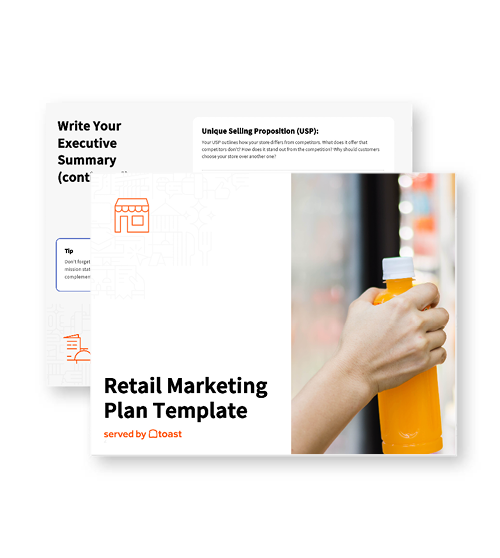
 Retail Marketing Plan
Create a marketing plan that'll drive repeat business with this customizable marketing playbook template and interactive calendar.
Get Free Download | Built for Restaurants
You’ve brainstormed marketing ideas, planned seasonal promotions, and maybe even pulled a few creative stunts to get customers through the door. But knowing what to do is only half the battle.
To really make your marketing work, you need more than a collection of good ideas—you need a cohesive strategy. That means aligning your promotions, channels, messaging, and brand experience so they all support the same goals and speak to the same audience.
In this guide, we’ll walk through how to build a retail marketing strategy that ties everything together—from digital presence to loyalty programs—so your efforts don’t just spark attention, but build lasting customer relationships.
Key takeaways
Know your audience inside and out by defining clear customer segments and using data to refine your approach.
Build a brand that resonates across every touchpoint—from signage to social media—to create a memorable, unified identity.
Connect your channels with a consistent multi channel presence that bridges in-store and online experiences.
Use promotions and loyalty programs intentionally to drive repeat business, not just one-off sales.
Track performance and adapt by measuring what works and fine-tuning your strategy based on real data and feedback.
Retail Marketing Plan
Create a marketing plan that'll drive repeat business with this customizable marketing playbook template and interactive calendar.

1. Understand your target market
Before you can build a strong retail marketing strategy, you need to know who you’re marketing to. Your target market isn’t just a vague idea of “anyone who shops”—it’s a specific group of people who are most likely to buy from you, and who you want to attract again and again. Start by defining your ideal customer. This includes both:
Demographics: age, income level, gender, location, etc.
Psychographics: values, lifestyle, shopping behavior, brand affinities, and interests
For example, in grocery retail, Aldi and Whole Foods cater to very different audiences. Aldi focuses on budget-conscious shoppers and private-label products, while Whole Foods appeals to health-conscious consumers with higher incomes. As customer experience expert Shep Hyken explained in Forbes:
“Twenty percent of Whole Foods visits took place in California, more than double the percentage of any other state. Compared to typical shoppers, Whole Foods customers make more money, as they are 154% more likely to earn more than $200,000. They love to exercise and embrace what is termed ‘athleisure,’ as 62% are more likely to visit stores like Lululemon. Sixty-seven percent are more likely to spend time outdoors.”
Once you have a general profile, use data to validate and refine it. Loyalty programs and POS systems often hold valuable insights into purchasing patterns and customer frequency. For digital-first insights, tools like Google Analytics and Meta Ads Manager can help you understand where your traffic is coming from and what drives conversions.
2. Create a strong brand identity
Once you know who you’re speaking to, make sure your brand speaks their language. Your brand identity is more than your logo—it’s the full experience customers have when they interact with your store, whether online or in person. As Danielle Wiley, CEO of Sway Group, puts it:
“I hope that other brands see this move by Nike and realize that all the performance marketing in the world won’t do a thing without awareness and branding. Regardless of how hot D2C marketing is, the basic rules of the sales funnel still remain. Most people won’t buy anything without six to eight previous exposures to the brand.”
Your brand identity should stay consistent across:
Visual elements: colors, signage, product packaging, and website design
Tone and voice: how you write and speak on social media, in ads, and in-store
Core values: what your brand stands for and how that’s reflected in your customer experience
In short: branding isn’t about being everything to everyone—it’s about being exactly right for the people you most want to reach.
3. Build a multichannel presence
Today’s shoppers move fluidly between physical and digital spaces—your retail marketing strategy should too. Building a multichannel presence means creating a seamless experience that connects your brick-and-mortar store with your online platforms. Start with the essentials:
A mobile-friendly website with basic info like hours, location, and product highlights
Social media accounts that reflect your store’s personality and engage your community
Local listings (Google Business Profile, Yelp, etc.) to boost your visibility in nearby searches
From there, improve convenience by offering tools like online ordering, appointment scheduling, or digital catalogs—especially if you sell food, health products, or personal services. These additions not only streamline the customer journey but also capture data you can use for targeted marketing later. As Todd Lebo, CEO of Ascend2, puts it:
“Maintaining consistent brand messaging across channels is crucial for building a unified brand identity, which enhances customer recognition and trust... Data quality is the most essential attribute of a successful multichannel marketing strategy. It might not be glamorous or exciting, but improving the quality of your data is essential for the success of your multichannel strategy.”
The key is consistency. Whether someone is browsing your Instagram, checking your hours on Google, or walking into your store, they should encounter the same brand voice, visual identity, and tone. A unified presence builds trust and makes your brand more memorable—no matter where customers find you.
4. Use promotions and loyalty programs strategically
Discounts and deals can drive traffic—but only when they’re deployed with intention. Strategic promotions help you meet short-term goals (like clearing seasonal stock) while reinforcing long-term loyalty. Here are a few smart ways to use them:
Limited-time offers and seasonal sales create urgency and keep your calendar fresh.
Loyalty programs reward repeat customers with points, discounts, or exclusive access—the best POS systems offer built-in loyalty features that track and reward behavior
Bundle deals (e.g., buy one, get one 50% off) can increase average order value, while cross-promotions with neighboring businesses can introduce your store to new audiences
The goal isn’t to train customers to only buy on sale—it’s to make them feel like they’re getting value, being recognized, and staying connected to a brand they enjoy. The right offer, at the right time, can bring them back again and again.
5. Leverage local marketing
National ad campaigns are great—but for most retailers, it’s your immediate community that matters most. Local marketing helps you connect with nearby shoppers, build name recognition, and drive consistent foot traffic. Start with local SEO:
Claim and optimize your Google Business Profile with up-to-date hours, photos, and links
Encourage happy customers to leave reviews on Google, Yelp, and niche platforms
Use location-based keywords on your website (e.g., “gift shop in Fishtown” or “best Philly convenience store”)
Then get out into the neighborhood. Community events, small business fairs, school sponsorships, and flyer/poster placements in high-traffic areas can all reinforce your presence. These offline efforts signal that you're part of the local fabric—not just another storefront.
And don’t forget digital tools: geo targeted social ads can help you reach potential customers within a few miles of your location, often for less than broad campaigns. You can also run promos tied to local holidays, sports games, or festivals to stay timely and relevant.
6. Invest in visual merchandising
How your store looks isn’t just a matter of aesthetics—it’s a core part of your marketing strategy. Visual merchandising turns your layout, signage, and displays into silent salespeople that guide, entice, and inspire shoppers. According to Taylor Foxman, founder of The Industry Collective, good merchandising is essential for standing out:
“People often buy what’s literally and metaphorically right in front of them, so the positioning of the product on the actual shelf can be just as important as the look and price.”
This is especially true in competitive categories like ready-to-drink beverages, where packaging design, shelf placement, and display strategy can make or break a sale. Brands like Tip Top have adapted by shifting toward trial-friendly displays and compact multipacks, helping convert casual shoppers into loyal customers. A few foundational elements of strong visual merchandising include:
Store layout that creates flow and directs attention to key areas
Signage and displays that communicate deals, tell brand stories, or introduce new products
Window displays that grab attention and invite passersby in
Look for opportunities to create Instagrammable moments—a neon quote wall or quirky product installation can encourage customers to share their experience online. Also, keep things fresh with seasonal refreshes. Even small updates—like rotating signage or themed product groupings—can keep regulars engaged and show newcomers you’re active.
7. Collect and act on customer feedback
The best way to improve your retail marketing strategy? Ask the people who experience it. Customer feedback offers direct insight into what’s working, what’s missing, and how you can better meet your shoppers’ needs. Start by gathering feedback through multiple channels:
Quick surveys (in-store or emailed after purchase)
Online reviews
Everyday conversations at checkout or via social DMs
But don’t just collect feedback—show that you’re listening. If several customers mention your store hours are inconvenient, consider testing an adjustment. If people ask for specific product lines, experiment with a small batch and gauge interest.
8. Measure and optimize performance
Marketing isn’t a one-and-done effort—it’s a process of testing, measuring, and improving. To get the most out of your retail strategy, track key performance metrics regularly and use them to guide your decisions. Some of the most useful metrics include:
Foot traffic: How many people enter your store and when
Conversion rate: What percentage of visitors make a purchase
Average transaction value: How much each customer spends per visit
Use your POS and marketing platforms to generate performance reports and identify patterns. Then test new strategies through A/B experiments—like two versions of a window sign, two types of email subject lines, or different promo formats—to see what drives results.
Over time, small refinements based on real data can lead to major improvements in customer engagement, sales, and brand loyalty.
Ring everything up with a cohesive retail marketing strategy
No single marketing tactic will transform your business on its own—but when combined thoughtfully, each piece of your retail strategy reinforces the others. The key is cohesion. When your marketing channels, messaging, and customer experience all work in sync, you can grow a retail business rooted in trust, loyalty, and long-term sustainability.
So as you shape your strategy, don’t just check off boxes—look for ways to make every element support the bigger picture!
Press Kit Template
Use this customizable template to craft a polished one-pager that showcases your business’s key details. It condenses essential information into a concise, visually appealing format that’s quick to read and easy to share.
Is this article helpful?
DISCLAIMER: This information is provided for general informational purposes only, and publication does not constitute an endorsement. Toast does not warrant the accuracy or completeness of any information, text, graphics, links, or other items contained within this content. Toast does not guarantee you will achieve any specific results if you follow any advice herein. It may be advisable for you to consult with a professional such as a lawyer, accountant, or business advisor for advice specific to your situation.
 Trending


Subscribe to On the line
Sign up to get industry intel, advice, tools, and honest takes from real people tackling their restaurants’ greatest challenges.
By submitting, you agree to receive marketing emails from Toast. We’ll handle your info according to our privacy statement. Additional information for California residents available here.