
How Diners Really Feel About Sustainability in Restaurants in 2025 [Survey data]
Find out which sustainable practices are enticing today’s diners with data from our 2025 study.

Tessa ZuluagaAuthor

Kate BennettProgram Sustainability & ESG Manager at Toast
 RESOURCE
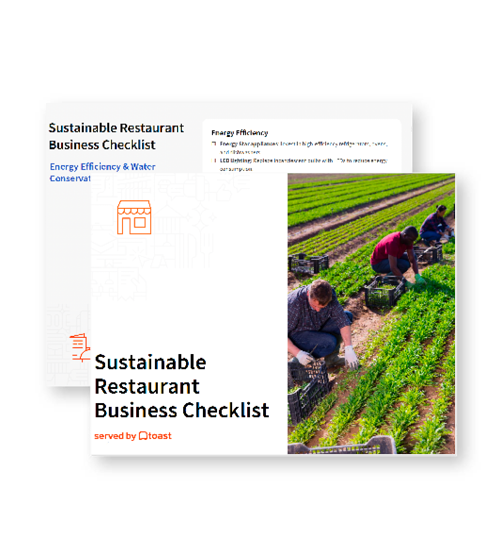
 Sustainable Restaurant Business Checklist
Use this free checklist to help your restaurant run efficiently while minimizing its environmental impact.
Get Free Download | Built for Restaurants
A great dining experience isn’t just about food anymore. It’s about impact. Diners are no longer just looking at what’s on the plate, but at where it came from, how it was made, and what happens to it after they leave. In 2025, sustainability isn’t just a bonus, but a deciding factor in where people choose to eat.
So what does this really mean for restaurants? Which sustainability efforts matter most to diners, and how can restaurants adapt to these shifting expectations?
To find out, Toast conducted a blind survey to understand how guests truly feel about sustainability in the restaurant industry. This article breaks down the data, revealing what today’s diners expect and how restaurants can meet the growing demand for greener dining experiences.
Key takeaways:
73% of respondents consider a restaurant’s approach to sustainability an important factor when deciding where to eat.
Sustainability is particularly important to younger diners, as 41% of respondents in their 20s marked it as “very important”.
44% of respondents are most encouraged to visit a restaurant if it uses locally sourced ingredients.
72% of respondents are willing to pay more at a restaurant that prioritizes sustainability, with 18% saying they’d pay 6-10% more.
44% of respondents prefer to learn about a restaurant's sustainability efforts through information on the menu.
40% of respondents are more likely to engage with a restaurant’s sustainability initiatives if rewarded through a loyalty program.
For over 39% of respondents, the biggest barrier to making more sustainable dining choices is the higher cost.
2025 restaurant sustainability insights
Let’s dive in.
Sustainability’s impact: 73% of diners consider sustainability a key factor
For today’s diners, sustainability isn’t just a passing concern, it’s a core value. Nearly three out of four guests (73%) now factor sustainability into their restaurant choices, and for younger generations, it’s even more critical. A whopping 41% of diners in their 20s say that sustainability is ‘very important’ when deciding where to eat.
For restaurants aiming to capture the attention (and loyalty) of Gen Z and younger millennials, showcasing green initiatives is a smart move. Check out our guide on 6 Types of Sustainable Technology That Help Restaurants Reduce Paper and Food Waste for more information.
One of the biggest draws respondents cited for restaurant sustainability is locally sourced ingredients. Nearly 44% of diners say they’re most encouraged to visit a restaurant that prioritizes local sourcing. This underscores the value of farm-to-table offerings and partnerships with nearby producers.
72% of consumers are willing to pay more at sustainable restaurants
Diners aren’t just prioritizing sustainability, but they’re also willing to pay more for it. About 72% of respondents said they’d pay extra at restaurants that emphasize sustainable practices. Among those, 18% would pay an additional 6-10% for a meal that aligns with their eco-friendly values.
This willingness to spend more is particularly strong among younger diners. Over 86% of respondents in their 20s expressed a willingness to pay extra for sustainable dining options. This demographic is leading the charge in supporting restaurants that prioritize sustainability, so maybe you should lead the charge in Gen Z marketing.
How diners want to learn about sustainability efforts
Let’s set the scene: You’re a restaurant operator committed to making your business more sustainable. You’ve put in the work from sourcing local ingredients, reducing food waste, to maybe even composting, but no one seems to notice. Then, you find out that diners want to support sustainable restaurants and are even willing to pay more at restaurants like yours. The problem? They don’t know about your efforts.
So, how do you change that?
Turns out, 44% of respondents prefer to learn about a restaurant’s sustainability efforts through information on the menu. Whether they’re a first-time guest or a loyal regular, clear menu callouts will ensure that they see your commitment in action.
Beyond the menu, 41% prefer to see sustainability initiatives highlighted on a restaurant’s website or social media. Be a squeaky wheel! Share your efforts online, highlight local partnerships, and encourage guests to support an eco-conscious business. The more you share, the more impact you can make.
Use these guides to your advantage: the restaurant social media guide and the website guide.
What matters most in restaurant sustainability?
About 36% of respondents cited environmental impact, such as carbon footprint and waste reduction, as their biggest concern. As climate consciousness grows, restaurant operators have an opportunity to align with these values by adopting greener practices.
Looking for one simple yet impactful step? Try rethinking takeout packaging. More than half of diners (53%) are happy to skip plastic utensils and napkins with their orders, signaling a shift toward waste-conscious dining habits. By making these items optional, restaurants can reduce waste and cut some costs. These sustainability efforts aren’t just good for the planet, they’re good for business.
Incentives and barriers affecting sustainable choices
Diners are open to making more sustainable choices, but sometimes they need a little nudge. Offering incentives can be a game-changer in encouraging eco-friendly habits.
Loyalty rewards are a strong motivator, with 40% of respondents saying they’d be more likely to engage with a restaurant’s sustainability initiatives if rewarded through a loyalty program. Whether it’s earning points for skipping single-use plastics or getting a discount for bringing reusable containers, small perks can drive a big impact.
Unsurprisingly, cost remains a major hurdle. For 39% of respondents, the higher price of sustainable options is the biggest reason they don’t choose them more often. Restaurants that find ways to offset or communicate the value of these costs may win over hesitant diners who want to make greener choices but feel restricted by their budget.
Reusable cups present another opportunity for restaurants to encourage sustainable behavior. While only 23% of diners in their 20s regularly bring their own coffee cup, an additional 26% do so occasionally. More importantly, 42% of respondents said they would start bringing a reusable cup if given an incentive. A simple discount or extra reward points could be the push that turns an occasional habit into a regular practice.
By aligning sustainability efforts with meaningful incentives, restaurants can not only make a positive environmental impact but also strengthen customer loyalty and engagement.
Sustainability doesn’t happen overnight
Sustainability isn’t just a trend, it’s a way to build loyalty and increase revenue. This is especially true among the younger crowd who are passionate about their dining choices’ impact on the environment. By emphasizing sustainable sourcing, reducing food waste, and transparently communicating these efforts, restaurants can differentiate themselves in an increasingly competitive industry.
Sustainable Restaurant Business Checklist
Use this free checklist to help your restaurant run efficiently while minimizing its environmental impact.



Is this article helpful?
DISCLAIMER: This information is provided for general informational purposes only, and publication does not constitute an endorsement. Toast does not warrant the accuracy or completeness of any information, text, graphics, links, or other items contained within this content. Toast does not guarantee you will achieve any specific results if you follow any advice herein. It may be advisable for you to consult with a professional such as a lawyer, accountant, or business advisor for advice specific to your situation.
 Trending


Subscribe to On the line
Sign up to get industry intel, advice, tools, and honest takes from real people tackling their restaurants’ greatest challenges.
By submitting, you agree to receive marketing emails from Toast. We’ll handle your info according to our privacy statement. Additional information for California residents available here.