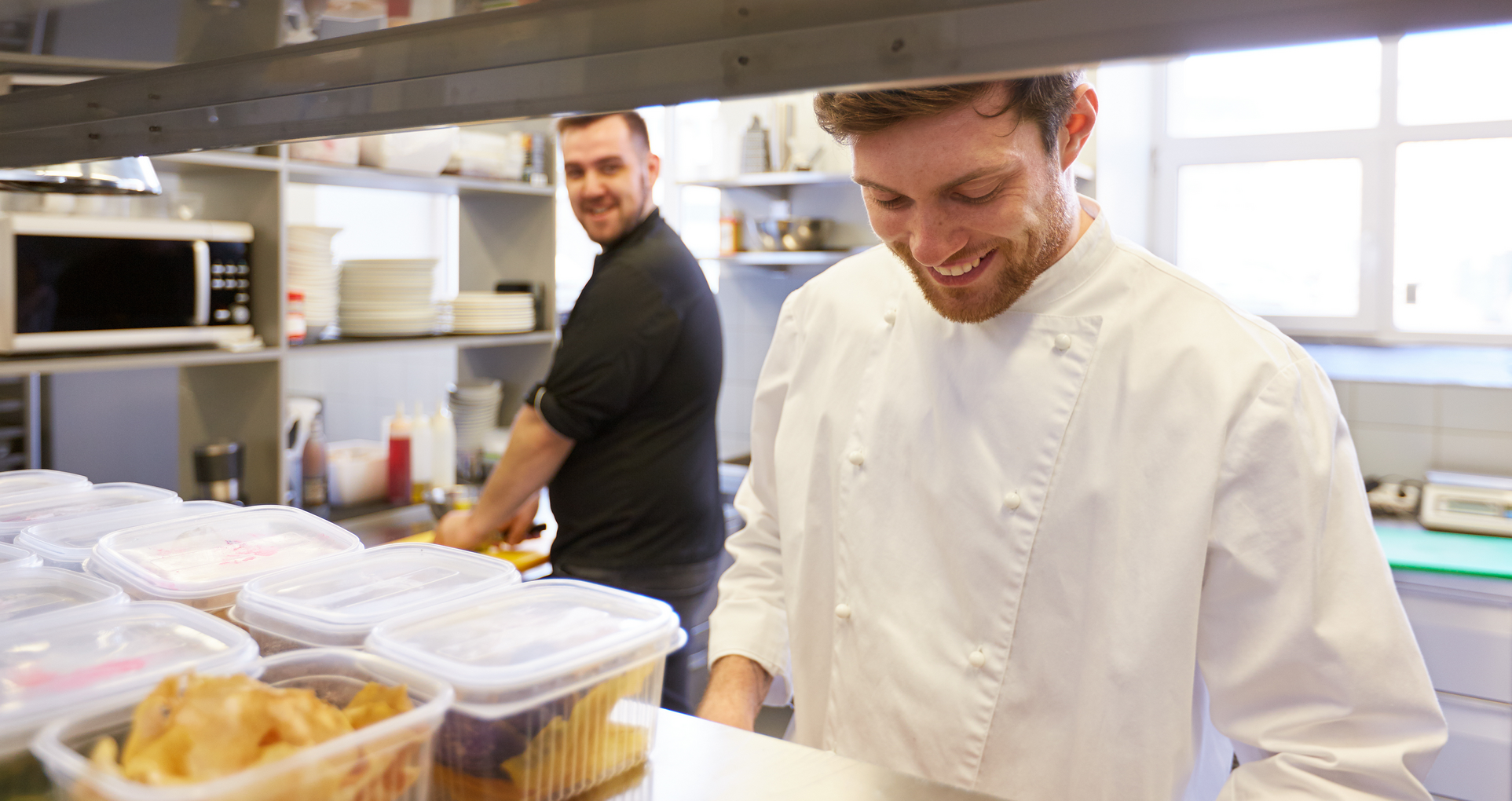
Restaurant Slang: A Complete Guide to FOH and BOH Lingo
Restaurant slang keeps service fast and efficient across the floor. Learn the lingo and terminology used by servers, chefs, bartenders, and beyond.
Aislinn CokerAuthor
 RESOURCE
 Guide to Restaurant Social Media Marketing
Learn how to optimize your social media presence to showcase your brand, tell your story, attract new customers, and engage with your audience.
Get Free Download | Built for Restaurants
In a restaurant, words move as fast as the food. Whether it’s a cook calling out orders, a bartender slinging shorthand, or a server whispering code at the host stand, slang is what keeps the whole operation running smoothly.
It’s not just kitchen speak—it’s a shared, high-speed vocabulary used by nearly everyone on the floor. And it’s been that way for decades. As William Grimes writes in his book Eating Your Words: 2000 Words to Tease Your Taste Buds:
“Let’s imagine it’s 1938… You place your order and hear the ‘beanery queen’ shout into the kitchen, ‘Wax a high hat on a cable car, go heavy on the barn paint and carnations!’ Just like that, this ‘call’ gets you an open-faced cheeseburger, smothered in ketchup and onions, pronto.”
While the slang may have changed, the purpose hasn’t. Restaurant lingo saves time, builds camaraderie, and keeps service flowing. Here’s your guide to the terms that make it all happen.
Key takeaways
Restaurant slang speeds up communication across front and back of house, making service more efficient during busy shifts.
Front of house (FOH) terms help hosts, servers, and bartenders coordinate pacing, seating, and customer experience.
Back of house (BOH) slang streamlines communication between kitchen staff to keep food moving and avoid collisions or mistakes.
Learning the lingo builds team cohesion and helps new hires get up to speed quickly in a high-pressure environment.
Guide to Restaurant Social Media Marketing
Learn how to optimize your social media presence to showcase your brand, tell your story, attract new customers, and engage with your audience.

Front of house slang
The front of house (FOH) includes all areas of a restaurant where guests interact with staff—think the dining room, bar, host stand, and patio. FOH team members include hosts, servers, bartenders, bussers, and managers—anyone responsible for creating a smooth, positive guest experience.
To keep service running smoothly in high-pressure environments, FOH staff rely on a fast-paced shorthand. This restaurant slang helps the team communicate quickly, solve problems efficiently, and keep the dining room humming.
Common FOH terms (A–Z)
Campers: Guests who stay at a table long after paying.
Check back: To follow up with guests shortly after food arrives.
Check down: Dropping the check at the end of a meal.
Comp: A free item given to the guest, often to resolve an issue.
Double: Working two shifts in a row.
Full hands in / full hands out: Always bring something into or out of the kitchen to stay efficient.
In the weeds: Overwhelmed with too many tasks or tables.
On the floor: Actively working and taking tables.
Service bar: A dedicated station where bartenders make drinks for the dining room.
Stiffed: When a guest leaves no tip.
Turn a table: Clearing, resetting, and reseating a table quickly.
Turn and burn: Quickly serving and flipping tables for new guests.
Upsell: Suggesting add-ons or higher-priced items to increase check value.
Verbal tip: A compliment from a guest with no accompanying tip.
Void: A canceled item that was never prepared or served.
Back of house slang
The back of house (BOH) refers to all the behind-the-scenes areas where food is prepped, cooked, and plated. This includes the kitchen, dish pit, walk-in fridge, dry storage, and staff areas. BOH team members typically include chefs, line cooks, dishwashers, prep cooks, and kitchen managers.
In the high-speed, high-stress environment of a kitchen, communication needs to be lightning-fast and crystal clear. BOH slang helps streamline the workflow, coordinate tasks, and keep the whole brigade moving in sync—even during the dinner rush.
Common BOH terms (A–Z)
All day: The total quantity of an item needed at that moment (e.g., “I need four steaks all day!”).
Behind: Said when walking behind someone to avoid collisions.
Burn it: Cook something well-done.
Drop: Start cooking or frying an item (e.g., “Drop two fries!”).
Fire: Start preparing a dish or order (e.g., “Fire table 12!”).
Flash: Quickly reheat something.
Hands: Someone in the kitchen requires immediate assistance.
Heard: Acknowledgment that an instruction was received.
In the window: Food that’s ready to be run to the dining room.
Kill it: Overcook something (intentionally or accidentally).
Low boy: A refrigerator that sits under the prep counter.
Mise (en place): French for “everything in its place”; refers to a cook’s organized setup.
On the fly: Needed urgently or last-minute (e.g., “I need a Caesar on the fly!”).
Pick up: Food is ready and needs to be taken out of the kitchen.
Push: Encourage staff to sell a specific item.
Sharp: Said to warn others you’re carrying a knife.
Shelf life: How long a prepped item can be used before it spoils.
Shuck: To open shellfish, like oysters.
Shoe: Derogatory term for a bad or inexperienced cook.
The pass: The area between the kitchen and dining room where finished plates are placed for pickup.
Wax: To clean or polish a station at the end of service.
Window: The shelf or ledge where plated food is placed for service.
Host stand slang
The host stand is the nerve center of the front of house—where pacing, first impressions, and table flow all come together. Hosts manage the dining room’s rhythm, and their slang reflects the fast-paced coordination it takes to keep things moving smoothly.
Cut the floor: When management begins closing server sections and sending staff home as service slows.
Deuce: A two-person table. Quick to seat, quick to turn.
Double-sat: When a server is given two tables at once, often unintentionally. Can lead to slower service and stressed-out staff.
Flip a table: Clearing, cleaning, and resetting a table for the next party. The quicker the flip, the higher the potential turnover.
Four-top / Six-top / etc.: A table that seats four, six, or more. Used universally to refer to party sizes.
On a wait: No tables currently available; guests are added to a waitlist.
Turn time: How long a party occupies a table. Hosts track this to gauge availability and optimize seating.
Walk-in: A guest who arrives without a reservation.
Dish pit slang
The dish pit is the unsung engine room of any restaurant. It’s loud, messy, and fast-paced—and the slang reflects the grit needed to keep clean plates flowing and service running.
Blasting: Rinsing dishes at full pressure before they go into the machine.
Drop the rack: Loading a full rack of dishes into the dishwasher.
Glass graveyard: The area where broken glass accumulates (usually a trash bin or designated space near the sink).
Hots: Hot plates or pans fresh out of the machine—handle with care.
Landing zone: The space where dirty dishes are dropped off before being sorted and cleaned.
Pre-rinse: Quickly scraping or spraying off food bits before dishes hit the machine.
Sanitize: The final rinse or dip to meet health code standards.
Stack ’em: Instruction to pile cleaned or rinsed wares neatly for drying or pickup.
Triple sink: The classic three-compartment sink used for wash, rinse, and sanitizing cycles when there’s no dishwashing machine.
Bar slang
Behind the bar, speed, style, and showmanship meet in a tight space where every second (and pour) counts. Bartenders use their own shorthand to keep orders flowing, customers happy, and service efficient.
Back: A small glass of something (often water or soda) served alongside a drink.
Build: Assembling a cocktail directly in the serving glass.
Call drink: A drink ordered with a specific brand of liquor (e.g., “Tito’s and soda”).
Dirty: A martini with olive brine added.
Free pour: Measuring liquor by sight rather than using a jigger.
Neat: A spirit served plain, at room temperature, no ice.
On the rocks: A drink served over ice.
Shaken / stirred: Methods used to mix cocktails, depending on the desired dilution and texture.
Speed rail: The row of frequently used liquors kept easily accessible below the bar.
Tall: A drink with the same amount of liquor, but more mixer—served in a larger glass.
Up: A drink that’s shaken or stirred with ice, then strained into a glass with no ice.
Well: The standard, lower-cost liquors used when no specific brand is requested.
POS slang
The point of sale (POS) system is the brain of the restaurant floor—where orders are entered, payments processed, and reports generated. Staff often use their own shorthand to navigate it quickly and efficiently during busy service.
Bump: To mark an order as completed on the expo screen (e.g., “Don’t bump that ticket yet—runner’s not ready”).
Chit: A printed ticket showing an order, usually sent to the kitchen or bar. Sometimes called a “dupe.”
Crash the system: When the POS freezes, loses power, or otherwise breaks mid-service.
Double ring: Accidentally entering the same item twice. Can result in kitchen confusion or overcharging the guest.
Ghost ticket: A glitch where a ticket shows up in the kitchen but doesn’t appear on the server screen.
Key in: Manually inputting an order into the system, especially if the modifier or item isn’t a preset button.
No-mods: Orders that go through with no modifications or special requests. Often celebrated for their simplicity.
Open tab: A check that hasn’t been closed out—often left by bar guests or large tables.
POS dump: Pulling all sales, labor, and transaction data from the system—usually at the end of a shift or day.
Re-open check: When a closed bill needs to be reopened.
Screen jam: When too many orders crowd the kitchen or expo screen at once.
Z-out: The process of closing and reconciling a POS terminal at the end of a shift.
Universal abbreviations and shorthand
Across the restaurant floor and kitchen line, speed is everything. Staff often use abbreviations and shorthand on tickets, whiteboards, or when calling out orders to save time and reduce confusion. These codes become second nature—and essential—for smooth service.
86: Item is out of stock or no longer available.
+1 / +2: Add one or two of an item (e.g., “+1 Caesar to table 7”).
BDAY: Birthday (often used to flag for comped desserts or celebratory touches).
MOD: Modifier—custom requests or changes to a dish.
O/H: On hold—an order that’s been entered but delayed from firing.
S/O: Side of—used to indicate an item served on the side (e.g., “S/O ranch”).
SUB: Substitute—swap one item for another (e.g., “SUB salad for fries”).
T.O.: Takeout or to-go order.
V: Vegetarian (sometimes VG for vegan).
W/ or W/O: With or without (e.g., “W/O onions”).
Fire up the restaurant slang and 86 slow communication
Restaurant slang isn’t just insider talk—it’s a practical tool that helps teams communicate clearly and quickly. Whether you’re new to the industry or brushing up your knowledge, knowing the terms used across different roles makes it easier to jump in, work together, and keep up with the pace during a busy shift.
FAQ
What does "86" mean in restaurants?
When something is “86’d,” it means it’s no longer available—typically because the kitchen has run out. It can also mean canceling an item from an order or removing a guest from the premises in extreme cases.
Why do kitchen staff say "behind" and "corner"?
These are safety calls. Saying “behind” lets coworkers know you're walking behind them—helping prevent collisions in a fast-moving kitchen. “Corner” is used when turning a blind corner, especially when carrying hot food, sharp tools, or trays.
What's the difference between "neat," "up," and "on the rocks"?
All the terms describe how a drink is served:
Neat: Poured straight from the bottle, no ice, no mixer, room temperature.
Up: Chilled with ice (shaken or stirred), then strained into a glass without ice.
On the rocks: Served over ice, usually in a short glass.
What does "in the weeds" mean?
It means a staff member is overwhelmed—usually juggling too many tables, orders, or tasks at once. When someone’s “in the weeds,” the team might jump in to help get them back on track.
What is "mise en place"?
French for “everything in its place,” mise en place refers to a chef’s workstation setup. It means having all ingredients, tools, and prep work ready before service begins—so the kitchen runs like a well-oiled machine.
Is this article helpful?
DISCLAIMER: This information is provided for general informational purposes only, and publication does not constitute an endorsement. Toast does not warrant the accuracy or completeness of any information, text, graphics, links, or other items contained within this content. Toast does not guarantee you will achieve any specific results if you follow any advice herein. It may be advisable for you to consult with a professional such as a lawyer, accountant, or business advisor for advice specific to your situation.
 Trending

Subscribe to On the line
Sign up to get industry intel, advice, tools, and honest takes from real people tackling their restaurants’ greatest challenges.
By submitting, you agree to receive marketing emails from Toast. We’ll handle your info according to our privacy statement. Additional information for California residents available here.