The Ultimate Restaurant Budget Template to Streamline Your Finances
Master your restaurant finances with this comprehensive budget template and cost-control strategies.
Aiden ToborAuthor
 RESOURCE
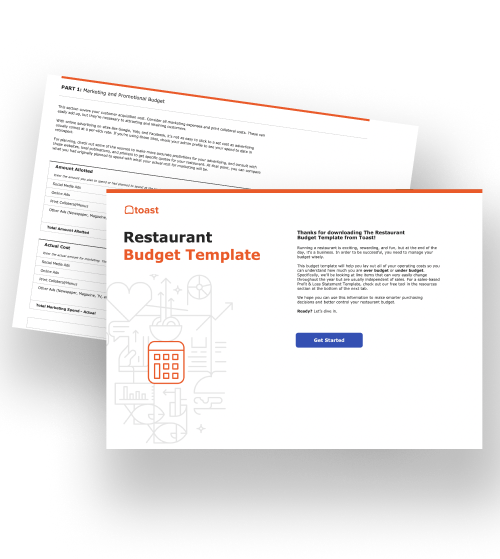
 Restaurant Budget Template
Use this template to make sure your projections are accurate and help eliminate overspending across your business.
Get Free Download | Built for Restaurants
Creating a comprehensive restaurant budget is essential for maintaining profitability and controlling costs in an industry where margins are notoriously thin — on average, restaurants achieve net profit margins of just 3% to 5%. After you set your restaurant budget, balancing month-to-month cash flow can be complex, but having the right template and understanding key cost categories will help you stay on track.
Essential budget categories
Your restaurant budget should reflect the biggest cost drivers in your business. Here's a breakdown of the most critical expense categories and benchmarks to guide your planning.
Food and beverage costs
Your cost of goods sold (COGS) is one of your largest variable expenses. On average, food and beverage costs should account for 28% to 35% of total revenue. Staying within this range requires careful tracking and proactive management across multiple areas:
Inventory tracking: Record beginning inventory, purchases, and ending inventory on a monthly (or even weekly) basis. This helps calculate your food cost percentage and uncover patterns like overordering or product loss. Software like xtraCHEF can automate this for more accuracy.
Vendor management: Regularly compare supplier pricing and renegotiate contracts when necessary. Even a small reduction in per-unit pricing can make a big difference over time.
Menu engineering: Use sales data to highlight high-margin menu items and rework or remove dishes that consistently run high food costs. Consider designing your menu around ingredients with lower price volatility.
Portion control: Train staff to follow portioning guidelines precisely. Over-serving — even by an ounce — adds up across hundreds of meals and can quietly destroy your margins.
Waste reduction: Track food waste and identify causes — overproduction, spoilage, trimming errors — and implement solutions like batch cooking or repurposing surplus ingredients into specials.
Restaurant Cost Control Guide
Use this guide to learn more about your restaurant costs, how to track them, and steps you can take to help maximize your profitability.

Labor costs
Labor remains a significant expense across all restaurant types. According to a recent study by BDO, the average labor cost percentage across all types of restaurants has risen to 31.6%. To control labor costs without sacrificing service, consider these key components:
Hourly wages: Covers wages for both front-of-house and back-of-house hourly staff.
Salaried positions: Includes general managers, kitchen managers, and other full-time leadership roles.
Payroll taxes and benefits: Accounts for employer-paid taxes, health insurance, paid time off, and other staff benefits.
Training costs: Training a new employee costs an average of $5,864 — making retention strategies critical to controlling turnover expenses.
Chipotle has reported that its labor costs make up roughly 26% to 27% of revenue, staying within healthy industry benchmarks by leveraging labor management tools and cross-training staff to boost efficiency.
Rent and occupancy
Rent and related occupancy costs should account for no more than 6% to 10% of your gross revenue to ensure a sustainable overhead. Key components of this category include:
Base rent or mortgage: Fixed monthly cost for your physical space.
Common area maintenance (CAM) fees: Charges for shared building upkeep, often included in lease agreements.
Property taxes and insurance: Local tax obligations and coverage to protect your space and assets.
Utilities
Most restaurants allocate 3% to 5% of their total revenue to utilities — a necessary but often overlooked operational cost. Common utility expenses include:
Electricity and gas: Powering kitchen equipment, lighting, and heating or cooling systems.
Water and waste services: Essential for dishwashing, restrooms, food prep, and sanitation.
Internet and phone: Supports POS systems, reservations, online ordering, and communication.
Marketing and advertising
According to data collected by Toast, 84% of restaurants plan to spend the same or more on marketing than the previous year — underscoring its importance for growth. Focus your marketing budget on these high-impact areas:
Customer acquisition: Use targeted ads, SEO, and social media to attract new guests and build brand awareness.
Customer retention: Leverage loyalty programs, email marketing, and special events to encourage repeat visits.
Channel optimization: Track ROI across platforms to prioritize the strategies that consistently drive traffic.
Budget template structure
Monthly revenue projections
Build realistic sales forecasts to guide your budgeting decisions. Strong projections set the foundation for effective cost management and cash flow planning:
Use historical data: Review past monthly sales to establish a baseline and identify patterns in customer behavior.
Account for seasonality: Adjust forecasts based on predictable fluctuations — like holiday traffic, local events, or seasonal tourism.
Factor in capacity: Consider your restaurant’s seating capacity, operating hours, and service model when estimating potential sales volume.
Average check size: Calculate the average amount spent per customer to help project daily and monthly revenue.
Table turnover rate: Estimate how many times each table turns over per shift to understand how many covers you can realistically serve.
Customer volume expectations: Base forecasts on daypart trends and traffic patterns, considering any planned promotions or marketing campaigns.
Fixed costs
Fixed costs remain consistent month to month, regardless of how busy your restaurant is. These are the backbone of your operating expenses and must be covered no matter your revenue:
Rent or mortgage payments: Regular payments for the physical space you occupy — usually your largest fixed expense.
Insurance premiums: Ongoing costs for property, liability, workers’ comp, or other required coverage.
License and permit fees: Set fees for health permits, business licenses, alcohol permits, and other legal requirements.
Equipment lease payments: Monthly costs for leased items like dishwashers, ovens, or POS systems.
Loan repayments: Scheduled payments for any existing debt, including business startup loans or equipment financing.
Variable costs
Variable costs rise and fall based on how busy your restaurant is. These expenses scale with customer volume, making them essential to monitor closely:
Food and beverage inventory: Costs increase as ingredient use rises with customer volume.
Hourly labor: Staffing needs grow during busy shifts or seasonal surges.
Credit card processing fees: Percentage-based charges that scale with sales.
Delivery platform commissions: Fees from third-party apps based on order volume.
Utilities beyond base charges: Energy and water usage typically rise during high-demand periods.
Semi-variable costs
These expenses have both fixed and variable components — part of the cost stays constant, while another portion depends on usage or activity level:
Labor: Combines fixed salaries for managers with variable hourly wages for staff.
Phone and internet: Base service fees stay the same, but usage charges can fluctuate.
Maintenance contracts: Flat monthly fees may be supplemented by extra charges for unexpected service calls.
Creating accurate projections
Accurate financial projections help you make smart decisions about pricing, staffing, inventory, and marketing.
Historical analysis
Look at year-over-year changes in revenue and expenses to identify patterns. Use this data to decide whether to aim for steady growth or take a more aggressive approach to increasing income and offsetting inflation.
Restaurant Metrics Calculator
Use this free calculator to calculate the key restaurant metrics needed to understand the health and success of your business.
Prime cost calculation
Your prime cost — food costs plus labor costs — should stay within 60% to 65% of total revenue. This metric is one of the clearest indicators of your restaurant’s financial health.
Seasonal adjustments
If your business sees seasonal spikes, like summer tourism or holiday rushes, adjust your projections accordingly. Plan for leaner months by scaling back inventory and labor to protect margins.
For example, a seafood restaurant in Cape Cod might earn 60% to 70% of its annual revenue between May and September, requiring leaner staffing and tighter budgets in the off-season to stay financially stable year-round.
Managing budget variances
Even with a strong plan, your actual numbers won’t always match your projections. Regular tracking and flexible adjustments can help you stay profitable when things shift.
Monthly tracking
Use tools like Toast's Restaurant Budget Template to track business expenses and maintain clear visibility into your financial performance. Regularly compare actual results against your budget to catch issues early and adjust as needed..
Cost control strategies
When expenses exceed projections, apply targeted solutions to bring spending back in line:
Supplier negotiations: Renegotiate contracts to secure better pricing, bulk discounts, or improved terms.
Portion control: Set and enforce standard portion sizes to reduce waste and maintain consistency.
Smarter scheduling: Match labor hours to customer demand using data-driven shift planning.
Energy efficiency upgrades: Invest in high-efficiency equipment to lower long-term utility expenses.
Inventory management: Track usage patterns closely to prevent spoilage, overordering, and unnecessary waste.
In a high-stakes, low-margin industry, operational discipline makes a measurable difference. As hospitality expert Jon Taffer notes, “In a business where pennies matter, standardisation isn’t just helpful—it’s essential. The most successful bars and restaurants run like machines behind the scenes.”
This level of consistency across cost centers — from inventory to labor — can be the difference between running lean and running behind.
Revenue optimization
Boost income by investing in the channels that deliver consistent results:
Ad spend limits: Set daily caps on digital advertising to avoid budget overruns.
High-ROI channels: Focus on platforms and campaigns that consistently bring in traffic, such as email marketing, social media ads, or Google search.
Performance tracking: Monitor conversion rates and customer acquisition costs to double down on what works.
Technology integration
Modern restaurant management relies on integrated systems to streamline operations and improve financial accuracy.
POS system tracking: Use point-of-sale systems that automatically monitor sales, inventory, and labor costs in real time to stay on top of your budget.
Real-time insights: Identify issues quickly — like rising food costs or labor overruns — so you can adjust before they impact your bottom line.
System integration: Connect your POS with accounting, scheduling, and inventory tools for a full-picture view of your restaurant’s performance.
Annual forecasting
Looking beyond the month-to-month view helps restaurant owners make proactive, strategic decisions that support long-term success.
Long-term planning
Annual forecasting encourages operators to step back from daily tasks and focus on the bigger picture. Build 12-month projections that account for seasonal highs and lows, as well as any planned changes — like renovations, new menu rollouts, or marketing pushes. This forward-thinking approach helps stabilize cash flow and support steady growth.
Growth planning
As you build your annual forecast, look beyond day-to-day operations. Include potential expansion plans, equipment upgrades, and staffing increases in your projections. And to stay resilient when the unexpected happens, set aside a contingency fund — ideally 3% to 5% of total revenue — to cover surprise costs or economic shifts.
Key performance indicators
Tracking the right metrics helps you stay financially healthy and quickly spot areas that need improvement. Review these KPIs monthly to keep your budget on track:
Prime cost percentage: The combined total of food and labor costs — your most critical benchmark — should stay between 60% and 65% of revenue.
Food cost percentage: A healthy range is 28% to 35% of revenue, helping you monitor inventory efficiency, purchasing, and portion control.
Labor cost percentage: Aim to keep labor costs between 25% and 35%, ensuring staffing levels align with your revenue.
Revenue per available seat hour (RevPASH): Helps evaluate how effectively you're using your seating capacity during operational hours — for example, a fast-casual restaurant with 40 seats, open 10 hours a day and generating $4,000 in daily revenue, would have a RevPASH of $10/hour.
Average transaction value: Monitors how much guests spend per visit — key for menu strategy and upselling efforts.
Customer acquisition cost: Tells you how much it costs to bring in each new customer, useful for refining marketing spend.
Cost reduction opportunities
Reducing operational costs doesn’t have to mean cutting corners. These strategies help you save money while maintaining quality and efficiency.
Energy efficiency
Invest in ENERGY STAR-rated or energy-efficient equipment to lower utility bills over time. While the upfront cost may be higher, the long-term savings in electricity, gas, and water usage can make a significant difference to your bottom line.
Starbucks has made energy efficiency a core part of its operations, outfitting stores with ENERGY STAR-certified appliances and building more than 2,000 LEED-certified locations worldwide. These initiatives are designed to reduce long-term utility use — and are part of the company’s broader sustainability and cost-saving efforts.
Vendor negotiations
Build strong relationships with multiple suppliers to increase your bargaining power. Regularly review contracts to identify opportunities for better pricing, bulk discounts, or improved terms — without sacrificing product quality.
Waste reduction
Minimize food waste by using inventory management systems that track usage patterns and flag inefficiencies. Train staff on portion control and proper handling techniques to improve consistency and reduce unnecessary loss across the menu.
Industry challenges for 2025
Food and labor cost pressures
Food inflation is the top concern for restaurant operators, with 52% ranking it as their number one issue and 86% placing it in their top three. Labor costs remain the second most pressing challenge. To maintain service quality, operators must plan for continued volatility in pricing and wages.
Technology adoption
Roughly 49% of restaurants are optimistic about technology’s role in easing labor burdens — 21% very optimistic and 28% somewhat optimistic. Evaluate automation tools, scheduling software, and integrated systems that can streamline operations and reduce long-term labor costs.
Final thoughts
Budgeting isn’t just a once-a-year task — it’s an ongoing discipline that can make or break your restaurant’s profitability. With rising costs, tight margins, and changing customer behaviors, having a detailed, flexible budget gives you the visibility and control needed to adapt quickly and make smarter decisions.
Whether you’re a new operator building your first forecast or a seasoned owner refining your strategy, the right budget template is a powerful tool. Track your numbers, adjust regularly, and plan ahead — because in this industry, financial clarity is the foundation of long-term success.
Restaurant Cost Control Guide
Use this guide to learn more about your restaurant costs, how to track them, and steps you can take to help maximize your profitability.
FAQ
What percentage of revenue should food costs represent?
Food and beverage costs should typically account for 28% to 35% of total revenue, though this varies by restaurant type and concept.
How often should I review my restaurant budget?
Review your budget monthly to track variances and make necessary adjustments. Annual reviews should reassess long-term projections and growth plans.
What's the most important cost metric to track?
Prime cost (food costs plus labor costs) is the most critical metric, ideally staying between 60% to 65% of revenue.
How can I reduce food costs without compromising quality?
Focus on portion control, reduce waste through better inventory management, negotiate with suppliers, and design your menu around seasonal ingredients.
Should utilities be a fixed or variable cost in my budget?
Utilities are primarily variable costs, though they may have fixed base charges. Budget 3% to 5% of revenue for total utility expenses.
How much should I budget for marketing?
Allocate 3% to 6% of revenue to marketing and advertising, adjusting based on your restaurant's growth stage and competitive environment.
Restaurant Labor Cost Calculator
Unlock the power of data-driven labor management with our free Restaurant Labor Cost Calculator. Stop guessing and start optimizing your staffing decisions today.


Is this article helpful?
DISCLAIMER: This information is provided for general informational purposes only, and publication does not constitute an endorsement. Toast does not warrant the accuracy or completeness of any information, text, graphics, links, or other items contained within this content. Toast does not guarantee you will achieve any specific results if you follow any advice herein. It may be advisable for you to consult with a professional such as a lawyer, accountant, or business advisor for advice specific to your situation.
 Trending

Subscribe to On the line
Sign up to get industry intel, advice, tools, and honest takes from real people tackling their restaurants’ greatest challenges.
By submitting, you agree to receive marketing emails from Toast. We’ll handle your info according to our privacy statement. Additional information for California residents available here.