
California Minimum Wage Guide in 2025
Learn about how California minimum wage has changed over the years, and how to work towards paying your staff a livable wage.

Katherine BoyarskyAuthor
 Resource
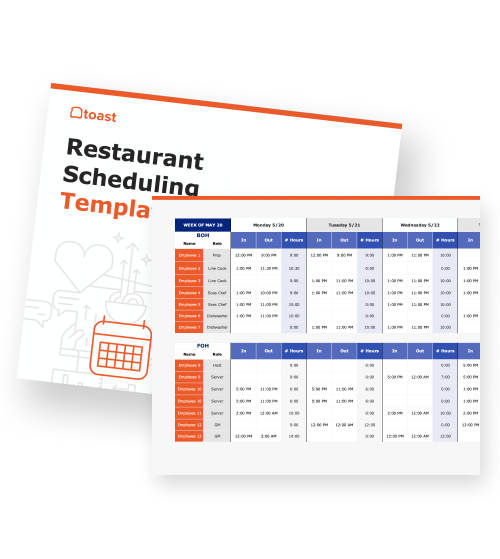
 Restaurant Scheduling Template
Use the Restaurant Scheduling Template to easily schedule your restaurant staff's shifts.
Get Free Download | Built for Restaurants
What is the minimum wage in California?
Califorinia employers will need to pay $16.50 an hour starting in 2025, regardless of how many people they employ, due to the intense financial pressure faced by workers in today’s climate of extreme inflation.
According to the California Department of Industrial Relations, these are the previous and current minimum wage rates for the State of California.
Minimum wage rates in California
Year | Minimum Wage Rate for Employers With 25 or fewer employees | Minimum Wage Rate for Employers With 26 or more employees |
2017 | $10.00 an hour | $10.50 an hour |
2018 | $10.50 an hour | $11.00 an hour |
2019 | $11.00 an hour | $12.00 an hour |
2020 | $12.00 an hour | $13.00 an hour |
2021 | $13.00 an hour | $14.00 an hour |
2022 | $14.00 an hour | $15.00 an hour |
2023 | $15.50 an hour | $15.50 an hour |
2024 | $16.00 an hour | $16.00 an hour |
2025 | $16.50 an hour | $16.50 an hour |
Minimum wage rates aren’t the same everywhere in California — here’s how city and county minimum wage rates differ.
It’s also important to know that many individual cities and counties have higher minimum wage rates than the state, so businesses in those counties are required to pay that higher rate.
Tipped minimum wage in California
California does not have a tipped minimum wage, or tip credit. Employers must pay every employee the full minimum wage of $14 or $15 an hour, and all tips received by employees are additional income.
California is one of the more progressive states in the USA when it comes to minimum wage — over the past five years, the state has heeded the call of labor organizers and increased minimum wage to, currently, $15 or $14 an hour depending on the size of the business. And starting in 2023, all businesses will need to start paying $15.50 an hour.
While this is a big win for workers and organizers, the fight for a $15 minimum wage began nearly a decade ago, when $15 an hour could be a livable wage in many areas. Unfortunately, by the time the 2017 bill was passed in California, requiring businesses to increase minimum wage on a yearly basis until reaching $15 in 2023, the cost of living in California’s major cities had climbed so high that $15 couldn’t be considered a living wage anymore.
And today, inflation and a looming recession have made things even more expensive. In order for workers to be able to get by with just one job, employers need to pay not only minimum wage, but a livable wage that takes into account the cost of living where they do business.
California minimum wage is determined by the state first, but cities and counties around California have higher minimum wages, and business owners are beholden to both local and state minimum wage laws. For example, a business owner in Los Angeles must already be paying their employees $16.04 an hour, at least, because the city of LA has its own minimum wage.
The USA federal minimum wage is still only $7.25 an hour, and some states, like Alabama, Louisiana, Mississippi, South Carolina, and Tennessee, don’t have their own state minimum wages, meaning they only have to pay the default $7.25. 15 more states, including North Carolina, Georgia, and North Dakota, do have their own state minimum wages, but they’ve also chosen to stick with $7.25 an hour.
As such, compared to other states in the U.S., California has a very high minimum wage. It’s tied with Connecticut for the third-highest minimum wage, behind Massachusetts which has a 14.25 minimum wage, and Washington State with the highest minimum wage at $14.49. However, it’s important to note that California also has an astronomically high cost of living.
In this article, we’ll cover the current and historical minimum wage in California, discuss the tipped minimum wage, cover cost of living in California, and provide suggestions for California businesses trying to figure out how to provide good pay to their employees.
 Toast Payroll
 Built to make restaurant teams better.
A payroll and team management platform built for restaurants to help you and your team succeed.

How will California approach minimum wage in the future?
In 2023, the California minimum wage will reach $15.50 an hour, which is the last stage of the yearly increases planned in 2017. It will be the first state in the US to reach a full $15 minimum wage.
However, with costs of living continuing to rise, and inflation continuing to add financial pressure on workers, it is likely that the minimum wage will continue to increase.
In fact, a new bill, AB 257, was recently introduced to create a council to regulate wages, increase protections and pay, for California fast food workers. The bill was created in response to widespread hazardous and low-pay conditions in fast food restaurants, and could eventually result in a yearly minimum wage increase up to $22 an hour. However, the bill faces significant opposition from powerful fast food companies and associations, and it could be severely delayed or even overturned.
Cost of living in California
What underpins all discussions about minimum wage in California is the state’s very high cost of living.
In San Francisco, the average rent for a one-bedroom apartment is $2,995. Many landlords require tenants to be able to prove that they can make three times the rent, which, for an average one-bedroom apartment, would require workers to bring in $107,820 a year.
By that standard, hourly workers would need to be making over $50 an hour in a 40-hour workweek. Even with a lenient landlord, who might take on a tenant who only makes double the rent, a worker would still need to make $34.56 an hour — which is more than twice the current San Francisco minimum wage of $16.99 an hour.
In the comparatively reasonable county of San Leandro, CA, the average rent for a one-bedroom apartment is $2,180. To make three times that rent, an hourly worker would need to be making $37.73 an hour — again, more than twice the current minimum wage there, which is currently $15 for all employers.
And these calculations are for comfortably affording a one-bedroom apartment — and they don’t take into account any other kind of critical expenses, including food, utilities, transport, and healthcare. For parents, especially single parents, and for workers caring for elders, $15 an hour is now virtually impossible to live on.
According to the MIT Living Wage Calculator tool, the living wage in San Francisco is currently $30.81 an hour for a single person with no children. For a single parent, it’s over $60 an hour. For a two-parent home with two children, where both parents work, a living wage for each parent is over $40 an hour. In short, California reaching the $15 threshold is a great step — but it’s still not a living wage.
This is a problem all around the country, not just in particularly expensive California. In 2018, it was found that 8% of workers in the U.S. have multiple jobs, with 16.7% of those workers being in the restaurant industry. And with the pandemic and inflation causing increased economic hardship, it stands to reason that this number is even higher today.
Toast Payroll Built to make restaurant teams better.
A payroll and team management platform built for restaurants to help you and your team succeed.
How can small businesses and restaurants in California be compliant with minimum wage laws?
We’ve covered what minimum wage means for workers — but what about their employers? Inflation is severely impacting many businesses, and many restaurants report that they are having a hard time affording great staff. Minimum wage is higher than ever, and restaurants in California need to be able to pay their employees at least minimum wage, if not better.
Restaurant profit margins and cost structures have long been more reliant on minimum wage workers than other industries, because the average profit margin in restaurants is only 3-5%. Other industries that bring in much better profit margins have historically been able to pay their employees better. But as long as we want restaurant work to be a sustainable job option, where employees want to stay at the same place (and not have to work multiple jobs), the industry needs to find ways to not only meet, but exceed, minimum wage.
How can small businesses and restaurants in California offer fair wages to their employees?
As mentioned above, a lot needs to change for restaurant work to provide a living wage. Firstly, the industry standard 30-35% labor cost estimation is no longer accurate: labor cost will almost certainly make up a greater percentage of your operating budget than it did several years ago.
Restaurants across the country have had to accept that labor cost is on the rise, and it will continue to rise as long as cost of living balloons unchecked. So what can a restaurant do to attract and keep the best staff with good pay and benefits?
Increase prices. The vast majority of restaurants have had to increase prices over the past year to cover the higher cost of ingredients, but you may have to raise prices again, by a more significant margin, to provide your team with good pay.
Trim your menu. Food waste is one of the most important controllable costs to curtail, because it adds up quickly. An easy way to get a better handle on food waste, and to reduce your inventory costs overall, is to reduce the size of your menu and focus on the most popular and most profitable items.
Ensure every ingredient is used in multiple recipes. Part of trimming down your menu is cutting out extraneous ingredients that are only used in one recipe — for example, if you have a huitlacoche taco, but you don’t use the huitlacoche in anything else, it might be time to cut that item from your menu.
Implement a service charge. Try adding a percentage or amount-based charge to each bill, but include the explanation that it helps you keep your staff well-paid and helps you offer benefits. Check with your lawyer and accountant about how this charge will work into your business’s taxes.
Try automatic gratuities. An automatic gratuity can help ensure that tips come in more evenly and regularly. If you try this, be sure to communicate this policy on your menu and on your website so customers aren’t caught by surprise. Check with your lawyer and accountant about how automatic gratuities can work into your business’s taxes.
How can you make sure that you’re compliant with state labor laws?
There are a lot of regulations to comply with when it comes to running payroll and scheduling employees. The easiest way to be compliant is to always pay every employee the full California minimum wage, and an all-in-one payroll and team management solution can also help ensure you’re not overscheduling employees, that you’re paying for overtime as needed, and that they’re always paid on time.
Livable wage means lower turnover
All restaurant workers deserve to be able to earn a living wage while learning the many skills that hospitality work provides: technical cooking skills, service skills, interpersonal skills, fast-paced team collaboration, business management, and so much more. Whether restaurant work is their first job, or they’ve been in the industry for decades, they can then choose to grow within a restaurant and rise through the ranks, or pursue a different career, knowing their restaurant experience is the backbone of their work ethic.
Providing a living wage, beyond just minimum wage, can help businesses attract the best talent and keep their workers engaged and on staff — especially when coupled with a supportive work culture.
Toast Payroll Built to make restaurant teams better.
A payroll and team management platform built for restaurants to help you and your team succeed.
Is this article helpful?
DISCLAIMER: This information is provided for general informational purposes only, and publication does not constitute an endorsement. Toast does not warrant the accuracy or completeness of any information, text, graphics, links, or other items contained within this content. Toast does not guarantee you will achieve any specific results if you follow any advice herein. It may be advisable for you to consult with a professional such as a lawyer, accountant, or business advisor for advice specific to your situation.
 Trending


Subscribe to On the line
Sign up to get industry intel, advice, tools, and honest takes from real people tackling their restaurants’ greatest challenges.
By submitting, you agree to receive marketing emails from Toast. We’ll handle your info according to our privacy statement. Additional information for California residents available here.