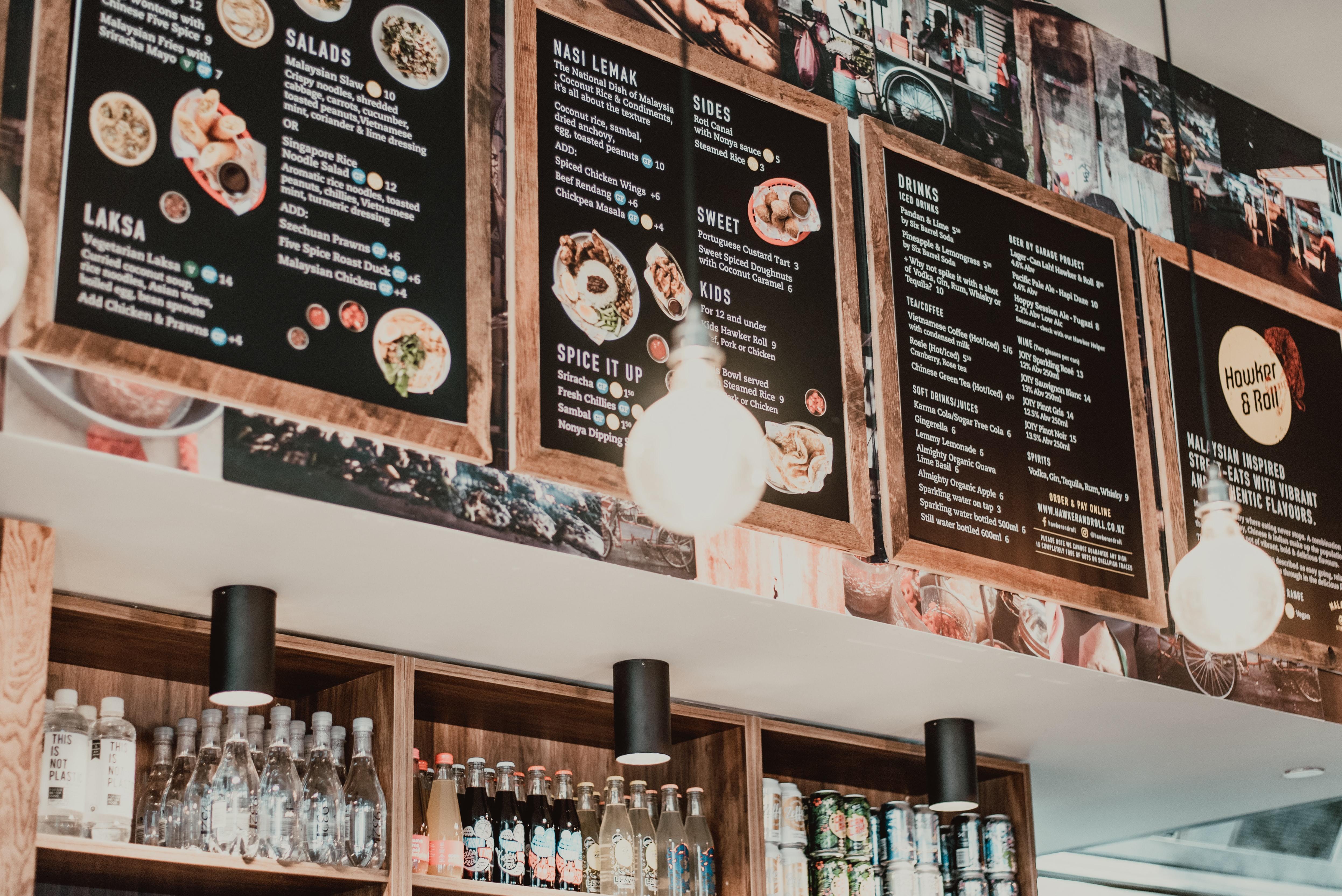
11 Smart Restaurant Menu Design Tips to Wow Your Guests
Get inspired by these 11 great menu designs and tips to help you make strategic design decisions and boost profitability.

Kendal AustinAuthor
 RESOURCE
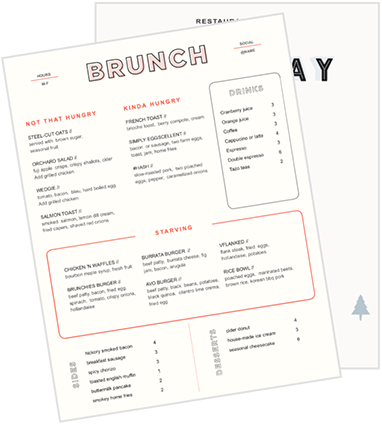
 Restaurant Menu Templates
Use these menu templates as a starting point for your menu design or to give your menus a refresh.
Get Free Download | Built for Restaurants
Key takeaways
Design with strategy, not just style: A beautiful menu is important, but strategic design backed by menu engineering data is what drives profitability. Highlight your most profitable items using layout, color, and visual hierarchy.
Keep it clear and focused: A clean layout with ample white space, limited fonts, and curated item selection makes your menu easier to read and helps guests make faster decisions—boosting both satisfaction and sales.
Words and visuals influence perception: Use descriptive language to enhance dish appeal, and include high-quality photos selectively to increase sales. Avoid dollar signs and price columns to minimize cost-conscious ordering.
Make it accessible and on-brand: Ensure your menu is readable, easy to hold, and aligned with your restaurant’s personality. Provide digital versions and accessible formats for all guests.
Don’t forget your digital presence: Your online menu should match your in-person experience—visually and functionally. Use HTML text, professional images, and a user-friendly ordering system to convert browsers into diners.
Your restaurant's menu is one of the first things your guests will interact with, sometimes before a cashier or server, and always before your food. That's why it's crucial to make sure your menu makes an outstanding first impression.
A menu with too many items, poor wording, bad photos, or incongruous design will detract from a diner's experience, putting pressure on your food and service to make up for it.
Menus with too many images are associated with low-end restaurants, which may curb customer spending. Studies reveal that having only one photo per page can increase sales by up to 30% (WebstaurantStore, 2023). Based on this, you may want to preserve this image for your most expensive meal to nudge customers closer to the purchase.
Harry Maule
Freelance Growth Marketing Consultant
A beautiful, well-written menu that fits seamlessly with your brand will make your guests feel like they've chosen the right restaurant right off the bat.
A well-designed menu can also make a significant impact on revenue. It does this by drawing attention to profitable menu items and leaving a lasting impression on guests.
While it's tempting to focus only on what looks pretty, a menu redesign is way more effective if you’ve analyzed the profitability and popularity of your menu items through menu engineering analysis.
Stay current on price trends
As part of your menu engineering analysis, consider comparing your prices with industry benchmarks. Tools like Toast’s Menu Price Monitor track monthly pricing trends for popular menu items across 140,000+ restaurants. For example, in April 2025, the median price for a burger was $14.31, and a burrito averaged $13.32. Understanding these benchmarks helps you price confidently, maximizing profit without alienating guests.
Take that data and use it to your advantage when designing your menu by drawing the reader's eye to your most profitable items.
These 11 restaurant menu design ideas and tips will help you make strategic decisions about how your menu should look. Keep reading to learn how to design a menu and get inspired by restaurants that are doing it well.
Restaurant Menu Templates
Use these menu templates as a starting point for your menu design or to give your menus a refresh.

11 menu design tips and examples
1. Consider eye-catching movement patterns
Some menu engineering specialists say that when reading a menu, our eyes typically start in the middle of the page, then move to the top right, then top left, referred to as The Golden Triangle. Others say that people's eyes will immediately go to the top of the page or the top right corner.
However, there are also theories that a third of your diners are more likely to order the first item they see. Or that guests read menus like a book, starting at the top left.
Tip: Cover your bases. Put high-margin dishes at the top left, top right, and center of your menu.
The menu at Alimentari & Vineria Il Buco, in New York City, does just that and places profitable items in all three of these areas.

As does Rose Foods in Portland, Maine. Except they just focus on the left and right sides of the pages.
2. Use white space well
The human eye hates clutter. Leaving negative space around an item you want to sell more of draws the customers’ eye to this part of the menu. If you want your menu items and descriptions to shine, plan to incorporate a solid amount of white space into your food menu design.
Tip: Negative space isn’t wasted space. It improves aesthetics and ensures the guest isn’t overwhelmed.
The Slanted Door, with locations in San Ramon, Napa, San Francisco, and Beaune, boasts a simplistic menu that balances text and white space artfully. This restaurant group adopts a minimalist style, put together by the visual communication studio - Manual, to clearly display. This kind of functionality is key for any menu.

And the menu from Eleven Madison Park in New York City shows how a straightforward white-and-black design can feel purposeful, brand-aligned, and allow the culinary experience to shine.
3. Use boxes and color for visual direction
Put profitable menu items center stage — and highlight them! Walk your guests through your menu using design elements that put the spotlight right where they should be looking. Direct their attention.
If you're able to, hiring a graphic designer or artist to create your menu can be a great way to make sure your brand resonates with a diner. A menu design professional can also help you design your menu in accordance with any menu engineering data you have: they can expertly use lines, color, and illustrations to draw attention to your “star menu items" (high profit, high popularity) and your “puzzle items” (high profit, low popularity).
To learn more about menu engineering, check out our full-length free online course.
Tip: Find an artist or graphic designer who can help you develop your brand identity and make your menu stand out.
Birdie G’s in LA has a standout menu that’s not only beautiful and memorable, but also draws attention to the menu items they want their guests to order. They worked with graphic designer Sheila Buchanan, who used beautiful color combinations and little birds dotted around to bring the menu to life. Restaurateurs can certainly benefit from such professional guidance.

Another great example of using colored boxes and strategic visual cues comes from Blackbird, an Asian restaurant in Jupiter, Florida. They leverage design to guide attention intentionally.
Menu Engineering Course
Take this course to make the most of your menu. Learn about menu psychology and design, managing your menu online, and adapting your menu to increase sales.
4. Say goodbye to dollar signs ($)
A study has found that diners who ordered from a menu without currency signs ($) spent significantly more than those who ordered from a traditionally priced menu.
Give your guests some credit, they know what the number next to the menu item means. When you emphasize currency signs on a menu, this triggers negative associations about spending money. So scrap them altogether and stick with a standalone number.
Tip: Consider removing dollar signs, and don’t list prices in a single column because it immediately invites comparison.
At REYLA in Asbury Park, NJ, their clean, beautiful menu is divided into clear categories, and the prices are listed without dollar signs.

Another strong example of this, similar in spirit to REYLA's clean pricing, is Lark, a farm-focused restaurant in Seattle.
5. Reduce the burden of choice
There’s a sweet spot between too few and too many menu choices. Diners are already at risk of feeling overwhelmed when choosing where to eat. Once they've settled on your restaurant, don't make them sift through hundreds of options.
It’s also important to note that every item on your menu should be unique to help your guests decide. It may seem like having two different steak dishes may create a feeling of abundance, but really, it just makes it harder for your guests to choose, and the two items compete with each other.
Having a super-long menu can also hurt sales: When it takes longer for guests to place their orders, it slows down the table turnover time. So, your front-of-house staff will serve fewer guests in a shift, leading to less profit. For back-of-house operations, too, a short, simple menu is much better to manage and can lead to the better execution of every dish.
Tip: Keep your menu short and curated.
The fast-food restaurant The Win-Dow, with its various LA locations, does a great job with this. There are three burger items, plus alternatives such as a chicken sandwich or a grain bowl if you feel like something slightly different. The concise one-page menu even saves space for dessert. With a selection of shakes, cones, and refreshing beverages to wash down your burger. For example, a specialized pizza menu or a concise list of entrees can be very effective.

Another great example of a short, curated menu setup, similar to The Win‑Dow but different, is Schwa in Chicago. They offer a highly focused dinner menu, typically just two options: a three-course dinner or an eight- to ten-course degustation, with no à la carte selections.
6. Harness the Power of Words
Use menu item descriptions to communicate the taste of a dish. Words like “savory,” “buttery,” and “crisp” elicit a visceral reaction of hunger. Use descriptions to convey the restaurant’s personality and the love you put into every dish.
A study by Behnke, Jung, & Bei found that descriptive menu labels increase customers' expectations surrounding the quality of a menu item. This, in turn, may lead to more favorable customer feedback (as long as the item lived up to the glowing description).
Tip: Use highly descriptive language when writing your menu description.
SuMiao Hunan Kitchen in Cambridge, MA has fantastic descriptions. Their menu explains their dishes with words like “daily catch tilapia”, “thirteen spices,” and “wok-tossed”. This menu has a great balance of being descriptive without getting too wordy. It matches the fun and food-focused tone of the restaurant perfectly. Consider highlighting your appetizers with enticing descriptions. Perhaps even a mouth-watering taco description could grab attention.

Another standout example of a menu with highly descriptive language comes from Tatte Bakery & Café in Boston. Their menu is descriptive and flavorful without being overwhelming. While matching a fun and food-focused tone.
7. Fonts and typography
It’s not just what you say, it’s how you say it. If your heavy, bold, capitalized menu font screams at your customer, are you portraying the right vibe for your restaurant? The font style and arrangement have the power to put potential customers off or draw them in.
Your customers' perceptions can be swayed even before they walk through the door. A font style can suggest whether a restaurant is an upscale establishment or a more affordable choice. The right combination of font styles can also guide the reader to certain parts of the menu.
Tip: Stick to a small selection of font types to keep your menu design clean. Using too many styles can make your menu look cluttered and affect readability. The chosen typeface will impact readability and overall menu aesthetic. Consider using unique headings to separate sections.
A great example of a menu that keeps things clean and simple by sticking to just two font styles comes from Lafayette, a French‑bistro‑style restaurant in New York City. Their menu uses a single serif font for section headings to give a refined, classic feel. And a complementary sans‑serif for item names and descriptions. It always feels consistent in style, never mixing more than two styles.
8. Consider using photos
Renowned menu engineer Gregg Rapp found that including high-quality photos alongside a food item increases its sales by 30%. A word of caution, though: Don't use mediocre snaps on your menu or on your social media. Better to use no photos than bad photos.
Note that if you don’t want to use photos on your menu, especially since it can be very expensive to print them, there is a way around this. You can write out your restaurant’s Instagram handle on the menu with a call-out like “Check out our Instagram if you want to preview any of our dishes.”
If you are tech-savvy, you can even add a QR code or bit.ly link for easy access. Make sure your Instagram is chock-full of beautiful photos, and update it regularly. This will lead potential customers to your expertly designed website menu and ultimately, through the door of your restaurant.
Tip: Especially in digital menu board design, consider using high-quality photos of high-margin items to entice diners — the same goes for your online ordering page (more on that below).
At Douzo Sushi in Boston, MA, the whole menu is showcased with high-quality photographs set on a black background. It's visually appealing and can get diners to order something they've never had before.

Here’s an example from BurgerFi, a fast-casual U.S. burger chain, that leverages high-quality, appetizing photography of high-margin items.
9. Design with all senses and needs in mind
When creating your physical restaurant menu design, you want to make sure that, above all, it’s usable and legible for all your guests.
Make sure your menu’s size is manageable. If it’s too big, it’ll be awkward to hold at the table. Too small, and some guests will have trouble reading it.
Another thing to consider for your guests with visual impairments. If your menu is up on a board above a prep area, like in many fast-casual restaurants, some customers might have trouble reading it. The solution here is to print a few copies of the menu in a large font to have on hand and offer them to guests who need them.
A digital menu through an easy-access QR code is also a good idea here. Set up a large QR code that guests can scan on their phones, and allow them to look up close at the menu. With a digital menu, you can also make quick changes as you cut or "86" items.
As for the other senses, make sure your menu feels nice to the touch. Choose sturdy paper, and depending on the style of your restaurant, you might want to laminate your menus or print them on cleanable cards so you don’t have to replace them as often.
Tip: Put yourself in the customer’s shoes. Design the menu to counteract all the common issues customers encounter when reading through the menu.
A compact, well‑executed example from a small restaurant that tackles common menu-grabbing issues, is Gather, a neighborhood bistro in Berkley, California.
11. Optimize your online menu on your website and ordering system
You’ll want to make sure your menu is easily readable online, as diners love to peruse a menu before deciding where to dine. Weighing up the pros and cons of restaurant menus is half the fun of eating out.
You can upload a PDF of your menu to your restaurant’s website so that its beautiful design is visible in its full glory. It’s also a good idea to have the menu written out directly on the webpage (in HTML text) so that guests who use screen readers can also experience your menu before arriving.
And it’s a great idea to make sure your online ordering system and website are synchronized, ensuring a seamless user experience that’ll keep customers coming back for more. Make sure your online ordering system allows you to personalize your online ordering menu as much as possible to match your brand.
Most importantly, you want to be able to upload high-quality images of every menu item, as online customers love to see what they’re gonna get from their homes. As they don’t get to chat with your awesome front-of-house staff and ask them questions about menu items, giving as much info via photos and descriptions on your online menu is the move here.
Tip: Consider using a comprehensive service provider for all your restaurant management needs. From website building services through to support with online ordering. It’s easier when you find that one company that can do it all.

Menu design matters!
Intelligent menu design is one component of a successful restaurant strategy: Make sure your menu reflects your style and your food, and make sure it highlights your most profitable items.
If you want a little help when starting to redesign your menu, check out our 17 menu templates and customize them to fit your restaurant's brand.
Related Menu Ideas
Restaurant Menu Templates
Use these menu templates as a starting point for your menu design or to give your menus a refresh.
Is this article helpful?
DISCLAIMER: This information is provided for general informational purposes only, and publication does not constitute an endorsement. Toast does not warrant the accuracy or completeness of any information, text, graphics, links, or other items contained within this content. Toast does not guarantee you will achieve any specific results if you follow any advice herein. It may be advisable for you to consult with a professional such as a lawyer, accountant, or business advisor for advice specific to your situation.
Subscribe to On the line
Sign up to get industry intel, advice, tools, and honest takes from real people tackling their restaurants’ greatest challenges.
By submitting, you agree to receive marketing emails from Toast. We’ll handle your info according to our privacy statement. Additional information for California residents available here.